Languages
Sunday, October 4, 2026



News and Views from the Global South
Labour

Empowering Women Improves Communities, Ensures Success for Generations
At an event held on October 29 at the International Fund for Agricultural Development (IFAD) Gender Awards 2017, five countries were honored for impressive achievements in gender equality and women’s empowerment despite harsh conditions and numerous daunting situational and societal obstacles. The five countries are Bangladesh, Mozambique, Colombia, Morocco, and Mauritania. The IFAD supported projects in these countries have ambitious goals for a more egalitarian future. To date these projects have successfully provided women with decision-making opportunities, skill training, and increased autonomy through the development of their own livelihoods.
South-South Cooperation Key to a New Multilateralism
“There are new challenges to all states: among them, the real threat to multilateralism... South-South and triangular cooperation can contribute to a new multilateralism and drive the revitalisation of the global partnership for sustainable development.”
Beware Public Private Partnerships
Public-private partnerships (PPPs) are essentially long-term contracts, underwritten by government guarantees, with which the private sector builds (and sometimes runs) major infrastructure projects or services traditionally provided by the state, such as hospitals, schools, roads, railways, water, sanitation and energy.
Coping with Foreign Direct Investment
Foreign direct investment (FDI) is increasingly touted as the elixir for economic growth. While not against FDI, the mid-2015 Addis Ababa Action Agenda (AAAA) for financing development also cautioned that it “is concentrated in a few sectors in many developing countries and often bypasses countries most in need, and international capital flows are often short-term oriented”.
The World is Losing the Battle Against Child Labour
The IV Global Conference on the Sustained Eradication of Child Labour, which drew nearly 2000 delegates from 190 countries to the Argentine capital, left many declarations of good intentions but nothing to celebrate.
Are Prospects of Rural Youth Employment in Africa a Mirage?
Many recent accounts tend to dismiss productive employment of youth in rural areas in Africa as a mirage largely because they exhibit strong resistance to eking out a bare subsistence in dismal working and living conditions. We argue below on recent evidence of agricultural transformation that this view is overly pessimistic, if not largely mistaken.
“Refugees Are Nothing but Commodities”
As countless refugees arriving on Italy’s shores report torture, extortion and forced labour in Libyan detention centers, many say they never intended to make the journey to Europe until the chaos in Libya left them no other choice.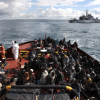
A New Global Compact on Safe, Orderly and Regular Migration
At this crucial juncture of international migration, where numerous push and pull factors have engendered unprecedented migration flows across the globe, the ongoing discussions at the United Nations must lead to meaningful and practical outcome.
Kashmir’s Farmland Plowed Under in Wave of Urbanization
In central Kashmir’s Ganderbal district, 40-year-old Javaid Ahmad Hurra remembers vividly how his small hamlet used to be lush and green when he was a child. It is now subtly turning into a concrete jungle, with cement structures dominating the scenery.
Innovation for Climate-Smart Agriculture Key to Ending Hunger in Kenya
Some parts of Kenya are reeling from the effects of probably the worst drought in the last 20 years. With nearly 3.4 million people food insecure, Kenya’s food security prognosis looks gloomy, with climate change and natural resource depletion set to pose even greater risks in the long term.
Austrian Elections: The Crisis of Europe Continues
The Austrian elections show clearly that media have given up on contextualising events. To do that, calls for a warning about Europe’s future, as a vehicle of European values is required. Europe has been weakened by all the recent elections, with the notable exception of France. Common to all, France included, were some clear trends, that we will hastily, and therefore maybe imperfectly, examine.
Zimbabwe’s Diaspora Could Help Revive Ailing Economy
At the dawn of the millennium, Sheila Mponda, 60, waved goodbye to her four children, who were leaving Zimbabwe for the United Kingdom in search of greener pastures. Mponda had just lost her husband and had been a housewife all her life.
New Villages Bloom in the Shadow of a Mountain’s Wrath
Repeated volcanic eruptions of Mount Sinabung since 2010 have displaced thousands of people, leaving villages around the mountain deserted, with volcanic ash, lava and mud covering the soil, trees and empty houses.
International Day of Rural Women
On this International Day of Rural Women, the world celebrates women and girls in rural areas and the critical role they play in enhancing agricultural and rural development, improving food security and eradicating rural poverty.
Can the Kenyan Lion Kick High Enough to Be the South Korean Tiger of Africa?
In 1953 South Korea emerged from the ravages of a debilitating war, yet the total gross domestic product in nominal terms has surged 31,000 fold since 1953.
Land Settlement Empowers: Bangladesh Sets an Example
History was made for 400 landless families in the remote char lands of Noakhali district. On 4th October, they all received land titles from the government for which they had waited for over two decades. In Bangladesh, as in other countries, the title is a permanent legal ownership document.
World Bank Must Stop Encouraging Harmful Tax Competition
One of the 11 areas that the World Bank’s Doing Business (DB) report includes in ranking a country’s business environment is paying taxes. The background study for DB 2017, Paying Taxes 2016 claims that its emphasis is “on efficient tax compliance and straightforward tax regimes”.
Alternative Financing Strategies to Boost Small Businesses in Africa
A few years ago, more than half a century after the concept was first proposed, the government of Côte d’Ivoire completed construction of the Henri Konan Bédié Bridge, a span over the Ébrié Lagoon linking the north and south of Abidjan, the country’s main city. The project became a reality after the government received development bank and private capital financing.
Ghana Aims to Regain Top Spot in Cocoa Production
Ghana is home to the world’s favourite cocoa beans. They’re bigger in size, have a higher butter content and superior flavour – all qualities which make Ghana’s cocoa the world standard against which all cocoa is measured.
Why American Overseas Aid Should Focus on SDGs?
The average American believes the US spends a whopping third of its federal budget on foreign aid. Consequently, a majority of people think that too much is spent on foreign aid. That is one reason US President Donald J. Trump, who has campaigned on putting the needs of Americans first, has proposed deep cuts to foreign aid in his 2018 budget.
Greater Cooperation To Strengthen Taxation
Since the 1950s, there has been a popular dance called the ‘limbo rock’, with the winner leaning back as much as possible to get under the bar. Many of today’s financial centres are involved in a similar game to attract customers by offering low tax rates and banking secrecy.« Previous Page — Next Page »


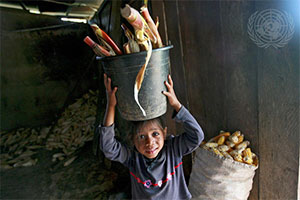 Timorese Girl with Fresh-Picked Corn. Credit: UN Photo/Martine Perret
A global common denominator is the need for a decent job. The economic realities of each country determine just how difficult it is to find one. Despite the labour movement's achievements, serious challenges persist: gender discrimination, child labour, worker migration, the digital divide and AI automation, evaporating pensions, unsafe workplaces, corporate pressure against union organising, negative impacts of trade agreements, and the precariousness of informal employment. The 2025 UN SDG Report identifies jobs and social protections as one of the six priority areas requiring urgent action, with progress either stalled or reversing in many developing nations.
In recent years, the fight to protect labour equality has taken on new dimensions with the rise of Environmental, Social and Governance standards. With the Social aspect aiming to promote equality and human rights, ESG principles have strengthened labour advocacy within corporate and governmental regulatory landscapes. In particular, ESG has become much more institutionalized in emerging economies such as Brazil and China. IPS follows the world’s workers as they confront these challenges - their setbacks and their successes.

The Week with IPS

NEXT STOP - SDGs
Tracking global progress towards a sustainable world
Tracking global progress towards a sustainable world
