Languages
Wednesday, September 30, 2026



News and Views from the Global South
Labour

African Brain Drain: Is There an Alternative?
“Brain drain is particularly acute in sub-Saharan Africa,” says the World Economic Outlook (October 2016), a report published by the International Monetary Fund (IMF). “The migration of young and educated workers takes a large toll on a region whose human capital is already scarce. The concentration of migrants among those who are educated is higher than in other developing economies.
Robots, Unemployment … and Immigrants
Amazon has recently introduced Amazon Go, a shop where the customer enters, chooses a product from the shelves, charges the price on a magnetic card and swipes it on the way out, transferring the charge to the customer’s bank account . No queues, no cashiers, fast and easy, and the first shop in Seattle has been a roaring success.
Bangladesh’s Garment Industry Boom Leaving Workers Behind
Although Bangladesh has made remarkable recent strides like building green factories and meeting stringent safety standards, garment workers here are still paid one of the lowest minimum wages in the world.
One Migrant’s Brutal Odyssey Through Libya
Thirty-year-old Nazir Mohammed sits on one of the two sofas in his single room in Kwame Danso, a small town about 290 kilometres north of Ghana’s capital Accra, reflecting on life back in Libya.
UN Refugee Agency Calls for Aid and Peace in South Sudan
As South Sudan quickly becomes Africa’s largest refugee and humanitarian crisis, the world must come to its aid, said the UN refugee agency. The UN Refugee Agency (UNHCR) has launched a global appeal to support displaced persons amid South Sudan’s rapidly deteriorating humanitarian situation.
Business Unusual will Drive Africa’s Quest to achieve Health Care for All
Africa’s quest for health continues to be held back by a combination of factors such as natural disasters and pandemics, prevailing high rates of communicable and rising incidence of non-communicable diseases, sedentary lifestyles, road accidents and greater population mobility.
Survival of Indigenous Tribes in Bangladesh Starts at School
Just before sundown on Jan. 30, a group of women day labourers from the Shantal indigenous community are in a rush to wind up their work harvesting potatoes in a field in the village of Boldipukur, some 15 km away from Rangpur district in northern Bangladesh.
Rohingya Refugee Crisis Creates New Generation of Bangladeshi Aid Workers: IOM
From new job seekers to experienced professionals, Bangladeshis are rallying to apply for new jobs and learn new skills as part of vital humanitarian efforts to help Rohingya refugees in Cox’s Bazar.
Treat Labourers with Dignity
A front-page picture of a worker unloading coal from a supply truck in Anu Majhir Ghat in Chittagong city's Sadarghat area, published by The Daily Star on Thursday, tells everything that is wrong with our informal labour market. The man in the picture is seen offloading coal with no safety gear on to thwart the effects of exposure to harmful coal dust or prevent bodily harm in the event of an accident. His whole appearance is a throwback to the pre-industrial times. But this is not just a question of safety in hazardous jobs like coal mining or offloading; it's also about basic human dignity that all people, irrespective of the kind of work they do, are entitled to.
Breaking Barriers in Bangladesh
It’s nearing 4:30 p.m. on a foggy day, but there seems to be no great hurry amongst the workers to wind up their day in a factory producing high-end designer bags. Located in the Export Processing Zone (EPZ) of Nilphamari, a northern district 40 kilometers from the divisional headquarters of Rangpur in Bangladesh, the area is known for creating job opportunities for the local population.
Migrants Without Shoes
Addis Ababa, Ethiopia, 2013. It is past midnight. The aircraft come in from Saudi Arabia carrying workers who had been hastily ejected. They had gone from Ethiopia to work in a variety of jobs in a Kingdom flush with oil wealth.
Left Behind: Families of Migrants Wait in Limbo
Wahid Haider talks about his son’s departure to Italy almost seven years ago without regret or hesitation. Haider has not seen Nayeem, now 30 years old, since he left Nankar in search of better economic prospects, travelling through Romania, where he spent several months, before entering Italy.
The Data Revolution Should Not Leave Women and Girls Behind
If there is one political principle that has been constant throughout the history of human civilization it is the fact that land is power. This is something that is particularly true, and often painfully so, for women who farm in Africa.
Tourism Should Be Regulated, Before It Is Too Late…
This year, we will have 3 million tourists each day wandering the world. This massive phenomenon is without precedent in human history and is happening (as usual), with only one consideration in mind: money. We should pause and take a look at its social, cultural and environmental impact and take remedial measures, because they are becoming seriously negative if things are left as they are.
On a Self-Destructive Path
Three pictures in this paper yesterday depict the utter callousness with which we have degraded our natural resources because of greed and indifference. The front page shows a horrific pile of rubbish in an area in Keraniganj—an earlier picture of the same area juxtaposed with it makes us realise with disbelief, that this garbage dump was actually a canal only a year and a half ago. It is hard to believe that once this pit of rubbish was a pristine waterbody running between rows of buildings, providing relief to the concrete jungle. Obviously, over this short period of time, there has been absolutely no oversight regarding illegal dumping of waste.
Our Right of Passage Should be Safe Migration, Not Leaky Boats
“I’m a migrant, but didn't have to risk my life on a leaky boat or pay traffickers. Safe migration cannot be limited to the global elite.” Thus spoke United Nations Secretary General Antonio Guterres in September 2017.
Migrants in Italy: “Shame Is Keeping Us Here”
Despite deplorable living conditions, loneliness and unemployment, many African migrants in Italy choose to stay - even when they have the means to return.
Food Sovereignty as a Pillar of Self-Determination
A recent meeting in Rome between our Pacific leaders and UN Food & Agriculture Organisation (FAO) highlighted the urgency of food security in our region given the reality of climate change affecting our agriculture and aquaculture.
Strengthening Governments to Cope with PPPs
Public-private partnerships (PPPs) have emerged in recent years as the development ‘flavour of the decade’ in place of aspects of the old Washington Consensus. Instead of replacing the role of government or consigning it to the garbage bin of history, corporations are increasingly using governments to advance their own interests through PPPs.
New Safety Handbook by IAWRT
Hopefully female journalists have read it by now “What if…? Safety Handbook for Women Journalists”. The handbook, written by renowned safety trainer Abeer Saady, an Egyptian, and published by The International Association for Women in Radio and Televison (IAWRT), provides hands on tips on what to do when caught in a crossfire , when stopped at checkpoints, arrested during coverage, or kidnapped and held hostage.
Empowering Women Improves Communities, Ensures Success for Generations
At an event held on October 29 at the International Fund for Agricultural Development (IFAD) Gender Awards 2017, five countries were honored for impressive achievements in gender equality and women’s empowerment despite harsh conditions and numerous daunting situational and societal obstacles. The five countries are Bangladesh, Mozambique, Colombia, Morocco, and Mauritania. The IFAD supported projects in these countries have ambitious goals for a more egalitarian future. To date these projects have successfully provided women with decision-making opportunities, skill training, and increased autonomy through the development of their own livelihoods.« Previous Page — Next Page »


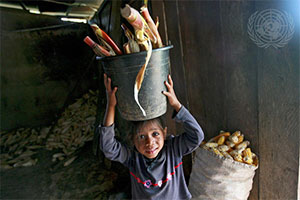 Timorese Girl with Fresh-Picked Corn. Credit: UN Photo/Martine Perret
A global common denominator is the need for a decent job. The economic realities of each country determine just how difficult it is to find one. Despite the labour movement's achievements, serious challenges persist: gender discrimination, child labour, worker migration, the digital divide and AI automation, evaporating pensions, unsafe workplaces, corporate pressure against union organising, negative impacts of trade agreements, and the precariousness of informal employment. The 2025 UN SDG Report identifies jobs and social protections as one of the six priority areas requiring urgent action, with progress either stalled or reversing in many developing nations.
In recent years, the fight to protect labour equality has taken on new dimensions with the rise of Environmental, Social and Governance standards. With the Social aspect aiming to promote equality and human rights, ESG principles have strengthened labour advocacy within corporate and governmental regulatory landscapes. In particular, ESG has become much more institutionalized in emerging economies such as Brazil and China. IPS follows the world’s workers as they confront these challenges - their setbacks and their successes.

The Week with IPS

NEXT STOP - SDGs
Tracking global progress towards a sustainable world
Tracking global progress towards a sustainable world
