Languages
Friday, October 23, 2026



News and Views from the Global South
Labour

Sustainable Use of Biodiversity Could Fill Gap When Belo Monte Dam Is Finished
Some argue that the sustainable use of biodiversity is the best alternative for local development in the area surrounding the enormous Belo Monte hydroelectric dam, now that the construction project is entering its final phase on the Xingú River in Brazil’s Amazon jungle.
Bangladeshi Migrants Risk High Seas and Smugglers to Escape Poverty
Though he is only 16 years old, Mohammad Yasin has been through hell and back. He recently survived a hazardous journey by sea, crammed into the cargo-hold of a rudimentary boat along with 115 others.
U.N. Chief Seeks Equity in Paris Climate Change Pact
When the 193-member General Assembly hosted a high level meeting on climate change Monday, Secretary-General Ban Ki-moon warned that any proposed agreement at an upcoming international conference in Paris in December must uphold the principle of equity.
Helping People with Disabilities Become Agents of Change
Participation, political and economic empowerment, inclusion, accessible technology and infrastructure as well as indicators for meaningful implementation are among the key issues persons with disabilities want to see reflected in the Sustainable Development Goals (SDGs).
Ghosts Of War Give Way to Development in Sri Lanka
 It is an oasis from the scorching heat outside. The three-storey, centrally air-conditioned Cargills Square, a major mall in Sri Lanka’s northern Jaffna town, is the latest hangout spot in the former warzone, where everyone from teenagers to families to off-duty military officers converge.

Studying and Working Poses New Challenges for Argentina’s Youth
Until not too long ago, youngsters in Argentina faced a choice: whether to study or drop out and go to work. But now most children and adolescents in Argentina who work also continue to study – a change that poses new challenges for combating school dropout, repetition and truancy, as well as the circle of poverty.
Opinion: Sub-Saharan Africa, Addis and Paris
After the turn of the century, growth in sub-Saharan Africa (SSA) picked up again after a quarter century of near stagnation for most, mainly due to increased world demand for minerals and other natural resources.
Critics of World Bank-Funded Projects in the Line of Fire
For an entire month beginning in February 2015, a group of between 40 and 50 residents of the Durgapur Village in the northern Indian state of Uttarakhand would gather at the site of a hydroelectric power project being carried out by the state-owned Tehri Hydro Development Corporation (THDC).
Opinion: 2015 and Beyond, Young Voices, Loud Demands
As a young person interested in development, my heart beats a little faster when I look at the potential of 2015. There has never been so much at stake as this year for the future of our planet.
Opinion: Building Civil Service Excellence in the Post-2015 Development Agenda
This September, we usher in the post-2015 development agenda with a set of Sustainable Development Goals (SDGs) agreed upon by Member States, with civil society participation, based on national, regional and global consultations.
Farmers Find their Voice Through Radio in the Badlands of India
Eighty-year-old Chenabai Kushwaha sits on a charpoy under a neem tree in the village of Chitawar, located in the Tikamgarh district in the central Indian state of Madhya Pradesh, staring intently at a dictaphone.
Opinion: No Place to Hide in Addis
My colleagues just got back from Munich, where we held a summit bringing together over 250 young volunteers from across Europe. These youngsters campaigned in the run-up to and at the doorstep of the G7 Summit in Schloss Elmau, as one of the key moments in a year brimming with opportunities to tackle extreme poverty.
Industrial Fisheries Crowd out Artisanal Fisherpersons in South America
Millions of families on South America’s Pacific coast have long depended on artisanal fishing for a living. But they have been increasingly being pushed aside by the industrial fisheries that have made this region a major player in the global seafood industry.
From Residents to Rangers: Local Communities Take Lead on Mangrove Conservation in Sri Lanka
Weekends and public holidays are deadly for one of Sri Lanka’s most delicate ecosystems – that is when the island’s 8,815 hectares of mangroves come under threat.
Domestics in Mexico Face Abuse and Scant Protection
Her last two jobs left a bitter taste in the mouth of Yoloxochitl Solís, a 48-year-old single mother from Mexico. She sums up the experience in two words: abuse and discrimination.
From Residents to Rangers: Local Communities Take Lead on Mangrove Conservation in Sri Lanka
Weekends and public holidays are deadly for one of Sri Lanka’s most delicate ecosystems – that is when the island’s 8,815 hectares of mangroves come under threat.

When a Kid With Low Self-Esteem Dreams of Becoming the President
You may have heard of Global Citizenship Education (GCED), but unless you move in international development circles, chances are you’re not entirely sure what the acronym means.
Remittances from Europe Top 100 Billion Dollars
One in five migrant workers – about 50 million people - lives and works in Europe, making the region home to a quarter of global remittance flows, according to a new report by the International Fund for Agricultural Development (IFAD).
U.N. Urged to Put Global Citizenship at Centre of Post-2015 Development Agenda
When Denmark hosted the World Summit on Social Development (WSSD) in March 1995, one of the conclusions of that international gathering in Copenhagen was to create a new social contract with “people at the centre of development.”
Organic Cacao Farmers Help Reforest Brazil’s Amazon Jungle
“Now we realise what a paradise we live in,” said Darcirio Wronski, a leader of the organic cacao producers in the region where the Trans-Amazonian highway cuts across the Xingú river basin in northern Brazil.
Infrastructure Investments in Emerging Economies Hit Record Levels – but at What Cost?
According to new data released by the World Bank Tuesday, investments in infrastructure in 139 emerging economies shot up to 107.5 billion dollars in 2014, with just five countries – Brazil, Colombia, India, Peru and Turkey – accounting for 73 percent of the total.« Previous Page — Next Page »





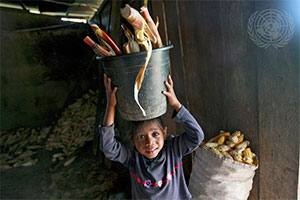 Timorese Girl with Fresh-Picked Corn. Credit: UN Photo/Martine Perret
A global common denominator is the need for a decent job. The economic realities of each country determine just how difficult it is to find one. Despite the labour movement's achievements, serious challenges persist: gender discrimination, child labour, worker migration, the digital divide and AI automation, evaporating pensions, unsafe workplaces, corporate pressure against union organising, negative impacts of trade agreements, and the precariousness of informal employment. The 2025 UN SDG Report identifies jobs and social protections as one of the six priority areas requiring urgent action, with progress either stalled or reversing in many developing nations.
In recent years, the fight to protect labour equality has taken on new dimensions with the rise of Environmental, Social and Governance standards. With the Social aspect aiming to promote equality and human rights, ESG principles have strengthened labour advocacy within corporate and governmental regulatory landscapes. In particular, ESG has become much more institutionalized in emerging economies such as Brazil and China. IPS follows the world’s workers as they confront these challenges - their setbacks and their successes.

The Week with IPS

NEXT STOP - SDGs
Tracking global progress towards a sustainable world
Tracking global progress towards a sustainable world
