Languages
Friday, November 13, 2026



News and Views from the Global South
Natural Resources

Pepsi Pledge Signals Momentum on Land Rights
PepsiCo, the world’s second largest food and beverage manufacturer, has agreed to overhaul its longstanding policies around land rights, instituting a series of new safeguards and transparency pledges throughout its global supply chains.
Georgia Opts for Gold Mining at Protected Historical Site
It turns out the choice between gold and historical preservation is an easy one to make for officials in Georgia: the government is going for gold.
U.S. Oil Firm Creates Tension over Western Sahara
Even as U.S. and Moroccan executives meet to discuss strengthening private sector ties between the two countries, advocacy groups are raising concerns about plans by a U.S. energy firm to explore for oil in the contested territory known as Western Sahara.
Sun Shines on Forest Women
Chintapakka Jambulamma, 34, looks admiringly at a solar dryer. It’s the prized possession of the Advitalli Tribal Women’s Co-operative Society- a collective of women entrepreneurs that she leads.
Kerala Throttling its Golden Goose
Farming, tourism, poor fishing practices along with misdirected policies are muddying the famous backwaters of Kerala, one of India’s best known holiday destinations. Nowhere is this misuse more visible than in and around the 95-km-long Vembanad Lake.
Chevron Wins Latest Round in Ecuador Pollution Case
In the latest twist in a 21-year-old environmental pollution case, a U.S. federal judge Tuesday ruled that the victims of massive oil spillage and their U.S. attorney could not collect on a nine-billion-dollar judgement by Ecuador’s supreme court against the Chevron Corporation.
Kyrgyzstan Coal Wars Stymie Critical Industry
Kara-Keche, a sprawling deposit containing about 430 million tonnes of coal in mountainous Naryn Province, is a key asset for Kyrgyzstan’s struggling economy.Water, Water, Everywhere: To Green our Deserts
Providing water for our still growing human population is reaching crisis levels. Water is vital for agriculture, energy production and industrial processes worldwide. Floods and droughts in Asia, Latin America, Europe and the United States accompanied unprecedented typhoons and winter storms. While none could be linked directly to climate change, the debate surfaced. Mainstream media started covering these issues more broadly.
An Equal Share of Wealth Equals Lasting Peace in CAR
While wrangling over Central African Republic’s (CAR) wealth in natural resources played a role in the country's crisis, its future peace and stability still partly depends on a solution that factors in how to equitably distribute its national wealth.
Arab NGOs Warn IMF Against Sharp Cuts to Subsidies
Civil society activists from five Arab countries are urging the International Monetary Fund (IMF) to ease pressure on their governments to reduce food and fuel subsidies until stronger social-protection schemes and other basic reforms are implemented.
Shifting Rainy Season Wreaks Havoc on Barbuda’s Crops
Water rationing has become a way of life for the 1,800 residents of the tiny island of Barbuda, which has been experiencing prolonged dry periods, especially in the Highlands area near the main agricultural lands.
Rich Railroad Brings Few Opportunities in Brazil
The Carajás railroad, regarded as the most efficient in Brazil, runs a loss-making passenger service for the benefit of the population. But this does little to make amends for its original sin: it was created to export minerals and crosses an area of chronic poverty.
Economic Reforms Needed for Peace in South Sudan
Gatmai Deng lost three family members in the violence that erupted in South Sudan on Dec. 15 and lasted until the end of January. And he blames their deaths on the government’s failure to use the country’s vast oil revenues to create a better life for its almost 11 million people.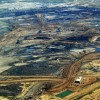
An Environment-Wrecking Pipeline Hangs in Limbo
The Pine Ridge Reservation of the Lakota Nation, in the midwest of the United States, is one of the most abandoned places in the country and in the world.
‘Humanitarian Crisis’ for Ogaden Living Near Ethiopia’s Oil Fields
New allegations of scorched earth evictions of the Ogaden people have raised concerns that a lack of benefit sharing could escalate instability in the region and reinforce separatist tensions as foreign energy companies prepare to extract oil and gas from troubled southeastern Ethiopia.
Poverty Rises Amidst Gold
Natural reserves such as gold, copper, nickel, gas and timber are being extracted in the western Pacific island states of Papua New Guinea and Solomon Islands to feed the soaring economies of East and South East Asia. But despite these Pacific nations recording economic growth rates of 6-11 percent over the past seven years, opportunities for human development have not been grasped.
Website Gives Real-Time Snapshot of Deforestation
A new website launched Thursday will allow governments, businesses, civil society and private citizens to monitor near real-time loss and gain in forest cover in every country around the world.
Chagos Islanders ‘Will Not Give Up’ Fight to Return Home
“The Marine Protected Area (MPA) created around the Chagos archipelago is a new obstacle that the British government has placed in our path to prevent us from going back to our homeland,” claims Olivier Bancoult, leader of the Chagos Refugees Group (CRG).

U.N. Focuses on Faltering Goals: Water, Sanitation, Energy
When the U.N.'s Millennium Development Goals (MDGs) reach their deadline in 2015, there will still be a critical setback: millions of people in the developing world without full access to safe drinking water, proper sanitation and electricity in their homes.
“Blessed” Rains Become a Curse in Antigua
 Antigua is one of the most drought-prone countries in the Caribbean. So whenever it rains, the inhabitants generally regard the weather as “showers of blessing”.

DRC Mega-Dam to Be Funded by Private Sector, Groups Charge
Watchdog groups here are warning that a deal has been struck that would see Chinese investors fund a massive, contentious dam on the Congo River, the first phase of a project that could eventually be the largest hydroelectric project in the world.
« Previous Page — Next Page »


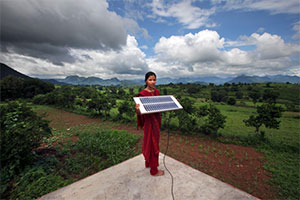 Bringing clean energy to rural India. Credit: Abbie Trayler-Smith / Panos Pictures / Department for International Development
Large reserves of oil, gas and minerals in developing countries generate opulent revenues. They could be used to stimulate economic growth and reduce poverty, but often result in environmental destruction and conflict, benefiting large companies and corrupt governments. Furthermore, competition over natural resources often manifests through geopolitical conflict. For example, before the US-Iraq war, Iraq’s domestic oil industry was nationalized. With US aggression came weakened Iraqi institutions and foreign intervention, thus eventually leading to the privatization of Iraqi oil, leaving the industry now largely dominated by Western companies. As another example, China’s rising investments within the lithium sector in South America are increasing the US-China rivalry across the Western Hemisphere. Notably, Bolivia has the largest reserves of lithium in the world, and the nation’s state-owned lithium extraction firm recently signed a contract with China’s CBC Consortium, while rejecting the entry of Western firms into the nation. In Bolivia’s case, rising Chinese investment in the nation’s lithium sector also raises concerns about environmental sustainability and the sociopolitical rights of Indigenous communities. More broadly, Sub-Saharan Africa holds nearly 30% of global reserves of critical minerals required for low-carbon technologies. Despite this, the region attracts less than 10% of global exploration investment, depicting a critical barrier to both the clean energy transitions and Sub-Saharan Africa’s economic development. Furthermore, resource wealth continues to fuel conflict like Sudan’s civil war, which has led to 9.1 million internally displaced people and is intensely connected to competition over gold, water, and agricultural land. IPS covers news about major oil, gas, and mining projects, their effects on the environment and local communities, and the ideas and actions of the interest groups involved.

The Week with IPS

NEXT STOP - SDGs
Tracking global progress towards a sustainable world
Tracking global progress towards a sustainable world
