Languages
Sunday, November 15, 2026



News and Views from the Global South
Natural Resources

Farming in the Sky in Singapore
With a population of five million crammed on a landmass of just 715 square kilometres, the tiny republic of Singapore has been forced to expand upwards, building high-rise residential complexes to house the country’s many inhabitants.
Swiss Battery May Lose Power
Swiss energy companies are determined to turn the country into a 'battery for Europe'. Vast investments are made in big-scale water power projects. But it is not certain they will eventually pay off.
Environmentalist Ends Hunger Strike Over Trinidad Highway
For 21 days Wayne Kublalsingh sat in the scorching sun outside the office of Prime Minister Kamla Persad Bissessar. He sat in support of his belief that constructing a highway in southern Trinidad would damage the environment and affect hundreds of lives in the surrounding area.
A Hotter World Is a Hungry World
Food prices will soar and hundreds of millions will starve without urgent action to make major cuts in fossil fuel emissions. That is what is at stake here on the last day of the U.N. climate talks known as COP 18, scientists and activists say.
Small Rural Businesses in Brazil Set Sights on Domestic Market
"Canjinjin has special powers," said Deize Coelho de Barros. The recipe for this local liquor, made from a mixture of herbs, was handed down from her African ancestors, and is seen as a sort of traditional "Viagra" in her homeland, the western Brazilian state of Mato Grosso.
Investments Into, Out of Developing Countries at Record Levels
Foreign direct investment (FDI) both into and out of developing countries is at or nearing record levels, an arm of the World Bank reported on Thursday.Deaf Ear Turned to Local Opposition to Mines in Guatemala
As the mining industry booms in Guatemala, local communities are increasingly opposed to the operations of the mainly foreign companies because of the potential negative effects on the environment and on their villages.
Brazilian Communities Revitalise the São Francisco River
José Geraldo Matos fondly recalls the massive traíras (Hoplias sp), carnivorous freshwater fish found in the lagoons and rivers of Brazil, that he used to catch in the Dos Cochos River just a few metres from his house.
Somaliland Rising from the Ruins of Somalia
As Somalia starts to emerge from its quagmire of instability and chaos, 20 years of relative peace and stability are starting to pay dividends for its close neighbour Somaliland, as this November it struck its first major oil deal since seceding from Somalia in 1991.
Trawlers Glide Past International Fishing Laws
Somali pirates on the southwest Indian Ocean have become one of the biggest security risks for commercial maritime shipping over the last several years. But even as piracy gave rise to international furore, an unlikely benefactor emerged: bluefin tuna stocks in the Indian Ocean.
Tiny Barbuda Fears Increasingly Hostile Climate
Local scientists are warning the tiny 62-square-mile island of Barbuda is becoming one of the most vulnerable spots on earth to the consequences of climate change.
Fossil Fuel Lobby in the Driver’s Seat at Doha
A new scientific report shows that global warming can be kept well under two degrees C, but only if most of the known deposits of coal, oil and gas remain in the ground.
OP-ED: Loss and Damage from Climate Change Must Not Become the “New Normal”
As United Nations climate talks get underway this week in Doha, Qatar, they show a subtle, unsettling shift in the global climate change debate.
Mining Saps a Thirsty Desert
The Oyu Tolgoi copper-gold mine in the southern Gobi desert in Mongolia has become a symbol of a looming crisis: a limited water supply that could be exhausted within a decade, seriously threatening the lives and livelihoods of the local population.
South Sudan Oiling Up for Self-Reliance
As South Sudan continues negotiations with Sudan regarding the resumption of oil production and transit, the South Sudanese government says that it is developing its own industry and will start producing fuel for domestic consumption within the next eight months in order to avoid continued reliance on its neighbour.
Guyana Seeks to Shield Gold Miners from Mercury Ban
As regional delegates meet to discuss a legally binding ban on the use of mercury this week, Guyanese officials are arguing that an exception should be made for the South American country's lucrative gold mining sector until an acceptable alternative is found.
The Planet’s Thermostat Moves to Doha
The upcoming United Nations climate talks may have a renewed sense of urgency with a new World Bank report warning that the planet is on a dangerous path to four degrees Celsius of global warming by 2100.
U.S. Escalation Against Iran Would Carry High Cost for Global Economy
The world economy would bear substantial costs if the United States took steps to significantly escalate the conflict with Iran over its controversial nuclear programme, according to the findings of a Federation of American Scientists’ (FAS) special report released here Friday.World Bank Launches Review of Social, Environmental Safeguards
The World Bank has begun a highly anticipated reappraisal of its social and environmental “safeguards” policies, a process that is slated to take place over the next two years.
Aluminium Industry Has Its Defenders in Brazil
Aluminium, opposed by environmentalists mainly because of the amount of energy needed to produce it, is one of the targets of the heated campaign against hydroelectric dams in Brazil’s Amazon jungle region.
“Writing Is on the Wall” at Upcoming Climate Summit
Two-thirds of the world's proven fossil fuel reserves cannot be used without risking dangerous climate change, the International Energy Agency (IEA) warned this week.« Previous Page — Next Page »


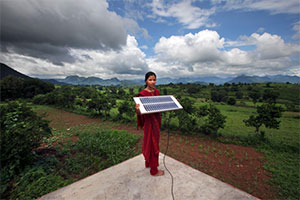 Bringing clean energy to rural India. Credit: Abbie Trayler-Smith / Panos Pictures / Department for International Development
Large reserves of oil, gas and minerals in developing countries generate opulent revenues. They could be used to stimulate economic growth and reduce poverty, but often result in environmental destruction and conflict, benefiting large companies and corrupt governments. Furthermore, competition over natural resources often manifests through geopolitical conflict. For example, before the US-Iraq war, Iraq’s domestic oil industry was nationalized. With US aggression came weakened Iraqi institutions and foreign intervention, thus eventually leading to the privatization of Iraqi oil, leaving the industry now largely dominated by Western companies. As another example, China’s rising investments within the lithium sector in South America are increasing the US-China rivalry across the Western Hemisphere. Notably, Bolivia has the largest reserves of lithium in the world, and the nation’s state-owned lithium extraction firm recently signed a contract with China’s CBC Consortium, while rejecting the entry of Western firms into the nation. In Bolivia’s case, rising Chinese investment in the nation’s lithium sector also raises concerns about environmental sustainability and the sociopolitical rights of Indigenous communities. More broadly, Sub-Saharan Africa holds nearly 30% of global reserves of critical minerals required for low-carbon technologies. Despite this, the region attracts less than 10% of global exploration investment, depicting a critical barrier to both the clean energy transitions and Sub-Saharan Africa’s economic development. Furthermore, resource wealth continues to fuel conflict like Sudan’s civil war, which has led to 9.1 million internally displaced people and is intensely connected to competition over gold, water, and agricultural land. IPS covers news about major oil, gas, and mining projects, their effects on the environment and local communities, and the ideas and actions of the interest groups involved.

The Week with IPS

NEXT STOP - SDGs
Tracking global progress towards a sustainable world
Tracking global progress towards a sustainable world
