Languages
Sunday, November 15, 2026



News and Views from the Global South
Natural Resources

Soy and Sugar Cane Fuel Native Land Conflicts in Brazil
The threat of mass suicide by native Guaraní-Kaiowá people in southwest Brazil brought to light a new formula for worsening conflicts over indigenous territory: the expansion of the cultivation of soy beans and sugar cane, two top export crops.
Nanotechnology Could Lighten Venezuela’s Oil Footprint
Venezuela is studying the use of nanotechnology as a means of reducing emissions of greenhouse gases caused by the oil industry.Canada Eyes African Resources amid Shrinking Foreign Aid
With an initial focus on oil-producing Nigeria and mineral-rich Ghana, Ottawa is bolstering its trade strategy in Africa, but some within the international development and economic communities have expressed concerns about Canada’s approach.
Bolivian Sugar Industry Recovers and Seeks Markets
Bolivia’s sugar mills are once again operating at full capacity, with producers flooding the domestic market and desperate to obtain permits to export a surplus of 138,000 tons to Chile, Colombia, Peru and the United States.
War’s End Threatens Water Supply in Northern Sri Lanka
War is seldom good for anything, especially protracted conflicts like the one in Sri Lanka, which dragged on for over three decades and claimed between 80,000 to 100,000 lives.
People’s Tribunal Defends Native Villages from Dams
"What do we stand to lose because of the dam? We will lose everything!" said Maria Abigail Agredani, a member of the committee for this indigenous community in the western Mexican state of Jalisco, reporting the damage that will be caused by the hydroelectric complex being built nearby.
Billions in Subsidies Prop up Unsustainable Overfishing
Calls are mounting for the world's big fishing powers to stop subsidising international fleets that use destructive methods like bottom trawling in foreign coastal waters, drastically reducing the catch of local artisanal fishers who use nets and fishing lines.
For Champions of Degrowth, Less Is Much More
The concept of degrowth is not a very comfortable one in overdeveloped countries such as the United States.
U.S. Concerned over Lao Approval for Huge Mekong Dam
The U.S. government is directly cautioning the Laotian government following Monday's announcement that the latter will move forward with contentious construction plans for a massive hydroelectric dam on the Mekong River.
Indigenous Seek Profits From Forests
Kenya’s Ogiek community, the indigenous group of hunter-gatherers who were evicted from the Mau Forest three years ago, say they will no longer sit by and watch logging companies profit from the resources of their traditional home while they live in poverty in tented camps around the forest without even the most basic of services, like sanitation.
Algeria Skips the Revolutionary Spring
As the Arab Spring continues to rage across the Middle East and North Africa, the gaze of the international media has largely passed over a country that was once known for its restive population, its long and bloody decolonisation struggle and revolutionary zeal.
OP-ED: Uruguay – Lessons from a Successful Rice Producer*
Uruguay is in the headlines of agricultural development news this week as it hosts the Second Global Conference on Agricultural Research for Development (GCARD 2) from Oct. 29 to Nov. 1 in the resort city of Punta del Este.
Regional Trade Key to African Food Security, World Bank Says
The World Bank is urging African countries to strengthen regional food trade, suggesting that food security could be greatly enhanced simply by allowing farmers to trade more easily across the continent.
U.S. Outlier in New Push to Reduce Gas Flaring
An international coalition led by the World Bank is calling for state-backed and private oil producers to reduce “gas flaring” by an additional 30 percent over the next five years, saying that doing so would be equivalent to taking 60 million cars off of the roads.
Worms, Termites, Microbes Offer Food Security
Worms and termites are not likely to win hearts and minds, but they, along with lichens and microbes, are vital to food security, say biodiversity specialists who attended this month’s United Nations conference on the Convention on Biological Diversity (CBD) in this south Indian city.
Palau Proves Sharks Worth More Alive Than Dead
Sharks have a safe haven the size of France, and the Republic of Palau that protects them is making millions of dollars from shark tourism.
‘Urban Planning Must Factor in Biodiversity’
“With more than 60 percent of the world projected to be urban by 2030 why not prepare for it and build cities that include biodiversity preservation into planning?” asks Kobie Brand of ICLEI Local Governments for Sustainability in Cape Town, South Africa.Shale Gas Extraction Brings Local Health Impacts
Shale gas extraction is putting some U.S. communities at risk of health issues, new research released here Thursday warns.
Agricultural Waste Boosts Energy Production in Argentina
A joint project by the energy and agriculture authorities in Argentina is seeking to boost electricity generation from forestry waste and other rural products which have enormous potential, according to experts.
India to Conserve Biodiversity at Grassroots
India’s National Biodiversity Authority (NBA) is actively promoting decentralised grassroots livelihoods as the best way to conserve biodiversity as mandated by the Nagoya Protocol on access and benefit sharing (ABS).
Some Caribbean Hotels Back Away from Battered Coastlines
The postcards portray sand, sea and sun. But key players in the Caribbean tourism industry are warning that it's time to shift gears away from the region's threatened coastlines and instead promote inland attractions like biodiversity.« Previous Page — Next Page »


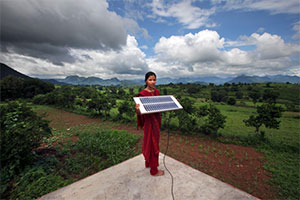 Bringing clean energy to rural India. Credit: Abbie Trayler-Smith / Panos Pictures / Department for International Development
Large reserves of oil, gas and minerals in developing countries generate opulent revenues. They could be used to stimulate economic growth and reduce poverty, but often result in environmental destruction and conflict, benefiting large companies and corrupt governments. Furthermore, competition over natural resources often manifests through geopolitical conflict. For example, before the US-Iraq war, Iraq’s domestic oil industry was nationalized. With US aggression came weakened Iraqi institutions and foreign intervention, thus eventually leading to the privatization of Iraqi oil, leaving the industry now largely dominated by Western companies. As another example, China’s rising investments within the lithium sector in South America are increasing the US-China rivalry across the Western Hemisphere. Notably, Bolivia has the largest reserves of lithium in the world, and the nation’s state-owned lithium extraction firm recently signed a contract with China’s CBC Consortium, while rejecting the entry of Western firms into the nation. In Bolivia’s case, rising Chinese investment in the nation’s lithium sector also raises concerns about environmental sustainability and the sociopolitical rights of Indigenous communities. More broadly, Sub-Saharan Africa holds nearly 30% of global reserves of critical minerals required for low-carbon technologies. Despite this, the region attracts less than 10% of global exploration investment, depicting a critical barrier to both the clean energy transitions and Sub-Saharan Africa’s economic development. Furthermore, resource wealth continues to fuel conflict like Sudan’s civil war, which has led to 9.1 million internally displaced people and is intensely connected to competition over gold, water, and agricultural land. IPS covers news about major oil, gas, and mining projects, their effects on the environment and local communities, and the ideas and actions of the interest groups involved.

The Week with IPS

NEXT STOP - SDGs
Tracking global progress towards a sustainable world
Tracking global progress towards a sustainable world
