Languages
Sunday, November 15, 2026



News and Views from the Global South
Natural Resources
Communal Land Titling at a Standstill in Peru
The titling of the lands of indigenous and peasant communities has been at a practical standstill for two years, with many of the corresponding files lost or incomplete. But the promotion of foreign investment is moving full steam ahead in the same regions.
China Wants Peace in Africa
China could soon expand its involvement in peace and security issues in Africa, according to government officials, researchers and academics from both the Asian giant and resource-rich continent who met at the second China-Africa Think Tanks Forum in Ethiopia from Oct. 12 to 13.
India Ignoring Coastal Biodiversity – NGOs
Indian civil society organisations see in the 11th United Nations Conference of the Parties (COP11) to the Convention on Biodiversity (CBD), underway in this south Indian city, a rare opportunity to highlight alleged neglect of biodiversity along the country’s extensive coastal and marine areas.Oil Industry Moves to Block New U.S. Transparency Rules
Lobby groups representing the oil industry filed a lawsuit in Washington court on Wednesday that seeks to halt the implementation of a new set of rules requiring U.S.-registered extractives companies to disclose all payments made to foreign governments.
Groups Rewarded in Their Fight for Fair Food
The Korean Women's Peasant Association won the 2012 Food Sovereignty Prize for its efforts on behalf of the survival of small-scale and ecologically sustainable farming in South Korea.Progress in Reducing Hunger ‘Tragically Slow’
WASHINGTON, October 11, 2012 (IPS) – At least 20 countries are currently at either "alarming" or "extremely alarming" levels of hunger, according to new research released here on Thursday.
KYRGYZSTAN: Mining Sector in Nationalists’ Crosshairs
When nationalist MP Kamchybek Tashiev led his supporters over a fence surrounding parliament in early October, both foreign and local executives working in Kyrgyzstan’s mining industry braced for the worst.
Pangolin Trade Betrays Apathy for Biodiversity
Conservationists see the decimation of pangolins (scaly anteaters) in Pakistan as a sign of the callousness with which this country’s rich biodiversity is being traded away for commercial gain.Funds Crunch Skews Aichi Targets on Biodiversity
The United Nations 11th Conference of the Parties to the Convention on Biological Biodiversity (COP 11 CBD), underway in this southern Indian city, is lost on where to garner the billions of dollars needed to implement the ‘Aichi targets,’ due to be met by 2020.
Environmentalists in Rio Worried about Reindustrialisation
The decline in Brazil’s manufacturing sector has not affected some parts of the country, which on the contrary have grown, driven by polluting industries like iron and oil production.
World Bank Refuses Call to Halt Land Deals
The World Bank has rejected a call to suspend its involvement in large scale agricultural land acquisition following the release of a major report by the international aid agency Oxfam on the negative impact of international land speculation in developing countries.To Press for Peace in Kivus, Donors Should Hold Aid, Report Says
Major donors to Rwanda and the Democratic Republic of the Congo (DRC) should withhold aid to both governments until they comply with prior agreements to pacify the DRC's mineral-rich Kivu provinces, states a new report released Thursday by the International Crisis Group.UZBEKISTAN-TAJIKISTAN: Souring Political Relations Damaging Human Ties
This summer, a 32-year-old musician with Uzbek citizenship was visiting her mother in Samarkand, Uzbekistan. For the last decade, the musician has lived in the Tajik capital Dushanbe with her husband, an ethnic Uzbek, and their 10-year-old daughter.
Money Versus Health: the Yasuni Story
In 2007 Ecuador's president, Rafael Correa, sponsored the Yasuni Initiative to end oil prospecting in the vast Yasuni National Park, thereby preventing some 400 million tonnes of carbon emissions, if the international community or the United Nations would compensate Ecuador for half of the unrealised oil revenues (an estimated 13 billion dollars over 13 years).
Caught Between Quarries and Sea Erosion
After more than a century of fighting sea erosion by massively dumping granite boulders along the beaches of southern Kerala state, environmentalists and administrators are beginning to see that this has been a costly and ineffective solution.
Major Extractives Firms No Longer Ignoring Community Consent
New research from Oxfam, an international aid agency, finds that some of the largest multinational oil and mining companies are increasingly incorporating principles of community consent into their day-to-day operations.
Arab Spring Teaches Food Security
African leaders should take note of the lessons learned from the Arab Spring and realise that ensuring good governance and food security will avoid crises on the continent, says Kofi Annan, chairman of the Africa Green Revolution Alliance.Serbians Unite Against Nickel Extraction
A popular Serbian proverb quips that when it comes to politics there are as many opinions as there are people in this central European country of seven million.
Starving for an Equitable Food System
The root cause of hunger and malnutrition for millions of people worldwide lies in the severely skewed and unfairly structured hierarchy of policymakers, not in natural disasters or food shortages, according to the Right to Food and Nutrition Watch 2012 (RTFN Watch) released Tuesday.
U.N. Chief Fires Up Private Investment for Global Energy Solutions
Following a lukewarm outcome of the Rio+20 sustainable development negotiations in June, U.N. Secretary-General Ban Ki-moon is moving full-steam ahead on a new initiative aimed at leveraging public-private partnerships to bring modern energy to over one billion people by 2030.
Stevia, a Flourishing Business in Spain
On a parcel of land a few kilometres outside the southern Spanish city of Málaga, unemployed activists are growing 2,000 seedlings of stevia, a plant used by the Guaraní indigenous people for centuries as a natural sweetener that is awakening ever greater interest in Spain.« Previous Page — Next Page »


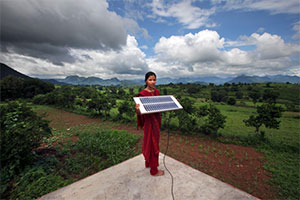 Bringing clean energy to rural India. Credit: Abbie Trayler-Smith / Panos Pictures / Department for International Development
Large reserves of oil, gas and minerals in developing countries generate opulent revenues. They could be used to stimulate economic growth and reduce poverty, but often result in environmental destruction and conflict, benefiting large companies and corrupt governments. Furthermore, competition over natural resources often manifests through geopolitical conflict. For example, before the US-Iraq war, Iraq’s domestic oil industry was nationalized. With US aggression came weakened Iraqi institutions and foreign intervention, thus eventually leading to the privatization of Iraqi oil, leaving the industry now largely dominated by Western companies. As another example, China’s rising investments within the lithium sector in South America are increasing the US-China rivalry across the Western Hemisphere. Notably, Bolivia has the largest reserves of lithium in the world, and the nation’s state-owned lithium extraction firm recently signed a contract with China’s CBC Consortium, while rejecting the entry of Western firms into the nation. In Bolivia’s case, rising Chinese investment in the nation’s lithium sector also raises concerns about environmental sustainability and the sociopolitical rights of Indigenous communities. More broadly, Sub-Saharan Africa holds nearly 30% of global reserves of critical minerals required for low-carbon technologies. Despite this, the region attracts less than 10% of global exploration investment, depicting a critical barrier to both the clean energy transitions and Sub-Saharan Africa’s economic development. Furthermore, resource wealth continues to fuel conflict like Sudan’s civil war, which has led to 9.1 million internally displaced people and is intensely connected to competition over gold, water, and agricultural land. IPS covers news about major oil, gas, and mining projects, their effects on the environment and local communities, and the ideas and actions of the interest groups involved.

The Week with IPS

NEXT STOP - SDGs
Tracking global progress towards a sustainable world
Tracking global progress towards a sustainable world
