Languages
Tuesday, October 13, 2026



News and Views from the Global South
Trade & Investment

Climate Action Greatest Economic Opportunity of this Century, Says UN Climate Chief
With fewer than 100 days to go to COP29, the highest decision-making body on climate issues under the United Nations Framework Convention on Climate Change (UNFCCC), the need for creative and innovative solutions to protect lives and livelihoods is now extremely urgent.
Global Poverty Grows as Super-Rich Get Richer Faster
Oxfam expects the world’s first trillionaire within a decade and poverty to end in 229 years! The wealth of the world’s five richest men has more than doubled from 2020, as 4.8 billion people became poorer.
Uganda Coffee Smallholders Grapple With EU Regulations on Imports
In Kubewo village in eastern Uganda, children often go to work with their parents in the coffee gardens. Earnings from Arabica coffee are used, their parents and grandparents say, to pay for children’s education and other expenses for the family.
Empowering Africa’s Informal Market Traders To Deliver Safe Food
Local informal food markets feed millions of urbanites in bustling African cities, but the consequences of tainted food could be illness and death for unsuspecting consumers.
Hydrogen from Renewables or Fossil Fuels? The Panamanian Question
In 2021, the Panama Canal welcomed a French experimental ship on a world tour, the Energy Observer, the first electric vessel powered by a combination of renewable energies and a hydrogen production system based on seawater.
Megaport in Brazil Makes No Contribution to Local Development
With barely 10 years in operation, the port of Açu is now the second in Brazil in cargo transport and seeks to become an industrial and energy transition hub. But so far it has contributed little to local development, causing environmental and social damage.
Mayurbhanj Kai Chutney: From Forests to Global Food Tables
On a scorching May morning, Gajendra Madhei, a farmer from Mamudiya village, arrives at the local bazaar in Udula, a town in Odisha's Mayurbhanj district. He displays freshly caught red weaver ants, known locally as kai pimpudi, in the bustling tribal market. Thanks to the recent recognition of Mayurbhanj's Kai chutney, or red weaver ant chutney, with a Geographical Indication (GI) tag awarded in January, his business of selling the raw ants has seen a significant surge in profitability.
Kashmir Frontier Woman Leads the Way in Breaking Down Patriarchy
Smelling the toxic smoke coming from burned powder kegs and helplessly watching fields turn into smoke and ash is traumatic. Rushing to the government's safe houses and leaving your homes, belongings and cattle behind whenever the armies of India and Pakistan trade fire is inexplicable. Then came climate-change-induced weather unpredictability.
Government Debt Is Symptom, Not Cause
Developing country governments are being blamed for irresponsibly borrowing too much. The resulting debt stress has blocked investments and growth in this unequal and unfair world economic order.
Sawantwadi’s Traditional Handmade Toys Struggle for Survival
Sawantwadi in Maharashtra, on the western coast of India, bordering Goa, has always been known for its wooden toys. A picturesque town amid hills and lush greenery, Sawantwadi retains an old-world charm to this day. The regal Sawantwadi Palace holds pride of place, with colleges, schools, and temples cloistered around the periphery of the lake, which was once an extension of the royal grounds. In the centre of the town is the Ubha Bazaar, or Hanging Market, which houses rows of shops selling the iconic wooden toys that are a hallmark of Sawantwadi.
Small Island Nations Demand Urgent Global Action at SIDS4 Conference
“This year has been the hottest in history in practically every corner of the globe, foretelling severe impacts on our ecosystems and starkly underscoring the urgency of our predicament. We are gathered here not merely to reiterate our challenges, but to demand and enact solutions,” declared Antigua and Barbuda Prime Minister Gaston Brown at the opening of the Fourth International Conference on Small Island Developing States on May 27.
Fine, Sanctions, or Waiver: Iranian Gas Will Come at a Price for Pakistan
When Iranian President Ebrahim Raisi visits Pakistan this week (April 22, 2024), experts say the two issues topmost on his mind that he will want to discuss with his Pakistani counterpart, President Asif Ali Zardari, will be border security and the Iran-Pakistan gas pipeline.
Portable Ginnery Could Revive Kenya’s Ailing Cotton Industry
Kirinyaga University may have just breathed new life into Kenya’s ailing cotton industry as varsity dons develop a portable cotton ginnery. For an industry that has been struggling to survive, this news came as a relief to cotton farmers, whose lives the invention is expected to change, and to a government pushing for job creation and self-reliance through manufacturing.
Rural Entrepreneurs Thriving Against All Odds in Zimbabwe
With heavy sweat drenching his face and his shirt soaked in the sweat, 39-year-old Proud Ndukulani wrestled with a homemade knife, which he dipped in some used oil, before turning the glistening knife upon a rather tough and dusty tyre obtained from what he said was a forklift. His assistant stood by his side as he (Ndukulani) cut some tough rubber from the giant tyre lying outside an open shade roofed with aging asbestos sheets at Juru Growth Point, located 52 km east of Harare in Zimbabwe’s Goromonzi district in the country’s Mashonaland East province.
Pioneering Digital Initiative Empowers Pacific Islands to Tackle Climate Disasters
Winning a battle for survival requires understanding the opponent. And, for the peoples of 22 island nations and territories scattered across more than 155 million square kilometres of Pacific Ocean, the volatility and wrath of the climate are their greatest threats.
Tensions with China Drive Investors Towards Vietnam
In recent months, several European representatives embarked on trade missions to Vietnam. German President Steinmeier visited Hanoi in January. The Netherlands sent Prime Minister Mark Rutte, with the Dutch royal couple, King Willem-Alexander and Queen Máxima, soon to follow suit. Notably, the Netherlands stands as the most significant European investor in Vietnam.
Made in Africa: Africa’s Fashion Redefining Narratives About the Continent
It is a new dawn as Africa’s high fashion industry enters an era defined and driven by young African fashion designers. As they take to the global stage, the young creatives are showcasing the continent in all its majesty through unique weaving techniques and patterns that combine their rich African heritage with contemporary styles.
It’s Africa’s Time To Shine, says UN Under Secretary Claver Gatete
With 20 percent of the global population and vast untapped natural resources, not forgetting its human capital, it is time Africa had its rightful seat at the global table, the United Nations Under Secretary and Executive Secretary of the Economic Commission for Africa (ECA), Claver Gatete, has called.
Inside Kenya’s Seed Control Battle: Why Smallholder Farmers Want to Share Indigenous Seeds
A group of 15 smallholder farmers in Kenya petitioned the country’s High Court, seeking to compel the government to review sections of a law that bans the sharing and exchange of uncertified and unregistered seeds.
Drought Narrows the Panama Canal, Delays Shipping
At the bar that Sandra manages in Panama City's central financial district, the variety offered on the menu has shrunk due to delays in ship traffic through the Panama Canal, one of the world's major shipping routes.
Neocolonial ISDS, Abused, Biased, Costly, and Grossly Unfair
Investor-State Dispute Settlement (ISDS) provisions in international trade and investment agreements – long abused by opportunists with means – are slowly being rejected by cautious governments.« Previous Page — Next Page »





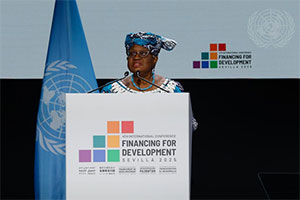 Opening of 4th International Conference on Financing for Development. Credit: UN Photo/Mariscal
International trade and investment are crucial elements of the world economy. While they can be powerful stimulators of development, they can also lead to global imbalances and dynamics of exploitation. In 2025, international trade entered a period of immense disruption, driven in part by a new wave of United States tariffs that reshaped global supply chains and investment flows. The increase in the US tariff rate, the highest since the 1930s, has forced bilateral renegotiations with global trading partners. Furthermore, the debt crisis in developing nations has accelerated while Official Development Assistance (ODA) has substantially dropped 7.3% in 2024.
In the 21st century, advancements in economic diversification in formerly colonized nations have propelled them into more central roles in the global economy. For example, both China and Mexico were able to develop their manufacturing sector and channel this development into booming export flows, thus advancing into the position of emerging economies. Foreign investment also plays an essential role in providing capital for developing countries, although they are oftentimes accompanied by social and environmental exploitation. For example, rising Chinese investments in natural resources in Latin America have often been met with tension as these investment projects fail to properly mitigate environmental risks and protect workers’ rights. In a more multifaceted vein, Sino-African relations have led to infrastructure development in Sub-Saharan Africa while also heightening the region’s economic dependency on China. IPS reports on global news in trade and investment, while shining a light on the nuanced nature of these endeavors.

The Week with IPS

NEXT STOP - SDGs
Tracking global progress towards a sustainable world
Tracking global progress towards a sustainable world
