Languages
Wednesday, September 30, 2026



News and Views from the Global South
Projects

From Mega to Micro, a Transition that Will Democratise Energy in Brazil
An energy transition is spreading around the globe. But in Brazil it will be characterised by sharp contrasts, with large hydroelectric plants being replaced by solar microgenerators and government decisions being replaced by family and community decision-making.
Over to You, Children! Zambia’s ‘Plant a Million Trees’ Takes Root
Trees are a vital component in the ecosystem—they not only give oxygen, store carbon, stabilise the soil and give refuge to wildlife, but also provide materials for tools, shelter and ultimately, food for both animals and human beings.
Dreaming of A New Sustainable Economy
Officials from around the world came together to create and support a vision for a new, sustainable economy: a bioeconomy. Almost 1000 bioeconomy experts, from former heads of state to civil society leaders, convened in Berlin for the second Global BIoeconomy Summit to discuss best practices and challenges.
Latin America Faces Uphill Energy Transition
Latin America is facing challenges in energy efficiency, transportation and power generation to move towards a low carbon economy and thus accelerate that transition, which is essential to cut emissions in order to reduce global warming before it reaches a critical level.
New GCF Project Signals Paradigm Shift for Water-Scarce Barbados
At the start of 2017, the Caribbean Drought and Precipitation Monitoring Network (CDPN) warned eastern Caribbean countries that they were facing “abnormal climate conditions” and possibly another full-blown drought.
Can modern bio-economy strengthen the climate agreement and energy security?
Dr. Frank Rijsberman, GGGI Director-General, will deliver a keynote presentation on Strengthening the Climate Agreement and Energy Security at the Global Bioeconomy Summit 2018 on April 20 in Berlin, Germany.
Getting Away with Murder in Slovakia
Sitting in a cafe in the Slovak capital, Bratislava, Zuzana Petkova admits that like many other investigative journalists in the country today, she is scared.
Food Is the Answer: Perugia International Journalism Festival
The twelfth International Journalism Festival on April 12-15 has drawn 710 speakers from 50 different countries, becoming the biggest journalism festival in Europe.
Tunneling Through the Andes to Connect Argentina and Chile
Visionaries imagined it more than 80 years ago, as a way to strengthen the integration between Argentina and Chile. Today it is considered a regional need to boost trade flows between the two oceans. Work on a binational tunnel, a giant engineering project in the Andes, is about to begin.
Caribbean Eyes Untapped Potential of World’s Largest Climate Fund
The Caribbean Community Climate Change Centre (CCCCC) also known as the 5Cs, is looking for ways to boost the region’s access to the Green Climate Fund (GCF).
UN’s Zero Hunger Goal Remains a Daunting Challenge
The United Nations, which is battling some of the world’s worst humanitarian crises in Asia, the Middle East and Africa, still remains focused on one of its equally daunting undertakings: how to achieve Zero Hunger by 2030.
For Many Migrants, No Land Is Sweeter Than Home
Most migrants to Europe, Australia and the United States from Rangpur in northern Bangladesh leave home at a young age and return when they have just passed middle age.
Trump Hurtles Toward Three Nuclear Crises
One year into the unorthodox presidency of Donald Trump, the United States faces an array of complex and dangerous foreign policy challenges that require principled leadership, pragmatism, patience, and smart diplomacy.
Senegalese Returnees from Libya, Niger Face Uncertain Future
Bouba Diop looks in delight at his uncle’s newly refurbished food canteen in the poor township of Keur Massar on the outskirts of the Senegalese capital Dakar.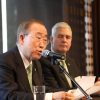
Former UN Chief Takes the Helm of Global Green Growth Institute
In the face of climate change and growing energy demand in developing countries, Ban Ki-moon, the new president and chair of the Global Green Growth Institute (GGGI), unveiled his vision for a more sustainable path by helping countries in their transition to greener economies and achieving the Sustainable Development Goals (SDGs).
Working Together Is Key to Meeting Water Targets by 2030
Mutual collaboration and coordination among the various stakeholders are tools to accelerate the actions necessary to meet the 6th Sustainable Development Goal (SDG) in the 2030 Agenda, which states the need to ensure access to clean water and sanitation for all.
GGGI supports Rwanda in solving pressure to the provision of water
Rwanda, although predominantly rural, has been urbanizing rapidly, from a half-million urban residents in 1995 to more than three and a half million today.
High and Dry: Can We Fix the World’s Water Crisis?
April 12 is expected to be the infamous “Day Zero” in South Africa’s second largest city of Cape Town, a tourist hub which attracts millions of visitors every year.
A Breath of Fresh Air in India
With India’s citizens clamouring for breathable air and efficient energy options, the country’s planners are more receptive than ever to explore sustainable development options, says Frank Rijsberman, Director-General of the Global Green Growth Institute (GGGI).
Latin American Indigenous People Fight New Plunder of Their Resources
Indigenous communities in Latin America, who have suffered the plunder of their natural resources since colonial times, are reliving that phenomenon again as mega infrastructure are jeopardising their habitat and their very survival.
Water Scarcity: India’s Silent Crisis
As Cape Town inches towards ‘Zero Hour’ set for July 15, 2018, the real threat of water scarcity is finally hitting millions of people worldwide. For on that day, the South African city's 3.78 million citizens -- rich and poor, young and old, men and women -- will be forced to queue up with their jerry cans at public outlets for their quota of 25 litres of water per day.« Previous Page — Next Page »


The Week with IPS

NEXT STOP - SDGs
Tracking global progress towards a sustainable world
Tracking global progress towards a sustainable world
