Languages
Monday, November 16, 2026



News and Views from the Global South
Global

Ending Violence Against Women – A Global Responsibility
Addressing violence against women, in all of its forms, is a global imperative and should be one of the international community’s top priorities, including in forthcoming intergovernmental processes, such as the post-2015 development agenda.Global Tax-Evasion Crackdown Sidestepping Poorest Countries
While a major global campaign to cut down on tax evasion is picking up momentum, anti-poverty advocates say the initiative overlooks the world’s poorest countries.
U.N. Favours Changeover from Landlocked to ‘Land-linked’
Some 440 million people are living in 32 countries that are among the world’s poorest, most of them least developed, and geographically isolated from world markets not only because they have very few commodities to export, but also because they have no direct territorial access to the sea.
OPINION: The Irresistible Attraction of Radical Islam
The Oct. 23 attack on the Canadian Parliament building by a Canadian who had converted to Islam just a month earlier should create some interest in why an increasing number of young people are willing to sacrifice their lives for a radical view of Islam.
Another Women’s Treaty? Implement Existing One, Say NGOs
Can violence against women be prevented or eliminated with a new international treaty signed and ratified by the 193 member states of the United Nations?
Better Water Management Needed to Eradicate Poverty
It demands repetition: water is a precondition for all life. It keeps us alive – literally – while being a prerequisite for or integral part of most of our daily activities. Think hospitals without water, think farms, energy producers, industries, schools and homes without our most needed resource. All sectors, without exception, are dependent on water.
OPINION: From Almaty to Vienna, New Prospects For LLDCs
Kazakhstan being the world’s largest landlocked country, and also the ninth largest country in the world of more than 2.7 million square kilometres, hosted in 2003 in Almaty the First United Nations Conference on Landlocked Countries.
OPINION: Towards an Inclusive and Sustainable Future for Industrial Development
As representatives of the United Nations Industrial Development Organization (UNIDO), we are sometimes asked whether industrial development is still relevant to a world which many observers have claimed over the past decades to have entered the “post-industrial age”. Our answer is always an emphatic “yes”, shaped both by the evidence of history and current events.
OPINION: The West Prefers Military Order Against History
More senseless bombing of Muslims, more defeats for the United States-West, more ISIS-type movements, more West-Islam polarisation. Any way out?
Good Twins or Evil Twins? U.S., China Could Tip the Climate Balance
China and the United States are responsible for 35 percent of global carbon emissions but could do their part to keep climate change to less than two degrees C by adopting best energy efficiency standards, a new analysis shows.Global South Brings United Front to Green Climate Fund
The United Nations’ key mechanism for funding climate change-related mitigation and adaptation in developing countries is now ready to receive funds, following a series of agreements between rich and poor economies.
OPINION: The Group of 77 & IPS at 50
When the Group of 77 commemorated its 50th anniversary recently, Inter Press Service (IPS) news agency was not far behind.
Halting Progress: Ending Violence against Women
As Juan Evo Morales Ayma, popularly known as 'Evo', celebrates his victory for a third term as Bolivia’s president on a platform of “anti-imperialism” and radical socio-economic policies, he can also claim credit for ushering in far-reaching social reforms such as the Bolivian “Law against Political Harassment and Violence against Women” enacted in 2012.
Climate Negotiators “Sleepwalking” in Bonn
The 410,000 people who took to the streets for climate action in New York City during the U.N. Climate Summit would have been outraged by the 90-minute delay and same-old political posturing at the first day of a crucial round of climate treaty negotiations in Bonn at the World Congress Center.
OPINION: The Politics of Biodiversity Loss
To mainstream biodiversity concerns into development planning, we must offer a compelling rationale and demonstrate biodiversity’s relevance to wealth generation, job creation and general human wellbeing. Only a persuasive “why” resonating throughout society will successfully get us to urgently needed negotiations of who, what, where, when and how to halt disastrous biodiversity loss.
We Must Think of “Security” in New Ways
Recent events in the Arab world and elsewhere have underscored the point that traditional notions of security being dependent solely on military and related apparatus are outmoded.
OPINION: Innovation Needed to Help Family Farms Thrive
Family farms have been contributing to food security and nutrition for centuries, if not millennia. But with changing demand for food as well as increasingly scarce natural resources and growing demographic pressures, family farms will need to innovate rapidly to thrive.
Family Farmers – Forward to the Future
"Who is more concerned than the rural family with regards to preservation of natural resources for future generations?"
OPINION: The Survivors
Oct. 18 is the EU’s Anti-Trafficking Day, as well as the United Kingdom’s Anti-Slavery Day. These events offer a good opportunity to talk about human trafficking within Europe’s borders, but we should not forget that there are victims and survivors all over the world.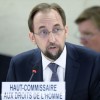
Cash-Strapped Human Rights Office at Breaking Point, Says New Chief
After six weeks in office, the new U.N. High Commissioner for Human Rights (UNHCHR) Zeid Ra'ad al-Hussein of Jordan launched a blistering attack on member states for insufficient funding, thereby forcing operations in his office to the breaking point "in a world that seems to be lurching from crisis to ever-more dangerous crisis."
Vanishing Species: Local Communities Count their Losses
The Mountain Chicken isn’t a fowl, as its name suggests, but a frog. Kimisha Thomas, hailing from the Caribbean island nation of Dominica, remembers a time when she could find these amphibians or ‘crapaud’ as locals call them “just in the backyard”.« Previous Page — Next Page »


The Week with IPS

NEXT STOP - SDGs
Tracking global progress towards a sustainable world
Tracking global progress towards a sustainable world
