Languages
Sunday, November 8, 2026



News and Views from the Global South
Active Citizens
Rights Crushed in Italy’s Overcrowded Prisons
When Claudio was detained in a prison in the northeastern Italian city of Vicenza, he had to share a 7.6 square-metre cell with two other people. “Once you excluded the space taken up by beds and drawers, each inmate was left with 90 centimetres to himself. We had to take it in turns to stand up,” he told IPS.
Civil Society Wants Bigger Role in Green Climate Fund Planning
As the new board of the United Nations Green Climate Fund meets in Berlin this week, activist and watchdog groups here and around the world are expressing frustration over proposed rules they say are already significantly limiting civil society participation in the new initiative.
India Strives to Become ‘Drought Proof’
In a country of 1.2 billion people, the threat of drought takes on epic proportions. Over a period of two centuries (between 1801 and 2002), India experienced 42 severe droughts, according to the Indian Space Research Organisation. One of these, in 1979, cut food grain production by 20 percent; another, in 1987, damaged 58.6 million hectares of cultivated land, affecting 285 million people.
Changing Weather, Changing Fortunes
Sri Lanka has paused for breath after the extreme weather conditions last year that many associate with climate change.Thailand Negotiating ‘Worrying’ Deal With EU
The negotiations launched this week for a Free Trade Agreement (FTA) between Thailand and the European Union have raised concerns among both Thai and European non-governmental organisations, who fear that EU demands could have a negative impact on Thailand’s progressive public health policies.
At Home, and Not at Home
The influx of hundreds of thousands of war-weary refugees from Syria to Lebanon is putting an almost unbearable strain on many of the communities that have taken them into their homes. A domestic economic crisis compounded by the arrival of such large numbers of refugees is weighing heavily on many impoverished areas.Pressure Grows on Washington to Pass IMF Governance Reforms
More than 130 scholars, former government officials and policymakers are calling on the U.S. Congress to enact pending legislation enabling broad governance reforms within the International Monetary Fund (IMF) that would strengthen the voice of developing countries within the institution.
Anti-Nuke Movement Goes to the Gulf
After a week of activities in Oslo during the Conference on the Humanitarian Impact of Nuclear Weapons, major anti-nuclear campaigners moved Monday to the Bahraini capital, Manama, in yet another step towards the abolition of atomic weapons.
Fighting Sex Trafficking in Brazil – in Fiction and Reality
The story generally begins in Brazil’s hinterland, with a pretty, young woman from a disadvantaged background and with little formal education, who is drawn in by false promises and ends up in a sex trade network that stretches overseas.
A Political Tug-of-War Over Militarism and Gender Violence
When the largest single gathering of women met at the United Nations in February last year, the adoption of a future plan of action was undermined by rigidly conservative governments opposed to women's reproductive rights - largely misinterpreted as a right to abortion.A “Golden Age” for Native Cinema
Indigenous filmmakers and audiovisual artists worldwide are celebrating their growing visibility, as native voices and stories edge their way onto the big screen, gaining international recognition both artistically and commercially.
Fukushima Running Out of Workers
Japan has promised to scrap the crippled Fukushima nuclear reactors that faced the world’s worst nuclear accident. But Hiroyuki Watanabe, councillor in Iwaki City located 30 kilometres from the accident site, greets such intentions on the second anniversary of the disaster on Monday with misgiving.
Switzerland Sets Example for Income Equality
For those who think that Occupy Wall Street, the Indignados in Spain, the World Social Forum and the numerous manifestations of protest worldwide are expressions without concrete outcomes, the result of the Swiss referendum on Mar. 3 on capping the salaries and bonuses of banks executives should make them think twice.
‘Every Day Is a Fukushima Memorial’
Japan prepares to mark the second anniversary of the Mar. 11 triple disaster - an earthquake, tsunami and a critical nuclear reactor accident - with much soul searching across the country.
Honesty to Contest Pakistan Elections
A new politics of honesty – and of campaigning for honesty – is surfacing in Pakistan. Its two prominent fronts are both Pakistanis who carry also a strong foreign stamp. What many within the country find more encouraging is the strong support people are giving them.
VIDEO: African Communities Strengthen Women’s Access to Justice
 On the sidelines of the 57th session of the Commission on the Status of Women (CSW), the United Nations Development Programme (UNDP) and the Huairou Commission (HC), on March 4th, organised a panel discussion on women's access to justice.
Nobel Laureates Back “Strong, Autonomous” Inter-American Rights System
Six women recipients of the Nobel Peace Prize on Friday lauded the work of the Inter-American Commission on Human Rights (IACHR), offering additional high-level support for the institution just weeks ahead of a critical vote on a reforms process that many worry could irreparably weaken the Inter-American system.
Across U.S., Health Concerns Vie with Fracking Profits
Peter “Pete” Seeger is a 93-year old U.S. folk legend who resides near Wappingers Falls in southern New York. He can be spotted occasionally on the traffic-heavy Route 9, flanked by world peace signs and armed with a banjo.
Hugo Chávez Made History
That his life and his deeds had black dots is part of the story but should not prevent us from seeing the greatness of a maker of history. First, in his own country, Venezuela, Hugo Chávez lifted those at the bottom up from misery, into economic wellness, political participation, cultural pride (in their often African, or Indian, blood), social dignity – going far beyond Gini coefficients to measure increasing equality.
OP-ED: Violence Against Women Must End
Today is International Women’s Day, and the issue of gender-based violence is topic A. Sadly, it has been a newsworthy topic in the global media, as well.Civil Society Members Replace UN in Taiwan Review
The just-completed review of Taiwan’s initial state human rights report offers a new model featuring direct involvement by civil society organisations in examining compliance with international rights covenants.« Previous Page — Next Page »





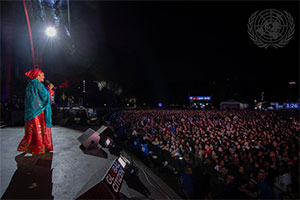 Global Citizen Festival in New York. Credit: UN Photo/Eskinder Debebe
Active citizens are committed to social change because they know that it is achievable. However, major political challenges face active citizens across the world. For example, in authoritarian regimes in Latin America where the hegemonic party has been in power for decades on end, protestors and human rights activists face enormous repression and struggle to materialize their advocacy into concrete results. The same can be said for Africans, where a shift towards elected government in recent decades has yet to translate into an effective voice in decision-making. Now, the Strengthening Citizen Demand for Good Governance, which uses evidence-based approaches – funded by DFID's Governance and Transparency Fund – seeks to raise their voices.
In 2025, the CIVICUS Monitor’s People Power Under Attack report revealed that civic freedoms are severely limited in 122 of 198 countries and territories, and only 7.2% of the global population now lives in countries where civic space is open. Through partnership with the Overseas Development Institute (ODI) and CIVICUS, IPS reporters across the continent will seek to define the extent and limits of state capability, government accountability and the responsiveness of leaders to the needs of citizens.

The Week with IPS

NEXT STOP - SDGs
Tracking global progress towards a sustainable world
Tracking global progress towards a sustainable world
