Languages
Monday, November 9, 2026



News and Views from the Global South
Active Citizens

Japanese Learn to Mind Their Business for Others
After two decades of economic stagnation and serial natural disasters, a growing number of young Japanese believe social entrepreneurship is the best way to rebuild their society.
Draft Assessment of Tar Sands Pipeline “Devastatingly Cynical”
The U.S. State Department late Friday released a draft environmental impact assessment of a contentious pipeline project that simultaneously acknowledged the dangers posed by climate change while also noting the project would “not likely result in significant adverse environmental effects”.
Protests in Portugal Get Creative
Indignation in Portugal over rampant joblessness and cuts in wages, pensions and unemployment benefits, together with a growing tax burden, has given rise to innovative forms of protest capable of drawing large crowds.
“Eco-Reconstruction” Still an Impossible Dream for Chilean Village
The reconstruction of the fishing village of Boyeruca, destroyed by the tsunami that swept over central-south Chile on Feb. 27, 2010, was meant to serve as a model of ecological and sustainable reconstruction.
Q&A: ‘Alliance of Civilisations, a Need and a Challenge’
The fifth global forum of the United Nations Alliance of Civilisations (UNAOC), founded to promote intercultural understanding and dialogue to bring civilisations closer, came to a close Thursday after two days of talks, at which world leaders restated their commitment to the Alliance’s ideals and pledged to build on the foundations it had laid to expand its work.
To Walk Down The Street
Molotov cocktails, clouds of teargas, live gunfire, ambulance sirens wailing as they ferried the wounded, and round after round of rubber-coated metal bullets exploding in the street…these were familiar scenes in Palestinian protest.
U.S. Finally Passes Stronger Protections for Women against Abuse
The U.S. House of Representatives on Thursday ended more than a year of stonewalling a piece of legislation that for two decades has offered legal protections for women against sexual violence, harassment and abuse.‘Media Needs an Alliance With Minorities’
Amid calls from world leaders for media diversity and plurality to be strengthened to combat a rising tide of extremism and intolerance, media experts have warned that change should not be expected overnight and that governments and states have a crucial role to play in the process.
Q&A: No “Us” and “Them” in Fight for Women’s Rights
As the earthquake in Haiti has proven, even more important than a recognised name or robust physical presence is the quality of services delivered by humanitarian relief organisations.Aid Hurting Palestinians
Local food for local people. That’s the idea behind Sharaka (‘partnership’, in Arabic), an entirely volunteer-run, Palestinian organisation that aims to bring locally grown products directly to Palestinian dinner tables.
Women Struggle for a Place in the Pacific
Women face greater odds in achieving equal political representation in the Pacific Islands than in any other region of the world, holding just 3 percent of seats in national parliaments, compared to 20 percent in Sub-Saharan Africa and 18.5 percent in South East Asia.
Freedom Pushes Past Snags in Tunisia
The extent to which Tunisians are able to express themselves freely is an ever-changing phenomenon. While the country is still in the grips of turmoil after the recent killing of left-wing politician Chokri Belaid, which sparked some of the largest protests since the initial revolution in 2011 that toppled Zine El Abidine Ben Ali, the airing of dissent has become second nature for many.Alliance Aims to Get Past Intolerance
A UN summit designed to promote tolerance, plurality and global inclusiveness of civilisations has opened with dire warnings of the threat of religious and ethnic intolerance – at the same time as many states that have ostensibly signed up to the UN’s ideals continue to enforce laws and practices restricting religious freedom, and implicitly marginalising communities.
Q&A: Climate Change Front and Centre in Cuban Development Model
Each of Cuba’s 168 municipalities faces the challenge of designing its own strategic development which, as well as economic and social progress, minimises the impact of extreme weather and other problems caused by global warming.
ALEC-Backed Laws Promote Controversial Charter Schools
The right-wing American Legislative Exchange Council (ALEC) and private education management firms are pushing for new “parent trigger” laws in states across the U.S. by lobbying many Republican and some Democratic legislators to make it easier to convert more traditional public schools to charter schools.
24 Nails Dug Into Body, Luckily
Lahandapurege Ariyawathie feels she got off lightly - if returning home with 24 nails embedded in your body is lucky.
Cuba, an Island of Questions
The Cuban National Assembly, the parliament, has just passed a historic milestone: the visible turning point when one momentous and complex phase in the life of the country begins to come to a close, and a door opens on a future that, however hard to predict, will in many ways be different.Activists Converge on High Court for Challenge to Voting Rights
The U.S. Supreme Court will hear oral arguments Wednesday in a challenge to the constitutionality of key sections of the historic Voting Rights Act (VRA) of 1965.
U.S. Cuts to Global Health Budget “Mass-scale Malpractice”
Public health workers, activists and policymakers are stepping up a last-minute campaign to highlight the global health impact of historic, sweeping cuts to the U.S. federal budget due to go into effect Friday if Congress doesn’t act.
All Eyes in Haiti on Duvalier Hearing
Angry and frustrated, but also cautiously hopeful, victims, human rights advocates and the Haitian population are waiting for Thursday, Feb. 28, the day former dictator Jean-Claude “Baby Doc” Duvalier has been ordered to appear at a hearing to determine whether or not he will face charges for human rights abuses committed during his brutal 15-year regime (1971-1986).
Profits Before Safety in Pakistan’s Factories
Twenty-seven-year-old Muhammad Arif works at a steel re-rolling mill in Lahore, capital of Pakistan’s northeastern Punjab province, producing steel ingots from scrap.« Previous Page — Next Page »





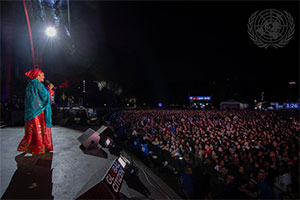 Global Citizen Festival in New York. Credit: UN Photo/Eskinder Debebe
Active citizens are committed to social change because they know that it is achievable. However, major political challenges face active citizens across the world. For example, in authoritarian regimes in Latin America where the hegemonic party has been in power for decades on end, protestors and human rights activists face enormous repression and struggle to materialize their advocacy into concrete results. The same can be said for Africans, where a shift towards elected government in recent decades has yet to translate into an effective voice in decision-making. Now, the Strengthening Citizen Demand for Good Governance, which uses evidence-based approaches – funded by DFID's Governance and Transparency Fund – seeks to raise their voices.
In 2025, the CIVICUS Monitor’s People Power Under Attack report revealed that civic freedoms are severely limited in 122 of 198 countries and territories, and only 7.2% of the global population now lives in countries where civic space is open. Through partnership with the Overseas Development Institute (ODI) and CIVICUS, IPS reporters across the continent will seek to define the extent and limits of state capability, government accountability and the responsiveness of leaders to the needs of citizens.

The Week with IPS

NEXT STOP - SDGs
Tracking global progress towards a sustainable world
Tracking global progress towards a sustainable world
