Languages
Tuesday, November 10, 2026



News and Views from the Global South
Active Citizens
U.S.: A Musical Movement for Liberation
Inside a dimly lit restaurant in New York City's historic Harlem neighbourhood, on an unusually warm night in the middle of February, an audience of 120 people sits spellbound while a forgotten gem is dusted off, polished and presented to the crowd.
Q&A: Where Abusing Women Is “An Accepted Norm”
Violence, torture and other forms of cruel treatment are on the rise for women in the highlands of Papua New Guinea.Social Unrest on the Rise in Southern Chile
The police have cracked down hard on demonstrators in the southern Chilean region of Aysén, who have been protesting the area's isolation and high local prices of fuel and food for the past two weeks.
Illegal Wiretapping Continues in Colombia, U.N. Says
Illegal spying on human rights activists and journalists is still happening in Colombia, according to a new report by the Office of the United Nations High Commissioner for Human Rights.U.S. Voters Increasingly Alienated by Two Major Parties
A new book shows there are now more U.S. voters who identify as independent than as Democrats or Republicans, despite the fact that the two major parties maintain their virtual stranglehold on U.S. politics and, so far, on the 2012 presidential election process.Tunisia Summit Highlights Glaring Absence of Unity on the ‘Syria Question’
In the Friends of Syria meeting held in Tunis last week, Gulf Arab monarchies offered nearly unqualified support for the Syrian opposition, while the democratic states were more cautious.SPAIN: Demonstrators Protest Bank Bailouts and Spending Cuts
Demonstrators in nearly two dozen cities in Spain raised their voices Friday to protest against the use of public funds to bail out banks while the budgets for basic services like education and health are being slashed.NGOs Urge “Solution from Within” For Somalia
While the international community discusses Somalia's future in London and Brussels, European and Somali non-governmental organisations are calling for a radical shift from a military to a humanitarian approach as the only solution to the country's war-torn condition.Privatisation Derailed Argentina’s Rail System
Increasingly frequent and tragic railway accidents in Argentina, like this week’s crash, show that the rail system, run by private companies that receive hundreds of millions of dollars in subsidies from the state, constantly ignores warnings from inspectors and fines, observers say.Community Radios in Colombia Tune In for Peace
Cleaning up a stream that used to be a garbage dump and restocking it with fish, or helping demobilised far-right paramilitaries reintegrate into society by returning to school, are some of the early outcomes of a project involving community radio stations in a remote area of northwest Colombia.
SENEGAL: Two Women Among 14 Candidates for President
There are two women among the 14 candidates contesting the first round of Senegalese presidential elections that will be held on Feb. 26. But according to several analysts, this overwhelmingly Muslim West African country is not ready to be governed by a woman.Jordanian NGOs Lead the Fight for Migrant Workers’ Rights
As the number of domestic workers flooding into Jordan from Indonesia, Philippines and Sri Lanka reaches 140,000 annually, non-governmental organisations on the ground are working hard to protect migrant labourers’ rights and expose the terrible working conditions in the rich households that employ them.INDONESIA: Community Radio Helps Revive Forests
Irman Meilandi unhesitatingly attributes the return of birds, wildlife and the forests around his hilly village of Mandalamekar in West Java province to conservation advice streaming in over community radio.
Community Station in Mexico Conquers Airwaves and Internet
It’s always cold in this city in Mexico’s Sierra Nevada mountains, more than 2,400 metres above sea level, at the foot of the Popocatépetl volcano.The Middle East: A Rainbow or a Tornado?
A year ago the fall of Hosni Mubarak in Egypt was greeted with general satisfaction and considerable relief. Was it already possible to glimpse (for example, in the spectacle of the Egyptian leader being judged bedridden in a cage) the difficulties that lay ahead for North Africa and the Middle East fulfilling the promise of the "Arab Spring"?
G20: Final Push for Financial Transactions Tax
While the Greek bailout and stimulus package dominated discussion among the Group of 20 (G20) major industrialised and emerging market economies at the high-level summit in Cannes, France, this week, the proposed financial transactions tax (FTT) received meagre attention.U.S.: CIA-NYPD Alliance = Systematic Racial Profiling
While some Muslim Americans might have been hoping for a relaxation of the decade-long counterterrorism onslaught on the tenth anniversary of 9/11, a report published by the Associated Press - unearthing new and shocking realities on the extent of intelligence-gathering operations in New York City - suggests that the offensive on "terror" is only just beginning.
MIDEAST: In Prison, and Denied Education
Access to education for Palestinian prisoners in Israeli jails is getting worse as international organisations remain unwilling or unable to intervene. Secondary- school students here completed their exams in June, and received their results by end of July. However, the 1,800 Palestinian prisoners who were supposed to complete their exams were not permitted to do so by the Israeli Prison Service.
LIBYA: Where Resistance to Gaddafi Runs High
Recent victories in Libya’s western mountains have led to a brief reprieve from violence and local fighters and civilians are slowly trying to piece their lives back together.Between Libya and the Deep Sea
NATO’s five-month bombing campaign in Libya, run under the guise of protecting civilians, is also killing victims fleeing the conflict, directly and indirectly.TURKEY: Resignations Herald the Demilitarisation of Politics
The simultaneous resignations of Turkey's top military brass last week indicates that the civilian government may finally have more sway over politics than the top generals, according to analysts and activists.« Previous Page — Next Page »





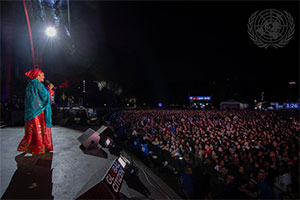 Global Citizen Festival in New York. Credit: UN Photo/Eskinder Debebe
Active citizens are committed to social change because they know that it is achievable. However, major political challenges face active citizens across the world. For example, in authoritarian regimes in Latin America where the hegemonic party has been in power for decades on end, protestors and human rights activists face enormous repression and struggle to materialize their advocacy into concrete results. The same can be said for Africans, where a shift towards elected government in recent decades has yet to translate into an effective voice in decision-making. Now, the Strengthening Citizen Demand for Good Governance, which uses evidence-based approaches – funded by DFID's Governance and Transparency Fund – seeks to raise their voices.
In 2025, the CIVICUS Monitor’s People Power Under Attack report revealed that civic freedoms are severely limited in 122 of 198 countries and territories, and only 7.2% of the global population now lives in countries where civic space is open. Through partnership with the Overseas Development Institute (ODI) and CIVICUS, IPS reporters across the continent will seek to define the extent and limits of state capability, government accountability and the responsiveness of leaders to the needs of citizens.

The Week with IPS

NEXT STOP - SDGs
Tracking global progress towards a sustainable world
Tracking global progress towards a sustainable world
