Languages
Thursday, October 8, 2026



News and Views from the Global South
Active Citizens

New Regional Secretariat to Advance Leprosy Advocacy in Asia
Organisations of people affected by leprosy in Asia have agreed to form a regional-level secretariat to support national advocacies and represent their collective agenda at a world conference to be held later this year.
Q&A: Leprosy-affected People Live Not at the Bottom, but Outside the Social Pyramid
Takahiro Nanri is the Executive Director of Sasakawa Memorial Health Foundation which has been supporting the global fight against leprosy for almost five decades. Since 2014, Nanri has been leading the foundation’s leprosy projects across the world and has deep insights into the challenges faced by the people affected by leprosy as well as the organisations that work with them.
Healthy Oceans, Healthy Societies
Over recent years, there have been shocking reports of marine endangerment and plastic pollution. The threats are clear, and now urgent action is needed more than ever.
Hope Springs Once Again for Nigeria’s Returnee Migrants
 Nigeria accounts for some of the largest number of irregular migrants trying to reach Europe from Africa.
Living with Leprosy on the Climate-Vulnerable Kiribati Island Atolls
Kurarenga Kaitire lives in Kiribati—one of the world’s most climate-vulnerable nations. Already vulnerable to nature, the 29-year-old mother of five has faced a series of vulnerabilities over the past decade, including facing social stigma and domestic abuse.
Q& A: We Need a Holistic Approach to Eradicate Leprosy
Dr. Maria Francia Laxamana is the Assistant Secretary in the Philippines ministry of health. With nearly two decades of work both as a senior government official and also as an expert in several non-government organisations, Laxamana has deep insight into the issue of leprosy in this Southeast Asian nation and the challenges faced by those who are affected by the disease.
A Leprosy-free Philippines by 2020?
 Dr Maria Francia Laxamana, assistant secretary of health in the Department of Health, Philippines outlines her recommendations for a leprosy country by 2020.
Leprosy Detection With a Personal Touch
Jennifer Quimno could put anyone at ease. So when she travels across the Philippines as part of peer to peer programme that helps identify new leprosy cases, people generally allow her to examine them.
First Asian Leprosy Assembly Calls for Greater Social Inclusion for the Affected
Growing up in Kathmandu, Nepal, Amar Bahadur Timalsina wasn’t allowed to attend school as a young boy because he was affected by leprosy. But decades later, after treatment and being able to re-integrate into his community, the boy who was once denied an education is now inspiringly the principal of a school of 400 students.
Local School Is a Model for Energy and Water in Rapa Nui
A school in the capital of Easter Island (Rapa Nui, in the local indigenous tongue) gives an example of clean management with the use of solar energy, rainwater recovery and an organic vegetable garden, as well as rooms and spaces built with waste materials.
Maldives Reiterates Commitment to ‘Free, Open Indo-Pacific Region’ & Democracy
Maldives Foreign Minister Abdulla Shahid has reiterated his nation's commitment to a “free and open” Indo-Pacific region and to democracy. During his meeting with Secretary of State Michael Pompeo in Washington Feb 20, Shahid “underscored the importance of his government's reform efforts to (ensure) the vitality of Maldives' democracy,” the department's Deputy Spokesperson Robert Palladino said.
Attacks on Human Rights Defenders: A Daily Occurrence in Latin America
"We're in a very difficult situation. There is militarisation at a regional level, and gender-based violence. We are at risk, we cannot silence that," Aura Lolita Chávez, an indigenous woman from Guatemala, complained at a meeting of human rights defenders from Latin America held in the Mexican capital.
Mining Grabs Up Land, Deals Blow to Agriculture in Central America
Like an octopus, metals mining has been spreading its tentacles throughout Central America and dealing a blow to the region's agriculture and natural ecosystems, according to affected villagers, activists and a new report on the problem.
Kenya’s Marginalised Say Nothing For Us, Without Us
Julia Mutua is a resident of Kalawa ward in the semi-arid Makueni County in Eastern Kenya and a member of a women's farmers group that runs a poultry project.
International Aid Feeds Hope and Fuels Confrontation in Venezuela
The international food and medical aid awaiting entry into Venezuela from neighboring Colombia, Brazil and Curacao is at the crux of the struggle for power between President Nicolás Maduro and opposition leader Juan Guaidó, recognised as "legitimate president" by 50 governments.
Rapa Nui’s Stone Statues and Marine Resources Face Threats from Climate Change
Social activists and local authorities in Rapa Nui or Easter Island are calling for urgent action to address rising sea temperatures, declining rainfall, and rising tides that threaten their fishing resources and their Moais, the mysterious volcanic stone monoliths.
Are Sustainable Development Goals Reaching Indigenous Peoples?
Life and death for whole communities hang in the balance of achieving the 17 Sustainable Development Goals (SDGs) that include eliminating poverty, conserving forests, and addressing climate change in a resolution adopted unanimously by the United Nations in 2015.
Deported Salvadoran Women Pin Their Hopes on Poultry Production
Salvadoran farmer Lorena Mejía opens an incubator and monitors the temperature of the eggs, which will soon provide her with more birds and eggs as the chickens hatch and grow up.
Bullets Against Pots and Pans in the Crackdown on Venezuela’s Protests
The protests in Venezuela demanding an end to the presidency of Nicolás Maduro in the last 10 days of January, whose soundtrack was the sound of banging on pots and pans in working-class neighbourhoods, had a high human cost: more than 40 deaths, dozens wounded and about a thousand detainees, including 100 women and 90 children under 18.
Mexican Village Wants to Turn Thermoelectric Plant into Solar Panel Factory
Social organisations in the central Mexican municipality of Yecapixtla managed to halt the construction of a large thermoelectric plant in the town and are now designing a project to convert the installation into a solar panel factory, which would bring the area socioeconomic and environmental dividends.
Protecting Your Security and Rights Online
On December 6, the Australian parliament rushed to pass a bill that could weaken security on the phones and software people rely on every day, in Australia and worldwide. The sweeping law could force tech companies to take vaguely described actions to access encrypted data.« Previous Page — Next Page »





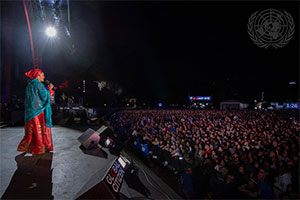 Global Citizen Festival in New York. Credit: UN Photo/Eskinder Debebe
Active citizens are committed to social change because they know that it is achievable. However, major political challenges face active citizens across the world. For example, in authoritarian regimes in Latin America where the hegemonic party has been in power for decades on end, protestors and human rights activists face enormous repression and struggle to materialize their advocacy into concrete results. The same can be said for Africans, where a shift towards elected government in recent decades has yet to translate into an effective voice in decision-making. Now, the Strengthening Citizen Demand for Good Governance, which uses evidence-based approaches – funded by DFID's Governance and Transparency Fund – seeks to raise their voices.
In 2025, the CIVICUS Monitor’s People Power Under Attack report revealed that civic freedoms are severely limited in 122 of 198 countries and territories, and only 7.2% of the global population now lives in countries where civic space is open. Through partnership with the Overseas Development Institute (ODI) and CIVICUS, IPS reporters across the continent will seek to define the extent and limits of state capability, government accountability and the responsiveness of leaders to the needs of citizens.

The Week with IPS

NEXT STOP - SDGs
Tracking global progress towards a sustainable world
Tracking global progress towards a sustainable world
