Languages
Thursday, September 24, 2026



News and Views from the Global South
Active Citizens

Opinion: Time for the World to Protect and Value its Young Human Rights Defenders
There’s a deep irony that as people around the world mark International Youth Day on Aug. 12, hardly any attention will be paid to the shrinking space for young human rights defenders who increasingly find themselves on the receiving end of government repression.
Protests Greet Japan’s Relaunch of Nuke Power
Protesters rallied outside Japan's Sendai nuclear plant a day ahead of its planned opening and four years after the Fukushima disaster galvanised opposition to nuclear power in the country.
Caribbean Artists Raise Their Voices for Climate Justice
Award-winning St. Lucian poet and playwright Kendel Hippolyte thinks that Caribbean nationals should view the Earth as their mother.
Opinion: The Road to Paris and the Path to Renewable Energy
Renewable energy is now being seen by many people around the world as a cost-effective development solution both for developed and developing nations. Countries have slowly been realising that the use of coal and the huge amount of carbon emissions it generates harms the environment and impacts our daily activities.
Obama Takes Lead on Climate Change Ahead of U.N. Talks in Paris
This week, U.S. President Barack Obama formally unveiled the details of his Clean Power Plan (CPP), a comprehensive carbon-cutting strategy he described as “the biggest and most important step…ever taken to combat climate change” in a prior video address posted on Facebook.
Unique Alliance Between Gauchos and Environmentalists Protects Argentina’s Pampas
The traditions of Argentina’s gauchos or cowboys have joined together with modern agricultural technology in a unique alliance between stockbreeders and environmentalists aimed at preserving biodiversity in the pampas, boosting productivity, and enhancing the flavour of this South America’s country’s famous beef.Amnesty Wants International Criminal Court to Intervene in Libya
Calling for an end to “an epidemic of kidnapping blighting” Libya, Amnesty International has faulted the International Criminal Court (ICC) for failing to undertake any investigations into crimes under international law committed by armed groups in the last four years.
Making the World’s Indigenous Visible in the SDGs
As the International Day of the World's Indigenous Peoples approaches on Sunday, Aug. 9, concerns are growing that they will not fully benefit from the newly drafted Sustainable Development Goals (SDGs).
No More Hiroshimas, No More Nagasakis, Vows U.N. Chief
Speaking at a commemoration of the 70th anniversary of the atomic bombings of Japan, Secretary-General Ban Ki-moon, a vociferous advocate of nuclear disarmament, echoed the rallying cry worldwide: “No more Hiroshimas, No more Nagasakis.”
Half a Million U.S. Women and Girls at Risk of Genital Cutting
Jaha Dukureh knows firsthand the barbaric effects of undergoing female genital mutilation/cutting (FGM/C). Now a resident of the United States, she was mutilated as a baby in the Gambia in West Africa. Her sister bled to death after enduring the same procedure.
U.N. Taps Private Sector to Fund Development, Advocate Social Causes
When the United Nations seeks outside financial assistance either for development needs or to advocate social causes, it invariably turns to the private sector these days.
Mexico’s Anti-Poverty Programmes Are Losing the Battle
While most of Latin America has been reducing poverty, Mexico is moving in the other direction: new official figures reflect an increase in the number of poor in the last two years, despite the billions of dollars channeled into a broad range of programmes aimed at combating the problem.
Mandela Prizewinner from Namibia Still Bringing Sight to the Blind
There was pure emotion in the face of Dr. Helena Ndume, more used to bringing sight to the blind than wiping away tears of her own.
U.N. Targets Trillions of Dollars to Implement Sustainable Development Agenda
After more than two years of intense negotiations, the U.N.’s 193 member states have unanimously agreed on a new Sustainable Development Agenda (SDA) with 17 goals -- including the elimination of extreme poverty and hunger -- to be reached by 2030.
Churches Seek to Amplify Echo of Hiroshima and Nagasaki
The accounts of survivors of the atomic bombs dropped on Hiroshima and Nagasaki will serve as inspiration for leaders of Christian churches grouped in the World Council of Churches (WCC), which advocates the elimination of nuclear weapons.
Partnerships Critical to the SDGs, Reducing Inequality
Last week, South Korea's Permanent Representative Oh Joon was inaugurated as the new president of the U.N. Economic and Social Council (ECOSOC). As such, he will have a key role in setting the course for implementing the ambitious Post-2015 Sustainable Development Goals (SDGs) that will be adopted at the summit of world leaders in September.
Opinion: RIP Cecil the Lion. What Will Be His Legacy? And Who Decides?
Cecil the lion, a magnificent senior male, much loved and part of a long-term research project, was lured out of a safe haven in Zimbabwe's Hwange National Park last week and apparently illegally shot, to endure a protracted death.
Women, Peace and Security Agenda Still Hitting Glass Ceiling
This October will mark the 15th anniversary of the adoption of U.N. Security Council Resolution 1325. The landmark resolution on Women, Peace and Security (WPS) recognises not only the disproportionate impact armed conflict has on women, but also the lack of women’s involvement in conflict resolution and peace-making.
U.N.’s Post-2015 Development Agenda Under Fire
The U.N.’s highly ambitious post-2015 development agenda, which is expected to be finalised shortly, has come fire even before it could get off the ground.
Opinion: Uneven MDG Progress Must Inspire Resolve to Do Much Better
The world received an important report card last month, in the form of the latest annual Millennium Development Goals Report. The report highlights a number of important achievements, but omits mention that some targets of the Millennium Development Goals (MDGs) were lower than those agreed to at the relevant U.N. international conferences of the 1990s.
Central America Fails to Take Advantage of Energy from Sun, Wind and Earth
Central America, a place of abundant wind and sunshine, is still chained to thermal power and large-scale hydroelectricity and has failed to include local communities in clean, environmentally-friendly and less invasive projects.« Previous Page — Next Page »


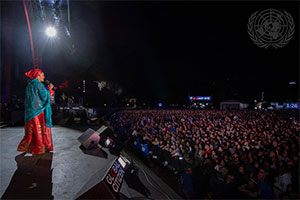 Global Citizen Festival in New York. Credit: UN Photo/Eskinder Debebe
Active citizens are committed to social change because they know that it is achievable. However, major political challenges face active citizens across the world. For example, in authoritarian regimes in Latin America where the hegemonic party has been in power for decades on end, protestors and human rights activists face enormous repression and struggle to materialize their advocacy into concrete results. The same can be said for Africans, where a shift towards elected government in recent decades has yet to translate into an effective voice in decision-making. Now, the Strengthening Citizen Demand for Good Governance, which uses evidence-based approaches – funded by DFID's Governance and Transparency Fund – seeks to raise their voices.
In 2025, the CIVICUS Monitor’s People Power Under Attack report revealed that civic freedoms are severely limited in 122 of 198 countries and territories, and only 7.2% of the global population now lives in countries where civic space is open. Through partnership with the Overseas Development Institute (ODI) and CIVICUS, IPS reporters across the continent will seek to define the extent and limits of state capability, government accountability and the responsiveness of leaders to the needs of citizens.

The Week with IPS

NEXT STOP - SDGs
Tracking global progress towards a sustainable world
Tracking global progress towards a sustainable world
