Languages
Saturday, September 19, 2026



News and Views from the Global South
Active Citizens

Organic Farmers Cultivate Rural Success in Samoa
Rural farming families in Samoa, a small island developing state in the central South Pacific Ocean, are reaping the rewards of supplying produce to the international organic market with the help of a local women’s business organisation.World Bank Tribunal Weighs Final Arguments in El Salvador Mining Dispute
A multilateral arbitration panel here began final hearings Monday in a contentious and long-running dispute between an international mining company and the government of El Salvador.
A Flood of Energy Projects Clash with Mexican Communities
Since January, villagers and townspeople near the Los Pescados river in southeast Mexico have been blocking the construction of a dam, part of a multi-purpose project to supply potable water to Xalapa, the capital of the state of Veracruz.
U.N. Climate Summit: Staged Parade or Reality Show?
The much-ballyhooed one-day Climate Summit next week is being hyped as one of the major political-environmental events at the United Nations this year.
‘Breaking Silence’ on the Slave Trade
The Oscar-winning film 12 Years a Slave recently generated international discussion about the barbarity of slavery, but it is not alone in the attempt to break the silence around the 400 years of the transatlantic slave trade and to “shed light” on the lasting historical consequences.
Salvadoran Farmers Stake Their Bets on Sustainable Development
Peasant farmers from one of El Salvador’s most fragile coastal areas are implementing a model of sustainable economic growth that respects the environment and offers people education and security as keys to give the wetland region a boost.
Majority of Consumer Products May Be Tainted by Illegal Deforestation
At least half of global deforestation is taking place illegally and in support of commercial agriculture, new analysis released Thursday finds – particularly to supply overseas markets.
Free Economic Zone Plan Slammed as ‘Suicide’ Pact for Taiwan Farmers
The Taiwan government’s plan to liberalise tariff-free imports of agricultural produce from China and other countries for processing in free economic pilot zones, which will then be exported as ‘Made in Taiwan’ items, may mean suicide for Taiwanese farmers if approved by the national legislature.
Mideast Nuclear Weapons-Free Zone Remains in Limbo
After four long years of protracted negotiations, a proposal for a nuclear weapons-free zone (NWFZ) in the strife-torn Middle East remains in limbo - and perhaps virtually dead.
Global Citizenship: “From Me to We to Peace”
If a Silicon Valley existed for the culture of peace, it would most likely look to global citizenship as the next big industry shake-up.
Global Commission Urges Decriminalisation of Drug Use
A top-level international panel called Tuesday for a major shift in global drug-control policies from prohibition to decriminalisation and regulation.
LGBT Visibility in Africa Also Brings Backlash
Eighteen-year-old Gift Makau enjoyed playing and refereeing football games in her neighbourhood in the North West Province of South Africa. She had come out to her parents as a lesbian and had never been heckled by her community, according to her cousin.
U.S. Military Joins Ebola Response in West Africa
The U.S. military over the weekend formally began to support the international response to the Ebola outbreak in West Africa.
Mexico’s Cocopah People Refuse to Disappear
In their language, Cocopah means “river people”. For over 500 years the members of this Amerindian group have lived along the lower Colorado River and delta in the Mexican states of Baja California and Sonora and the U.S. state of Arizona.
Latin America’s Anti-drug Policies Feed on the Poor
Poor young men, slumdwellers and single mothers are hurt the most by anti-drug policies in Latin America, according to representatives of governments, social organisations and multilateral bodies meeting at the Fifth Latin American Conference on Drug Policies.
Women – the Pillar of the Social Struggle in Chile’s Patagonia Region
In few places in Chile are women the pillars of community, grassroots rural and environmental movements as they are in the southern wilderness region of Patagonia. It is a social role that history forced them to assume in this remote part of the country.
Child Trafficking Rampant in Underdeveloped Indian Villages
In a country where well over half the population lives on less than two dollars a day, it takes a lot to shock people. The sight of desperate families traveling in search of money and food, whole communities defecating in the open, old women performing back-breaking labour, all this is simply part of life in India, home to 1.2 billion people.In Azerbaijan, ‘Family Is the First Fear’ of LGBT Community
The 19-year-old Azerbaijani man claims he awoke one morning in mid-August to the sound and feel of gasoline splashing on his body and his mother angrily screaming. Through a sleepy haze, he saw her burning a piece of paper. Suddenly, he alleged, his mother’s intentions became clear; he was about to be burned to death for being homosexual.
OPINION: Civil Society Calls For Impartial Inquiry on Air Crash and Catastrophe in Ukraine
It is ironic that at this moment in history when so many people and nations around the world are acknowledging the 100th anniversary of our planet’s hapless stumble into World War I, great powers and their allies are once again provoking new dangers where governments appear to be sleepwalking towards a restoration of old Cold War battles.
Why Principle Matters at UN Human Rights Council
The killings of hundreds of civilians, including scores of children, in Gaza – whose only fault was to have been born on the wrong side of the wall – was a major point of contention at the United Nations Human Rights Council at the end of July.
SDGs Make Room for Education for Global Citizenship
Civil society leaders and U.N. development experts gathered on Wednesday to discuss the role of education for global citizenship in the post-2015 development agenda.« Previous Page — Next Page »


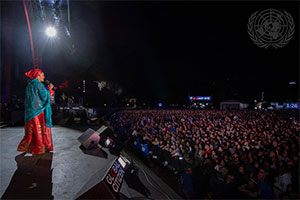 Global Citizen Festival in New York. Credit: UN Photo/Eskinder Debebe
Active citizens are committed to social change because they know that it is achievable. However, major political challenges face active citizens across the world. For example, in authoritarian regimes in Latin America where the hegemonic party has been in power for decades on end, protestors and human rights activists face enormous repression and struggle to materialize their advocacy into concrete results. The same can be said for Africans, where a shift towards elected government in recent decades has yet to translate into an effective voice in decision-making. Now, the Strengthening Citizen Demand for Good Governance, which uses evidence-based approaches – funded by DFID's Governance and Transparency Fund – seeks to raise their voices.
In 2025, the CIVICUS Monitor’s People Power Under Attack report revealed that civic freedoms are severely limited in 122 of 198 countries and territories, and only 7.2% of the global population now lives in countries where civic space is open. Through partnership with the Overseas Development Institute (ODI) and CIVICUS, IPS reporters across the continent will seek to define the extent and limits of state capability, government accountability and the responsiveness of leaders to the needs of citizens.

The Week with IPS

NEXT STOP - SDGs
Tracking global progress towards a sustainable world
Tracking global progress towards a sustainable world
