Languages
Sunday, September 20, 2026



News and Views from the Global South
Active Citizens

IPS at 50, Leads That Don’t Bleed
Tarzie Vittachi, a renowned Sri Lankan newspaper editor and one-time deputy executive director of the U.N. children's agency UNICEF, once recounted the oft-quoted story of an African diplomat who sought his help to get coverage in the U.S. media for his prime minister's address to the General Assembly.
Climate Policy Goes Hand-in-Hand with Water Policy
Concerned that climate change could lead to an intensification of the global hydrological cycle, Caribbean stakeholders are working to ensure it is included in the region's plans for Integrated Water Resources Management (IWRM).
Amid Crisis, Puerto Rico’s Retirees Face Uncertain Future
A feeling of insecurity has overtaken broad sectors of Puerto Rican society as the economy worsens, public sector debt spirals out of control, and the island's creditworthiness is put in doubt.
World Bank Urged to Rethink Reforms to Business-Friendliness Report
Civil society groups from several continents are stepping up a campaign urging the World Bank to strengthen a series of changes currently being made to a major annual report on countries’ business-friendliness.
Threat of Hydropower Dams Still Looms in Chile’s Patagonia
After its victory in a nearly decade-long struggle against HidroAysén, a project that would have built five large hydroelectric dams on wilderness rivers, Chile’s Patagonia region is gearing up for a new battle: blocking a quiet attempt to build a dam on the Cuervo River.
OPINION: Towards a Global Governance Platform
Inter Press Service News Agency has braved severe political assaults and financial tempests since 1964, when Roberto Savio and Pablo Piacentini laid its foundation as a unique and challenging information and communication system.
The Time for Burning Coal Has Passed
“People have gathered here to tell their politicians that the way in which we used energy and our environment in the 19th and 20th centuries is now over,” says Radek Gawlik, one of Poland’s most experienced environmental activists. “The time for burning coal has passed and the sooner we understand this, the better it is for us.”
U.N. Conference Set to Bypass Climate Change Refugees
An international conference on small island developing states (SIDS), scheduled to take place in Samoa next week, will bypass a politically sensitive issue: a proposal to create a new category of "environmental refugees" fleeing tiny island nations threatened by rising seas.
OPINION: This Flower Is Right Here
Where have all the flowers gone? Yes, of course, those are the opening words of a beautiful song made famous by such illustrious singers as Joan Baez, Harry Belafonte, Vera Lynn and the Kingston Trio, among others. It was a great number made greater by the different styles in which singers of different musical temperaments belted it out.
New York’s Homeless Pushed Deeper into the Shadows
Joe sits on newspapers spread on the sidewalk by the entrance to midtown's Grand Central Station. His head rests in his hands, only looking up when coins from passersby clink into his paper cup.
OPINION: International Relations, the U.N. and Inter Press Service
In 1979, I had a debate at the United Nations with the late Stan Swinton, then the very powerful and brilliant director of Associated Press (AP). At one point, I furnished the following figures (which had been slow to change), as an example of Western bias in the media:
Organic Farming Taking Off in Poland … Slowly
Polish farmer Slawek Dobrodziej has probably the world’s strangest triathlon training regime: he swims across the lake at the back of his house, then runs across his some 11 hectares of land to check the state of the crops, and at the end of the day bikes close to 40 kilometres to and back from a nearby town for some shopping.
No Hope for AIDS-Free Generation in Uganda as Controversial HIV Bill is Signed into Law
HIV/AIDS activists are adamant Uganda will not achieve an “AIDS-free generation” now a “backwards” HIV/AIDS Bill criminalising the “wilful and intentional” transmission of the disease has been signed into law.
U.S., Brazil Nearing Approval of Genetically Engineered Trees
The U.S. and Brazilian governments are moving into the final stages of weighing approval for the commercialisation of genetically engineered eucalyptus trees, moves that would mark the first such permits anywhere in the world.
Churches at the Frontline of Climate Action
Johannes Kapelle has been playing the organ in the Protestant church of Proschim since he was 14. The 78-year-old is actively involved in his community, produces his own solar power and has raised three children with his wife on their farm in Proschim, a small village of 360 inhabitants in Lusatia, Germany.
A Life Reserve for Sustainable Development in Chile’s Patagonia
The people of Patagonia in southern Chile are working to make the Aysén region a “life reserve”. Neighbouring Argentina, across the border, is a historic ally in this remote wilderness area which is struggling to achieve sustainable development and boost growth by making use of its natural assets.
Despite Current Debate, Police Militarisation Goes Beyond U.S. Borders
The shooting of an unarmed black teenager by a white police officer in the southern United States earlier this month has led to widespread public outrage around issues of race, class and police brutality.
Island States to Rally Donors at Samoa Meet
Amid accelerating climate change and other challenges, a major international conference in the South Pacific island nation of Samoa next month represents a key chance for Small Island Developing States (SIDS) in the Caribbean to turn the tide.
Militarism Should be Suppressed Like Hanging and Flogging
I once asked Dan Berrigan, the great American anti-war activist, for some advice to me in my life as a peace activist. He replied “Pray and Resist”.
Does Iceland Gain From Whaling?
Although fin whaling by Icelanders has encountered increasing opposition over the last year, Icelandic whaling boats headed off to sea again in mid-June for the first hunt of the summer and by August 14 had killed 80 fin whales.
Trauma Kits and Body Bags Now Fill Aleppo School
Volunteer civil defence units operating here in Syria’s largest city careen through crater-pocked routes of precariously hanging, pancaked concrete where barrel bombs have struck.« Previous Page — Next Page »


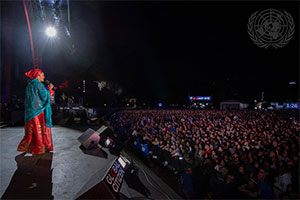 Global Citizen Festival in New York. Credit: UN Photo/Eskinder Debebe
Active citizens are committed to social change because they know that it is achievable. However, major political challenges face active citizens across the world. For example, in authoritarian regimes in Latin America where the hegemonic party has been in power for decades on end, protestors and human rights activists face enormous repression and struggle to materialize their advocacy into concrete results. The same can be said for Africans, where a shift towards elected government in recent decades has yet to translate into an effective voice in decision-making. Now, the Strengthening Citizen Demand for Good Governance, which uses evidence-based approaches – funded by DFID's Governance and Transparency Fund – seeks to raise their voices.
In 2025, the CIVICUS Monitor’s People Power Under Attack report revealed that civic freedoms are severely limited in 122 of 198 countries and territories, and only 7.2% of the global population now lives in countries where civic space is open. Through partnership with the Overseas Development Institute (ODI) and CIVICUS, IPS reporters across the continent will seek to define the extent and limits of state capability, government accountability and the responsiveness of leaders to the needs of citizens.

The Week with IPS

NEXT STOP - SDGs
Tracking global progress towards a sustainable world
Tracking global progress towards a sustainable world
