Languages
Wednesday, October 14, 2026



News and Views from the Global South
Conferences

Climate Neutrality – the Lifeboat Launched by Lima
Packed into stifling meeting rooms in the Peruvian capital, delegates from 195 countries are trying to find a path that would make it possible for the planet to reach climate neutrality in the second half of this century – the only way to avoid irreversible damage, scientists warn.
“Indigenous Peoples Are the Owners of the Land” Say Activists at COP20
The clamor of indigenous peoples for recognition of their ancestral lands resounded among the delegates of 195 countries at the climate summit taking place in the Peruvian capital. “I want my land…that’s where I live and eat, and it’s where my saintly grandparents lie,” Diana Ríos shouted with rage.
Q&A: Why Kyoto’s Clean Development Mechanism is at a Crossroads
The U.N. mechanism for supporting carbon emissions projects in developing countries – the Clean Development Mechanism (CDM) – is in crisis as a result of a dramatic slump in the prices being paid for carbon credits.
Climate and Post-2015 Development Agenda Talks Share the Same Path
The international community’s post-2015 development agenda will depend, in key aspects, on whether the delegates of 195 countries meeting now at the climate summit in the Peruvian capital reach an agreement to reduce global warming, since climate change affects all human activity.
The South Demands Clarity in Financing and Adaptation at COP20
At the 12-day climate summit that began Monday in the Peruvian capital, representatives of 195 countries and hundreds of members of civil society are trying to agree on the key points of a new international treaty aimed at curbing global warming.
Illegal Logging Wreaking Havoc on Impoverished Rural Communities
Rampant unsustainable logging in the southwest Pacific Island states of Papua New Guinea and Solomon Islands, where the majority of land is covered in tropical rainforest, is worsening hardship, human insecurity and conflict in rural communities.
Only a Few Drops of Water at the Lima Climate Summit
Although it is one of the victims of global warming, water will not be given a place of importance at the COP20 climate change conference to be held Dec. 1-12 in Lima, Peru.
Democratising the Fight against Malnutrition
There is a new dimension to the issue of malnutrition – governments, civil society and the private sector have started to come together around a common nutrition agenda.
Laying the Foundations of a World Citizens Movement
Has organised civil society, bound up in internal bureaucracy, in slow, tired processes and donor accountability, become simply another layer of a global system that perpetuates injustice and inequality?
Central American Civil Society Calls for Protection of Local Agriculture at COP20
Worried about the effects of global warming on agriculture, water and food security in their communities, social organisations in Central America are demanding that their governments put a priority on these issues in the COP20 climate summit.
To Fight Inequality, Latin America Needs Transparency…and More
As public policy, political transparency and open data need an active ingredient to bring about social change that would reduce inequality in Latin America: citizen participation, said regional experts consulted by IPS.
Will New Climate Treaty Be a Thriller, or Shaggy Dog Story?
This December, 195 nations plus the European Union will meet in Lima for two weeks for the crucial U.N. Conference of the Parties on Climate Change, known as COP 20. The hope in Lima is to produce the first complete draft of a new global climate agreement.
High Expectations At the World Parks Congress
 Conserving the world's most valuable natural resources is the focus of the sixth World Parks Congress 2014, taking place Sydney, Australia. The congress, which takes place once every 10 years, is convened by the International Union for Conservation of Nature (IUCN).

How SADC is Fighting Wildlife Crime
"We are underpaid, have no guns and in most instances are outnumbered by the poachers," says Stain Phiri, a ranger at Vwaza Marsh Wildlife Reserve — a 986 km reserve said to have the most abundant and a variety of wildlife in Malawi — which also happens to be one of the country’s biggest game parks under siege by poachers.
OPINION: Bringing More International Pressure to Bear on Wildlife Crime
A surge in wildlife crime is fuelling criminal syndicates, perpetuating terrorism, and resulting in the loss of major revenues from tourism and industries dependent on iconic species while also endangering the livelihoods of the rural poor. But this surge in wildlife crime is not only threatening iconic species, which include elephants, rhinos and tigers, but also lesser-known animals that are also on the brink of extinction.
The Nagoya Protocol: A Treaty Waiting to Happen
For over 20 years, Mote Bahadur Pun of Nepal’s western Myagdi district has been growing ‘Paris polyphylla’ - a Himalayan herb used to cure pain, burns and fevers.
Protecting Biodiversity in Costa Rica’s Thermal Convection Dome in the Pacific
The vast habitat known as the Costa Rican Thermal Convection Dome in the eastern Pacific Ocean will finally become a protected zone, over 50 years after it was first identified as one of the planet’s most biodiversity-rich marine areas.
Vanishing Species: Local Communities Count their Losses
The Mountain Chicken isn’t a fowl, as its name suggests, but a frog. Kimisha Thomas, hailing from the Caribbean island nation of Dominica, remembers a time when she could find these amphibians or ‘crapaud’ as locals call them “just in the backyard”.
Facing Storms Without the Mangrove Wall
As the cyclonic storm Hudhud ripped through India’s eastern state of Andhra Pradesh, home to two million people, at a land speed of over 190 kilometres per hour on Sunday, it destroyed electricity and telephone infrastructure, damaged the airport, and laid waste to thousands of thatched houses, as well as rice fields, banana plantations and sugarcane crops throughout the state.
Civil Society in Cuba Finds More Space Under the Reforms
Cafés, real estate agencies, taxis and other small privately-owned businesses and cooperatives in Cuba have brought new life to the depressed local economy and have given rise to pockets of prosperity in the country’s towns and cities.
Reducing Hunger: More Than Just Access to Food
“We want healthy food, we want to produce according to our traditions,” farmers and activists demanded during an international forum of experts on agriculture and the environment in this southern Italian city.« Previous Page — Next Page »





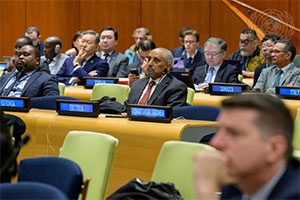 General Assembly Meets to Hear Briefing on UN80 Initiative. Credit: UN Photo/Manuel Elías
Global development conferences are continuing to produce critical frameworks for South-South cooperation and multilateral reform. In January of 2024, the 3rd Global South Nexus (GSN) International Conference was held in Odisha, India, with its theme being “Creating Responsible Professionals for Advancing SDGs: Inputs from Global North and South.” The 2025 UN SDG Report provided a midpoint assessment of the 2030 Agenda, with only 35% of targets on track and 18% having reversed. The 2025 UN Climate Change Conference (COP30) in Belém, Brazil, agreed to mobilize $1.3 trillion annually for climate action by 2035, operationalize the loss and damage fund, triple adaptation finance, and launched the Belém Mission to 1.5°C. In 2025, the Partnership for Economic Policy (PEP) convened its annual Policy Conference in Nairobi, Kenya, addressing the issue of “Financing and Inclusivity in Green Energy Transition in the Global South.” As the Global South advocates increasingly for a South-South framework alongside North-South cooperation, international conferences on sustainability aim to bridge economic and social divides between developed and developing countries in achieving the UN SDGs. Furthermore, to mark the UN’s 80th anniversary, the UN80 Initiative was launched to reshape how the UN system works so that every mandate, dollar, and decision creates greater impact for the global system.

The Week with IPS

NEXT STOP - SDGs
Tracking global progress towards a sustainable world
Tracking global progress towards a sustainable world
