Languages
Sunday, November 15, 2026



News and Views from the Global South
Civil Society

Kenyan Journalists Feel Heat of Govt Pressure
Freedom of the press in Kenya is facing its biggest challenge since independence, with government censorship on the rise both during and since last year’s general election.
Forest Communities Join Forces to Fight Land Degradation in Mexico
Forest communities play a fundamental role in Mexico in combating land degradation, but they need more support to that end.
Women Miners Stake a Claim in Zimbabwe
Tapiwa Moyo, 40, religiously leaves her home each day when the first cock crows and joins a throng of women who have taken up artisanal mining in her community.
Women Lead the Fight for Housing in Brazil
"Here we empower women and we do not tolerate domestic violence, which we treat as our own, not as an intra-family, issue," says Lurdinha Lopes, a leader of the squatting movement in Brazil.
In Latin America “Me Too” Doesn’t Always Mean the Same Thing
From the Argentine slogan "Ni una menos" (Not one [woman] less)" to Colombia’s “Now is not the time to remain silent”, activism against gender violence has grown in Latin America since 2015, with campaigns that have social and cultural differences from the "MeToo" movement that emerged later, in 2017, in the United States.
Women Peace Laureates Condemn Inaction on Rohingya “Genocide”
Nobel Laureates Mairead Maguire, Shirin Ebadi and Tawakkol Karman met with more than 100 women refugees in camps in the coastal Cox’s Bazar region of Bangladesh this week, as well as travelling to the “no man’s land” where thousands of Rohingya have been stranded between Myanmar and Bangladesh.
Argentina’s Patagonia Rebels Against Oil Field Waste Pits
A project to install a huge deposit of oil field waste pits has triggered a crisis in the north of Argentina’s southern Patagonia region, and brought the debate on the environmental impact of extractive industries back to the forefront in this Southern Cone country.
Demonizing OXFAM – Fair or Foul?
As a member of OXFAM GB's Council of Trustees since 2014, I have received many queries about the recent scandal concerning sexual misconduct committed by some OXFAM staff in Haiti in 2011 and elsewhere. I appreciate the concerns expressed as well as many messages of solidarity and support for OXFAM in the face of the relentless onslaught of criticism – both fair and foul.
Crowd-Sourced Data and a Mobile Phone Application Are Making Cities Safer for Women
When Shiba Kurian alighted from Chennai’s city train, the evening office-returning crowd was thick and jostling. Having booked a ride-hail cab she walked out to the entrance. Instead of the cab for which she had to wait an hour, ribald comments and derisive laughter came her way from a group of roadside Romeos.
Paradise on Tenterhooks
It was a shutdown that was emblematic of the instability plaguing the Maldives in recent months. On Feb. 8, Raajje TV, an opposition aligned TV channel in the atolls, suspended broadcasting due to lack of security.
UN Seeks Private Sector Leadership to End Violence Against Children
It may seem as if achieving Sustainable Development Goal (SDG) 16, and its target of ending all violence against children, depends mostly on action from governments and civil society. But we also need leadership from the business community to achieve a world where every child is free from violence, abuse, trafficking and torture.
Internet Freedom Rapidly Degrading in Southeast Asia
Researchers recently evaluated 65 countries which represent 87 percent of internet users globally. Half of them experienced a decline of internet freedom. China, Syria and Ethiopia are the least free. Estonia, Iceland and Canada enjoy the most freedom online.
Geneva Centre ED Jazairy meets Grand Imam of Al-Azhar
In the wake of the Al-Azhar sponsored international conference on the situation in Jerusalem held from 17 to 18 January 2018 in Cairo, the Executive Director of the Geneva Centre for Human Rights Advancement and Global Dialogue (“the Geneva Centre”) Ambassador Idriss Jazairy was received in a private audience by the Grand Imam of Al-Azhar His Eminence Dr. Ahmed al-Tayeb.
Development, Self-Interest & Countries Left Behind
The world’s wealthiest countries today promote development abroad in a way that is relatively new. For centuries, some of these countries colonized the developing world. As former colonies gained independence they were caught in the international power struggle of the Cold War, often led by dictators who found it in their interest to serve as pawns in great power proxy conflicts.
Combating Africa’s Inequalities
Nelson Mandela, shortly after becoming the first democratically elected president of South Africa, spoke to both his countrymen and women—indeed, for Africans everywhere—when he declared, “We must work together to ensure the equitable distribution of wealth, opportunity and power in our society.”
Boycott, Divest & Sanctions Campaign Not Anti-Israel but Pro-Palestinian, Says Norwegian MP
When Norwegian parliamentarian Bjørnar Moxnes recently nominated the BDS movement for the 2018 Nobel Peace Prize, the leader of Norway’s Red Party faced the inevitable: a furious backlash from pro-Israeli and anti-Palestinian groups.
Ethnic Violence in Ethiopia Stoked by Social Media from U.S.
In Ethiopia social media is a double-edged sword: capable of filling a sore need for more information but also of pushing the country toward even greater calamity.
Equal citizenship rights is another name for peace: Idriss Jazairy, Geneva Human Rights Centre
During a panel intervention at the 3rdannual dialogue in commemoration of the 2018 World Interfaith Harmony Week held on 9 February at the United Nations Office at Geneva (UNOG)- organized by the United Nations Institute for Training and Research (UNITAR) and the Permanent Mission of Jordan to UN Geneva on 9 February at the United Nations Office at Geneva (UNOG), Idriss Jazairy, Executive Director of the Geneva Centre for Human Rights Advancement and Global Dialogue appealed to decision-makers and religious leaders to “find appropriate ways to denounce and bring an end to practices that hinder equal citizenship rights in their societies.”Strengthening the Integrity and Transparency of Elections in the Age of Social Media
UNESCO and the Global Network Initiative (GNI)* are co-hosting a symposium that will examine ways to maximize the benefits of digital technology in enhancing the transparency and integrity of elections, on 8 February at UNESCO’s Headquarters (10 am to 1 pm, Room XI).
BDS Movement for Palestinian Rights Nominated for Nobel Peace Prize
As a member of the Norwegian parliament, I proudly use my authority as an elected official to nominate the Boycott, Divestment and Sanctions (BDS) movement for Palestinian rights for the Nobel Peace Prize.
Wars, Crises and Catastrophes Drive Immigration to Brazil
The war in Angola, the earthquake in Haiti, Venezuela’s political crisis and shortages and the political repression in the Democratic Republic of the Congo are the main driving factors behind the recent waves of immigration to Brazil.« Previous Page — Next Page »


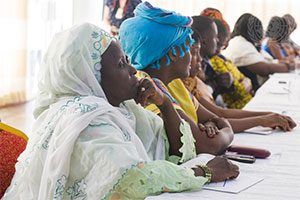 Representatives of Civil Society, Sierra Leone. Credit: UN Photo/Eskinder Debebe
Civil society faces mounting threats worldwide, even as it remains essential for democratic accountability, especially in countries struggling with economic instability and social inequality. However, at the same time, nations with weak democratic governance structures also systemically suppress the power of civil society. Human rights activists across the Global South frequently challenge issues such as political persecution and gender oppression, but in return face state-sanctioned punishment for their advocacy. Imprisonment and exile are common mechanisms of punishment that seek to erode the strength of civil society. The 2026 World Press Freedom Index has reached its lowest level in 25 years, with more than half of the world’s countries now falling into the "difficult" or “very serious” category for press freedom. IPS seeks to highlight the work of civil society across the Global South as well as the challenges that they face.
Updated by Yilan Batista and Shuli Wong August 2026

The Week with IPS

NEXT STOP - SDGs
Tracking global progress towards a sustainable world
Tracking global progress towards a sustainable world
