Languages
Wednesday, November 11, 2026



News and Views from the Global South
Civil Society

Extremists Harm Image of Islam and Pakistan
Every time, breaking news of a barbaric crime or terror act is reported from anywhere in the world, peace-loving Muslims the world over feel dejected and wish it had not been another tragedy that will make others glower at them with suspicion as though they too are complicit in the crime.
Homeless Camps, a Reflection of Growing Inequality in Chile
Camps made up of thousands of tents and shacks have mushroomed in Chile due to the failure of housing policies and official subsidies for the sector, aggravated by the rise in poverty, the covid-19 pandemic and the massive influx of immigrants.
APDA Young Leaders Devise Solutions for the Future
Whether you look at society, the environment, or technology – the world is changing rapidly. Global organizations strive to adapt to this change. The United Nations, for example, has developed the Sustainable Development Goals as a blueprint for human development.
Act to Save Children Living Precarious Lives in Cameroon’s Forgotten and Neglected Conflict
Education is under attack in Cameroon. As one of the most complex humanitarian crises in the world unfolds, Education Cannot Wait’s director Yasmine Sherif and the Secretary-General of the Norwegian Refugee Council, Jan Egeland, say the children are pawns for grown men in a political conflict.
Building a Disability-Friendly Workplace: Why Includability Matters
In her famous speech ‘The Danger of a Single Story’, Nigerian writer Chimamanda Ngozi Adichie warns us against a singular narrative of a person—a stereotype. This, Adichie asserts, is not because stereotypes are untrue, but because they are incomplete—“They make one story become the only story.” This is true in all walks of life, including in our interactions with people with disabilities at workplaces.
Volunteerism: Central to the Creation of a New Social Contract
The International Volunteer Day, on December 5, is not just one of the many internationally observed days that the United Nations commemorates annually.
School Meals Coalition Hopes to Provide a Meal to Every Child
Meals at schools not only give each child a nutritious meal but increase enrolments, among other benefits.
No Vaccine for the Pandemic of Violence Against Women in Latin America
Despite significant legal advances in Latin American countries to address gender-based violence, it continues to be a serious challenge, especially in a context of social crisis aggravated by the covid-19 pandemic, which hits women especially hard.
The Good, the Bad, the Ugly: What Went Wrong During India’s COVID-19 Response
From its devastating economic impact and the migrant crisis to the startling death toll, the COVID-19 pandemic in India unfurled one crisis after the other. The glaring gaps in our system, which had always been there, became even more prominent during the pandemic. There is one question at the back of everyone’s mind that still remains unanswered: What went wrong?
Climate Injustice at Glasgow Cop-Out
The planet is already 1.1°C warmer than in pre-industrial times. July 2021 was the hottest month ever recorded in 142 years. Despite the pandemic slowdown, 2020 was the hottest year so far, ending the warmest decade (2011-2020) ever. Betrayal in Glasgow Summing up widespread views of the recently concluded Glasgow climate summit, former Irish President Mary Robinson observed, “People will see this as a historically shameful dereliction of duty,… nowhere near enough to avoid climate disaster”.
Mother of Summits: Sweet and Sour Diplomacy, but Nothing Cooked!
It has been said that when Greek meets Greek, then comes the tug of war. The summit of the leaders of world’s two strongest powers, the United States and China, came face to face at long last. Albeit virtually. Still, this was undoubtedly the “mother of summits” this year. There were two telephone conversations earlier, but according to US officials this nearly four hours of summitry was far more “candid intense, and deeper interaction”. If there was one single take-away from this meeting, it was the establishment beyond all reasonable doubt of the incontrovertible fact that the US and China were indeed the two most influential global state actors. The decisions between the two, represented by their leaders, would profoundly impact the rest of humanity far into the future.
Citizen Leads Drive to Repatriate Temple Gods Looted from India – Podcast
 The illicit trade in idols and other historical treasures looted from temples, archaeological digs and various sites globally has been estimated at $100 billion a year.

Glasgow Summit Ends Amidst Climate of Disappointment
Developing countries will surely remember the Glasgow climate summit, the most important since 2015, as a fiasco that left them as an afterthought. That was the prevailing sentiment among delegates from the developing South during the closing ceremony on the night of Saturday Nov. 13, one day after the scheduled end of the conference.
Journalists Covering the Protest Movement in Nigeria were Beaten, Harassed & Fined by Law Enforcement
The photos showed blood-soaked concrete, a gashed open thigh, and an injured protester grimacing in pain on the ground. Taken by photojournalist Eti-Inyene Godwin Akpan on October 20, 2020, the images tell the story of Nigerian forces’ mass shooting of anti-police brutality protesters at Lagos’ Lekki Toll Gate, an incident the government continues to deny.
Social Movement Voices Fall on Deaf Ears of Governments at COP26
One element that runs through all social movement climate summits is their rejection of the official meeting of the United Nations Framework Convention on Climate Change (UNFCCC) and the low ambition of its outcomes - and the treaty's 26th Conference of the Parties (COP26) was no exception.Campaigners Petition UN to Investigate Racial and Gender Discriminations in Global COVID-19 Vaccine Roll-Out
An international coalition of human rights law groups, public health experts, and civil society organisations is taking legal action against the US, UK, Germany, Norway, and Switzerland, on the grounds that these countries are in violation of international human rights law by failing to intervene on what has been an inequitable and racially discriminatory roll-out of the vaccine and other COVID healthcare technologies.
Indigenous Peoples Want to Move Towards Clean Energy Sovereignty
In the community of Bella Bella on Turtle Island in the western Canadian province of British Columbia, the indigenous Heiltsuk people capture heat from the air through devices in 40 percent of their homes, in a plan aimed at sustainable energy sovereignty.
As a Humanitarian Crisis Engulfs Afghanistan, Education Cannot Wait Makes Urgent Appeal for Access to Quality Learning for All Children
After leading a landmark, first-ever all-women mission to Afghanistan last week, Yasmine Sherif, Director of Education Cannot Wait, the United Nations global fund for education in emergencies and protracted crises, says that schools must reopen for all children and that girls, in particular, must be able to return to secondary school classrooms.
In Glasgow, Indigenous People Pound the Table for Their Rights
"For my people, the effects of climate change are an everyday reality. The rainy season is shorter and when it rains, there are floods. And we've suffered droughts." said Hindou Oumarou Ibrahim, a member of the Wodaabe or Mbororo pastoral people of Chad.
Combating Energy Poverty in Chile with Community Inclusion
More than 90 percent of Chile's 17.5 million people have access to electricity. But many live in energy poverty because they do not have access to hot water, have unsafe connections, houses without thermal insulation and with indoor pollution, or can't afford to pay the monthly bill.
From Taliban to Taliban: Cycle of Hope, Despair on Women’s Rights
Secondary schools have reopened for boys but remain closed to the vast majority of girls. Women are banned from most employment; the Taliban government added insult to injury by saying women in their employ could keep their jobs only if they were in a role a man cannot fill—such as being an attendant in a women’s toilet. Women are mostly out of university, and due to new restrictions it is unclear when and how they can return. Many female teachers have been dismissed.« Previous Page — Next Page »





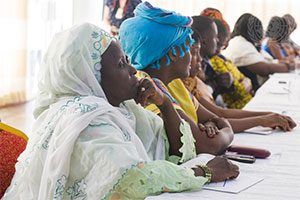 Representatives of Civil Society, Sierra Leone. Credit: UN Photo/Eskinder Debebe
Civil society faces mounting threats worldwide, even as it remains essential for democratic accountability, especially in countries struggling with economic instability and social inequality. However, at the same time, nations with weak democratic governance structures also systemically suppress the power of civil society. Human rights activists across the Global South frequently challenge issues such as political persecution and gender oppression, but in return face state-sanctioned punishment for their advocacy. Imprisonment and exile are common mechanisms of punishment that seek to erode the strength of civil society. The 2026 World Press Freedom Index has reached its lowest level in 25 years, with more than half of the world’s countries now falling into the "difficult" or “very serious” category for press freedom. IPS seeks to highlight the work of civil society across the Global South as well as the challenges that they face.
Updated by Yilan Batista and Shuli Wong August 2026

The Week with IPS

NEXT STOP - SDGs
Tracking global progress towards a sustainable world
Tracking global progress towards a sustainable world
