Languages
Monday, October 19, 2026



News and Views from the Global South
Aid

OPINION: Unleashing African Young People’s Potential
An African proverb says “a child that we refuse to build today will end up selling the house that we may build tomorrow.”
El Niño Triggers Drought, Food Crisis in Nicaragua
The spectre of famine is haunting Nicaragua. The second poorest country in Latin America, and one of the 10 most vulnerable to climate change in the world, is facing a meteorological phenomenon that threatens its food security.
Putting Population Management in Pacific Women’s Hands
Populations of many Melanesian countries in the southwest Pacific Islands region are expected to double in a generation, threatening regional and national efforts to improve low economic and human development indicators.
World’s Poorest Nations Seek Presence in Post-2015 Agenda
The 48 least developed countries (LDCs), described as the poorest of the world's poor, want to be an integral part of the U.N.'s post-2015 development agenda currently under discussion.
Amid Scepticism, U.N. Trumpets Successes in Cutting Poverty
With 17 months before the Millennium Development Goals (MDGs) reach their targets by the December 2015 deadline, the United Nations is trumpeting its limited successes - but with guarded optimism.
Single Mothers Battle on in Former War Zone
The village of Valipunam, 322 km north of Sri Lanka’s capital Colombo, occupies one of the remotest corners of the country’s former war zone. The dirt roads are impossible to navigate, there are no street lights, telephone connections are patchy and the nearest police post is miles away, closer to the centre of the battle-scarred Mullaitivu district.
For the Caribbean, a United Front Is Key to Weathering Climate Change
As the costs of climate change continue to mount, officials with the Commonwealth grouping say it is vital that Small Island Developing States (SIDS) stick together on issues such as per capita income classification.
Here Are the Real Victims of Pakistan’s War on the Taliban
Three days ago, Rameela Bibi was the mother of a month-old baby boy. He died in her arms on Jun. 28, of a chest infection that he contracted when the family fled their home in Pakistan’s North Waziristan Agency, where a full-scale military offensive against the Taliban has forced nearly half a million people to flee.
Looking to Africa’s LDCs to Learn How to Save the Lives of Millions of Mothers and their Babies
Every year, three million newborn babies and almost 6.6 million children under five die globally, but if the rest of the world looked towards the examples of two of Africa's least-developed countries (LDCs), Rwanda and Ethiopia, they would perhaps be able to save these children.
Walking Among the Victims of Pakistan’s ‘War’ on the Taliban
 It has been just two weeks since the Pakistan army began a full-blown military offensive - codenamed ‘the sword of the Prophet Muhammad strikes’ (Zarb-e-Asb) – to eradicate the Taliban from the country’s Federally Administered Tribal Areas (FATA), particularly from the sprawling North Waziristan Agency.

Ethiopia’s Somali Region Nomadic Pastoralists Benefit from Mobile Services
The pastoralists of Somali region make their living raising cattle, camels and goats. In the arid and drought-prone region, they are forced to move from place to place in search of pasture and watering holes for their animals. 
Trekking with Ethiopia’s Nomads, from Watering Holes to Pasture Lands, For a Better Life
When he was a young boy, 20-year-old Abdi, who comes from a small pastoralist community in Ethiopia’s Somali Region, “knew about school, reading and writing but did not expect this is something we would ever get close to.”
Women’s Political Representation Lagging in India
National outrage over women’s security in India – or the lack of it – is nothing new. From the gang rape of a young girl on a Delhi bus two years ago, to the recent rapes and lynching of two teenage cousins in the northern state of Uttar Pradesh, gender-based violence has claimed headlines.
Community Resilience Tops U.N.’s Disaster Relief Agenda
The Bangkok Declaration on Disaster Risk Reduction in Asia and the Pacific adopted at the close of the 6th Asian Ministerial Conference On Disaster Risk Reduction (AMCDRR) here today emphasised community-based solutions, and reflects a growing global desire to focus more on grassroots actions in the face of catastrophic climate change.
This is What Happened to the 18,000 People Forcefully Relocated to an Arid Zimbabwean Government Farm
When the Tokwe-Mukosi dam’s wall breached, so started the long, painful and disorienting journey for almost 18,000 people who had lived in the 50-kilometre radius of Chivi basin in Zimbabwe’s Masvingo province as even those not affected by the flood were removed from their homes.

When Faith Meets Disaster Management
A consortium of faith-based organisations (FBOs) made a declaration at a side event Wednesday at the 6th Asian Ministerial Conference On Disaster Risk Reduction (AMCDRR), to let the United Nations know that they stand ready to commit themselves to building resilient communities across Asia in the aftermath of natural disasters.
Tensions between CAR Refugees and Cameroonians Escalate over Depleting Resources
Central African Republic refugees living in Cameroon’s East Region are increasingly becoming frustrated about their deteriorating living conditions and their inability to support themselves as conflict between them and and local villagers has escalated over depleting resources.
Obama, Rights Groups Protest Egypt Sentencing
The administration of President Barack Obama joined international human rights groups around the world in “strongly condemn(ing)” Monday’s conviction and sentencing by an Egyptian court of three Al Jazeera journalists and 15 others for their alleged association with the outlawed Muslim Brotherhood.
Military Offensive Deepens Housing Crisis in Northern Pakistan
Shaukat Ali, a shopkeeper originally hailing from Miramshah in the Northern Waziristan Agency of Pakistan’s Federally Administered Tribal Areas (FATA), looks exhausted as he sits outside a makeshift shelter with his family of 10.
ARV Shortages Hit Mozambique’s HIV Treatment Programme
Chronic shortages of antiretrovirals across Mozambique are endangering the health and the lives of tens of thousands of HIV positive people on treatment.
Op-Ed: Overcoming the Twin Hurdles of Inequality and Climate Change
Two major injustices – inequality and climate change – are threatening to undermine the efforts of millions of people to escape poverty and hunger.« Previous Page — Next Page »





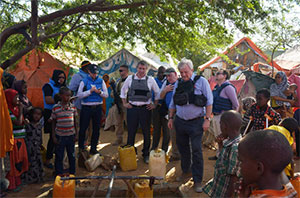 UN Emergency Relief Coordinator Visits Somalia. Credit: UN Photo/Tobin Jones
In recent years, conflicts have broken out across the world with no sign of slowing down or stopping. In times like this, millions of people globally are in dire need of humanitarian aid. Famine, warfare, natural disasters, and economic decline plague a host of nations, including Palestine, Sudan, Chad, Lebanon, and Haiti, to name a few. Humanitarian aid provides millions of people with critical services including healthcare, food, clean drinking water, psychosocial support, housing, and access to education. UN agencies such as the UNDP, UNICEF, the World Food Programme (WFP), UNHCR, UNRWA, and UNEP work with the UN Office for the Coordination of Humanitarian Aid (OCHA) and local organizations to come up with the best possible strategies to support affected communities. At the same time, humanitarian aid and those working on the frontlines are consistently threatened by both actors directly involved in conflict as well as those who are meant to contribute to the international humanitarian regime at large. The near-collapse of United States international aid structures in 2025, including the termination of 83% of USAID’s 6,300 global initiatives, has left millions of people without access to vital humanitarian assistance. 98 million people in 2025, only 65% of people targeted for humanitarian assistance, received the help they needed. In contrast, 123 million people received some form of humanitarian assistance in 2024, and OCHA’s 2026 Global Humanitarian Overview estimates that 239 million people are in need of assistance in 2026. IPS is well-positioned to discuss current initiatives to provide aid and relief through in-depth reporting and opinion content.

The Week with IPS

NEXT STOP - SDGs
Tracking global progress towards a sustainable world
Tracking global progress towards a sustainable world
