Languages
Tuesday, October 20, 2026



News and Views from the Global South
Aid

U.S. Supreme Court “Validates” Vulture Fund Activities
The U.S. Supreme Court’s decision to reject an appeal by the Argentine government will embolden aggressive “holdout” creditors, anti-poverty groups say, and make it far more difficult to arrive at debt-relief agreements for poor countries.
From Religious Conflict to an Interfaith Community
Holy men and their holy books have etched a trail of tears and blood in the annals of human history. From the depths of peaceful temples, mobs have been dispatched with flaming torches; from steeples and minarets messages of hatred have floated down upon pious heads bent in prayer. For too long religion has incited violence and fueled conflict.
Disaster-Prone Caribbean Looks to Better Financing
A freak storm, followed by heavy floods in December 2013, will go down in history as the most destructive natural disaster to have hit the Caribbean island nation of St. Vincent and the Grenadines, with reported total damages and losses of at least 103 million dollars.International Cooperation on Key Issues Fell in 2013
International cooperation on key global challenges declined in 2013, according to a new “report card” released here Friday by the influential Council on Foreign Relations (CFR).
Legislation Alone Will Not Address Africa’s Climate Challenges
Despite a raft of legislation dealing with the environment, African countries are still falling short when it comes to enforcing the legal instruments that respond to challenges posed by climate change, researchers say.
Foreign Aid Funding Luxury Hotels in Myanmar
New investments from the International Finance Corporation (IFC), the World Bank’s private-sector investment arm, may perpetuate economic inequality rather than alleviate poverty in Myanmar, critics here are warning.
Cell Phones and Cash Grants Can Promote Growth and Development
Mobile-finance and direct cash grants are revolutionary tools that can substitute for under-developed financial sectors and help reduce poverty and promote entrepreneurship in developing countries, according to researchers here.
OP-ED: Obama Signals Reset of U.S. Foreign Policy
A supertanker sails a long way, they say, between the time the helmsman sets a new course and the moment when the vessel fully responds.Obama Stresses Multilateralism over Militarism at West Point
U.S. President Barack Obama Wednesday stressed multilateralism over militarism in what was billed as a major foreign policy address and a rebuttal to an ever-louder chorus of criticism, mostly by Republicans and neo-conservatives, that his tenure has been marked by weakness and retreat.
U.S. Pledges to Reduce Child Stunting by Two Million Globally
The U.S. government has pledged to reduce the number of chronically malnourished children around the world by at least two million over the next half decade, receiving an initial positive response from the development community.
China Tightens Grip On Africa
Janice Gacheri imports handbags and shoes from China which she sells on social media sites and by word of mouth to customers in Nairobi and neighbouring towns.
OP-ED: Militarised Humanitarianism in Africa
As the world remains transfixed by the kidnapping of almost 300 Nigerian girls, there have been increasing calls for international intervention in the effort to rescue them. But what many people don’t know is that the U.S. military has been active in the region for years.
Traditional Wisdom to the Rescue in Cyclone Season
May and November bring the most vicious cyclones to the Bay of Bengal rim countries in Southeast Asia.
New Gestures to Opposition Unlikely to Change U.S. Syria Policy
Despite new gestures of support for the Syrian opposition, the administration of President Barack Obama is unlikely to change its longstanding policy of restraining U.S. involvement in the country’s more than three-year-old civil war, according to experts here.
Myanmar Wakes Up to Climate Change
Between 2008 and 2013, when Myanmar remained largely closed off to the rest of the world, it suffered a terrible toll at the hands of nature that remained largely unknown.
Displaced and Disturbed in Pakistan
Every night in his sleep, Rizwan Ahmed sees his sons being killed. “When he wakes up, he starts crying. He realises they are dead and it was the nightmare he has been having,” says Dr. Mian Iftikhar Hussain, the psychiatrist treating him.
Governments Crushing Their Own
The global spectre of state violence against political dissent, with paramilitary law enforcement units advancing against citizens they are employed to protect in cities such as Cairo, Bangkok and Kiev is daily news. But in some developing countries, the police are being used to put down indigenous opposition to the alliance of state and corporate power over resource extraction.
Obama’s Half-Pivot to Asia
President Barack Obama’s recent tour of Asia was an opportunity to reenergise his foreign policy after a series of setbacks in the global arena.
U.S. Calls Egypt’s Latest Mass Death Sentences “Unconscionable”
Five days after approving the transfer of 10 Apache helicopters to aid Egypt’s “counter-terrorism” campaign in Sinai, the administration of President Barack Obama denounced as “unconscionable” the latest round of mass death sentences against members of the Muslim Brotherhood handed down by an Egyptian court Monday.
U.S. Food Aid Reforms May Be Rolled Back
Lawmakers here may roll back recent landmark reforms to how the United States provides international food aid, despite warnings that doing so would reduce assistance for some two million people worldwide.
U.S. Apache Delivery Highlights Mixed Messaging on Egypt
Last October, the Barack Obama administration suspended the delivery of attack helicopters to Egypt’s interim government following the Jul. 2 military ouster of Egypt’s democratically elected president, Mohamed Morsi.« Previous Page — Next Page »





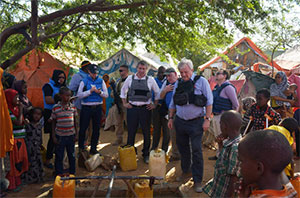 UN Emergency Relief Coordinator Visits Somalia. Credit: UN Photo/Tobin Jones
In recent years, conflicts have broken out across the world with no sign of slowing down or stopping. In times like this, millions of people globally are in dire need of humanitarian aid. Famine, warfare, natural disasters, and economic decline plague a host of nations, including Palestine, Sudan, Chad, Lebanon, and Haiti, to name a few. Humanitarian aid provides millions of people with critical services including healthcare, food, clean drinking water, psychosocial support, housing, and access to education. UN agencies such as the UNDP, UNICEF, the World Food Programme (WFP), UNHCR, UNRWA, and UNEP work with the UN Office for the Coordination of Humanitarian Aid (OCHA) and local organizations to come up with the best possible strategies to support affected communities. At the same time, humanitarian aid and those working on the frontlines are consistently threatened by both actors directly involved in conflict as well as those who are meant to contribute to the international humanitarian regime at large. The near-collapse of United States international aid structures in 2025, including the termination of 83% of USAID’s 6,300 global initiatives, has left millions of people without access to vital humanitarian assistance. 98 million people in 2025, only 65% of people targeted for humanitarian assistance, received the help they needed. In contrast, 123 million people received some form of humanitarian assistance in 2024, and OCHA’s 2026 Global Humanitarian Overview estimates that 239 million people are in need of assistance in 2026. IPS is well-positioned to discuss current initiatives to provide aid and relief through in-depth reporting and opinion content.

The Week with IPS

NEXT STOP - SDGs
Tracking global progress towards a sustainable world
Tracking global progress towards a sustainable world
