Languages
Friday, August 21, 2026



News and Views from the Global South
Energy

U.N. Climate Summit: Staged Parade or Reality Show?
The much-ballyhooed one-day Climate Summit next week is being hyped as one of the major political-environmental events at the United Nations this year.
Will Climate Change Denialism Help the Russian Economy?
The recent call from Russian Prime Minister Dmitry Medvedev for “tightening belts” has convinced even optimists that something is deeply wrong with the Russian economy.
Large Dams “Highly Correlated” with Poor Water Quality
Large-scale dams are likely having a detrimental impact on water quality and biodiversity around the world, according to a new study that tracks and correlates data from thousands of projects.
Mexico’s Wind Parks May Violate OECD Rules
Four wind farm projects in the southern Mexican state of Oaxaca, operated or financed by European investors, could violate Organisation for Economic Cooperation and Development (OECD) rules, say activists.
Climate Policy Goes Hand-in-Hand with Water Policy
Concerned that climate change could lead to an intensification of the global hydrological cycle, Caribbean stakeholders are working to ensure it is included in the region's plans for Integrated Water Resources Management (IWRM).
Threat of Hydropower Dams Still Looms in Chile’s Patagonia
After its victory in a nearly decade-long struggle against HidroAysén, a project that would have built five large hydroelectric dams on wilderness rivers, Chile’s Patagonia region is gearing up for a new battle: blocking a quiet attempt to build a dam on the Cuervo River.
OPINION: Boosting Resilience in the Caribbean Countries
Having lived and worked for more than a decade in four Caribbean countries, I have witnessed firsthand how Small Island Developing States (SIDS) are extremely vulnerable to challenges ranging from debt and unemployment to climate change and sea level rise.
The Time for Burning Coal Has Passed
“People have gathered here to tell their politicians that the way in which we used energy and our environment in the 19th and 20th centuries is now over,” says Radek Gawlik, one of Poland’s most experienced environmental activists. “The time for burning coal has passed and the sooner we understand this, the better it is for us.”
U.N. Conference Set to Bypass Climate Change Refugees
An international conference on small island developing states (SIDS), scheduled to take place in Samoa next week, will bypass a politically sensitive issue: a proposal to create a new category of "environmental refugees" fleeing tiny island nations threatened by rising seas.
Dumping Ban Urged for Australia’s Iconic Reef
Increased effort is needed to protect Australia’s iconic Great Barrier Reef, which is in serious decline and will likely deteriorate further in the future, according to a new report.
Churches at the Frontline of Climate Action
Johannes Kapelle has been playing the organ in the Protestant church of Proschim since he was 14. The 78-year-old is actively involved in his community, produces his own solar power and has raised three children with his wife on their farm in Proschim, a small village of 360 inhabitants in Lusatia, Germany.
Island States to Rally Donors at Samoa Meet
Amid accelerating climate change and other challenges, a major international conference in the South Pacific island nation of Samoa next month represents a key chance for Small Island Developing States (SIDS) in the Caribbean to turn the tide.
What Do the World Bank and IMF Have to Do With the Ukraine Conflict?
Mostly unreported as the Ukraine conflict captures headlines, international financing has played a significant role in the current conflict in Ukraine.
Chile’s Patagonia Seeks Small-Scale Energy Autonomy
The southern region of Aysén in Chile’s Patagonian wilderness has the highest energy costs in the entire country. And the regional capital, Coyhaique, is the most polluted city in the nation, even though it has huge potential for hydroelectricity and wind power.
Swamped by Rising Seas, Small Islands Seek a Lifeline
The world's 52 small island developing states (SIDS), some in danger of being wiped off the face of the earth because of sea-level rise triggered by climate change, will be the focus of an international conference in the South Pacific island nation of Samoa next month.
OPINION: Happy Birthday “UNO-City” – UN’s Vienna Headquarters Marks 35th Anniversary
Austrians call it “UNO-City”. The United Nations calls it the Vienna International Centre (VIC). Both names give a hint of the scale and scope of the U.N’s headquarters in the Austrian capital, but not the full story.
Will Obama’s “New Africa” Deliver on Its Promises?
As the three-day U.S- Africa Leaders Summit here drew to a close Wednesday, experts across the private, public and non-profit sectors continued to debate the opportunities and obstacles posed by the U.S’ expanding business partnership with Africa.
Asia Looks to Innovation to Achieve Sustainability
Innovation in the fields of renewable energy, food production, water conservation, education and health will be crucial for the developing economies of Asia to meet the United Nations’ Sustainable Development Goals (SDGs).
Chile Taps Solar Thermal Energy with Latin America’s First Plant
With the first solar thermal power plant in Latin America, Chile hopes to begin to alleviate its energy crisis, which threatens to further drive up the high cost of electricity and to hinder the growth of investment, especially in the mining industry.
Bringing “Smart” Building Technology to Jamaica’s Shantytowns
Buildings are among the largest consumers of earth’s natural resources. According to the Sustainable Buildings and Climate Initiative, they use about 40 percent of global energy and 25 percent of global water, while emitting about a third of greenhouse gas emissions.
Will Climate Change Lead to Conflict or Cooperation?
The headline of every article about the relationship between climate change and conflict should be “It’s complicated,” according to Clionadh Raleigh.« Previous Page — Next Page »


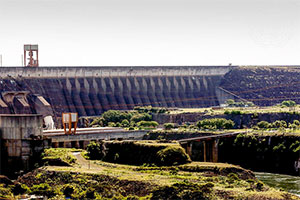 UN Power Plant, Paraguay. Credit: UN Photo/Evan Schneider
Energy has posed a great challenge for economies around the world. As global energy consumption skyrockets throughout the years, so does the need for sustainable solutions. The Sustainable Development Goals are essential in providing people with access to safe, affordable, and sustainable energy sources that minimize harm on the planet. Progress towards these goals opens the door for an advancement in modernization for communities on a global level and allows for a potential mitigation of tensions between nations.
The UN’s Summit of the Future in 2024 offered new initiatives that are being taken to achieve these goals, including a decreased reliance on fossil fuels, a switch to renewable energy sources, and improved climate financing.
IPS is well positioned to provide relevant, insightful, and compelling analysis of recent updates and measures being taken around the world to achieve a cleaner future.

The Week with IPS

NEXT STOP - SDGs
Tracking global progress towards a sustainable world
Tracking global progress towards a sustainable world
