Languages
Friday, November 6, 2026



News and Views from the Global South
Humanitarian Emergencies

Undocumented Afghan Women Fear Eviction from Pakistan
Amid a looming threat of forceful eviction, Afghan women who arrived in Pakistan after the Taliban’s takeover in Kabul have asked the host country to allow them to stay because they want to continue their education.
Alarm Raised as Israel’s Ground Military Invasion, Blockade of Gaza Strip Looms
It is a bloodbath and unmitigated mayhem as heavy fighting unfolds between Israeli forces and the Palestinian group Hamas which has taken the world by surprise. Amidst raids, rockets and sustained fierce gunfire, bombs, and death, a humanitarian crisis is unfolding. Now, both sides are warned to consider the impact of their actions on the civilian population.
Afghan Women Speak Out About Life and Resistance Two Years After the Taliban Takeover
The Taliban takeover of Afghanistan on 15 August 2021 has devastated millions of Afghans. But women and girls have been particularly affected by progressively restrictive decrees that have created a virtual system of gender apartheid.
Kerala Proved Good Governance Vital in a Pandemic
When COVID-19 claimed millions of lives across India, Kerala state at the southern tip of the subcontinent stood apart for low mortality rates that experts attribute to good governance, a robust public health delivery system and strong civil society support.
In Brazil, Indigenous Leaders and Youth Activists Fight To Protect Amazon
Raffaello Nava, a youth and student activist, has fled his home at the peak of the global Coronavirus pandemic after receiving death threats from multinational companies that invaded his ancestral lands in the Amazon rainforest.
Open Migration Flows and Closed-Up Houses in Venezuela
Gladys swore she would not cry in front of her small children, but she still had to wipe away a couple of tears when she turned her head and looked, perhaps for the last time, at her dream house on Margarita Island in Venezuela, from where she migrated, driven by a lack of income and by fear.
Record-Breaking Global Migration
On 14 June, the UN High Commissioner for Refugees (UNHCR) issued his flagship annual report, Global Trends: Forced Displacement 2022. It states that by the end of 2022, the number of people displaced by war, persecution, violence and human rights abuse had dramatically increased by 19.1 million — the biggest increase on record — reaching a total of 108.4 million.
Peacekeeper Cecilia Erzuah Promotes Gender Equality by Example
Cecilia Erzuah was torn between two opposite career paths at the end of university. The week she was supposed to begin military training, her professor offered her a position as an assistant to a lecturer.
Wrecked by Climate Change, Farmers in Kashmir Shift to Lavender Cultivation
Mohammad Subhan Dar diligently tends to some bright purple plants on a four-acre farm in Bijbehara, a hamlet south of Kashmir’s capital, Srinagar. As you draw nearer, you’ll be mesmerized by the sight of sprawling lavender fields, where about 10 to 15 farmers, including Dar, prepare for a promising harvest.
Peru Faces Challenge of Climate Change-Driven Internal Migration
Nearly 700,000 people have migrated internally in Peru due to the effects of climate change. This mass displacement is a clear problem in this South American country, one of the most vulnerable to the global climate crisis due to its biodiversity, geography and 28 different types of climates.
Zimbabwe’s Food Security Ambitions in El Niño’s Crosshairs
Zimbabwe is riding a wave of food security assurances after what officials said was last year’s bumper grain harvest, but recent El Niño forecasts could test the country’s agriculture production ambitions.
Skyrocketing Inflation Puts Food Security in Pakistan at Risk
“We are under extreme stress about skyrocketing prices of essential edible commodities and the cost of gas and electricity. The situation is becoming worse because every day. We must pay more for wheat flour, sugar, tea, milk, oil, etc.,” Azizullah Khan, a civil servant, says.
Why Floods ‘Beyond Our Imagination’ Hit Nepalese Himalayan Town
When a flash flood descended on a Himalayan community in the Mustang district in Nepal, it shocked the residents, climate change experts, and disaster risk management. Anil Pokharel described it as "beyond our imagination." He has experienced many disasters as the Chief Executive at the National Disaster Risk Reduction and Management Authority for the Government of Nepal.
Barriers to Movement are the Never Ending Normal for Palestinians
Sundus* scans the news before she heads home, checking for signs that her 30-minute commute could turn into a four-hour-long slog. Any incident could make travel difficult. Sometimes Sundus waits for her father to call and tell her if the checkpoints around their home are open. After living in Hebron, a city in the West Bank, for the last 20 years, she is used to planning her day around unpredictability.
Multilingual #AfghanGirlsVoices Campaign to Return Millions Back to School
A Taliban edict is rolling back time in Afghanistan after access to education for all Afghan girls over the age of 12 was indefinitely suspended on September 18, 2021. Afghanistan is the only country in the world where girls are forbidden from attending school beyond the primary level, leaving more than 1.1 million girls and young women without access to formal education.
Human Trafficking: Women Lured by Promise of Jobs, Sold as Brides
It has been over a decade since 32-year-old Rafiqa (not her real name) was sold to a villager after being lured by the promise that she would be employed in the handicrafts industry of Indian-administered Kashmir.
ECW’s New Report Shows Successful Education Funding Model for Crises-Impacted Children
In a world set on fire by climate change and brutal conflict, millions of children in emergencies and protracted crises need educational support. Children in 48 out of 49 African countries are at high or extremely high risk of the impacts of climate change, particularly in the Central African Republic, Chad, Nigeria, Guinea, Somalia, and Guinea Bissau.
Safe, Regular & Orderly Migration for Inclusion and Sustainability
In Asia and the Pacific, migration is again on the rise. In 2020, almost 109 million people lived in a country other than that of their birth. They represented 2.3 per cent of the region’s population in 2020 and almost 38 per cent of the world’s international migrants.
Africa Finds Common Ground on Climate as Nairobi Declaration Unveiled
To cool down a burning planet, Africa’s Head of State and Government at the inaugural Africa Climate Summit unveiled the ‘Nairobi Declaration’ as curtains fell on the inaugural Africa Climate Summit held in Nairobi, September 4-6, 2023, under the theme “Driving Green Growth and Climate Finance Solutions for Africa and the World.”
Toothless Global Financial Architecture Fuelling Africa’s Climate Crisis
As thousands convene in Kenya’s capital, Nairobi, for the Africa Climate Summit, the first time the African Union has summoned its leaders to solely discuss climate change under the theme ‘Driving Green Growth and Climate Finance Solutions for Africa and the World’, the backdrop is a country on the frontlines of a climate crisis.
Lawmakers Call on G20 to Prioritise Spending on Youth, Gender, and Human Security
Legislators from around the world, this week, officially submitted to the Sherpa of the G20 meeting set for September in New Delhi a declaration calling on governments to prioritise spending on ageing, youth, gender, human security, and other burning population issues.« Previous Page — Next Page »





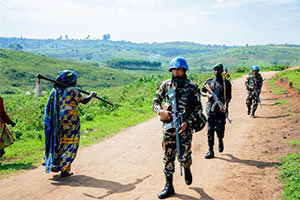 MONUSCO Peacekeepers and FARDC Soldiers Patrol Fataki Area. Credit: UN Photo/Jorkim Jotham Pituwa
Conflict, human rights violations, natural disasters, and famine have been at the forefront of concerns for humanitarian organizations. The escalation of humanitarian crises has led to over 239 million people in need of humanitarian assistance at the start of 2026, as estimated by OCHA’s Global Humanitarian Overview. The 2025 humanitarian appeal received only $12 billion, the lowest funding in over a decade, which has left 24 million fewer people reached in comparison to 2024. Conflict has remained the primary driver of crisis.
Humanitarian emergencies massively impact progress towards the Sustainable Development Goals (SDGs), adversely affecting economic development, inequality, education, planetary well-being, and poverty. Millions of people are faced with reduced access to essential services, including shelter, food, healthcare, and access to clean drinking water. UN Organizations such as UNHCR and the United Nations Children’s Fund (UNICEF) are committed to providing direct relief to affected communities when state governments cannot.
The United Nations 2024 Summit of the Future discussed measures that will be taken to reduce global inequality and promote peacekeeping efforts around the world. The recent UN Climate Change Conference (COP30) in Belém, Brazil, agreed to mobilize $1.3 trillion annually for climate action by 2035, operationalize the loss and damage fund, and triple adaptation finance. However, a fossil fuel transition commitment was not secured, despite climate change and the greenhouse effect being major contributors to humanitarian crises worldwide.
Countries across the world have also rallied to end humanitarian crises, as witnessed in conflicts such as Palestine and Ukraine. IPS is committed to providing relevant and in-depth reports of humanitarian emergencies around the world and their implications.

The Week with IPS

NEXT STOP - SDGs
Tracking global progress towards a sustainable world
Tracking global progress towards a sustainable world