Languages
Monday, May 4, 2026



News and Views from the Global South
Humanitarian Emergencies

UN Agencies Call to Commit to Transforming Education in Crises
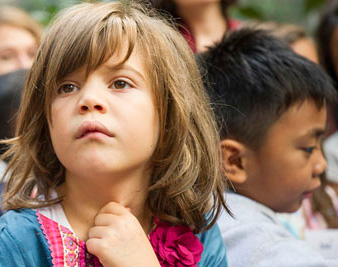
Refugee youth advocate, Mary Maker, called on UN member states to honor their commitments to transform education from the foundation up to the top, starting with those living in the direst and fraught circumstances.
Killings, Abductions Fuel Fear of Taliban Return in North-West Pakistan
The killing of eight people by the outlawed Tehreek Taliban Pakistan on September 13 has given credence to the fear of a new wave of terrorism in the Swat district of Khyber Pakhtunkhwa.
Unsettled Lives in a Troubled World
Cross-continent vacations seem to be the norm once again with the lessening of COVID-19 while new cities are being built with skyscraping $4M condos shooting up in a matter of months, and just-out-of-University millennials launching into their careers with minimum start-off salaries of $75K.
Building Leadership for Teachers in the Developing World
If we truly want to re-imagine the role education can play in the decades to come, it is going to be indispensable to take drastic measures to elevate the role of teachers in developing countries.
As New Covid Boosters Move Forward, Better Outreach is Needed to Save US Lives
This week––nearly ten months after the emergence of the Omicron variant––the United States is rolling out Covid-19 booster vaccines that specifically target newer, now-dominant strains of the virus.
Inequitable Global Health Responses Underscore Need for More Self-Sufficiency in Developing Countries
With the outbreak of Monkeypox in non-endemic countries leading to a scramble for vaccines, global health advocates are again calling for equity to be prioritized in the international response.
Pakistan’s Climate Catastrophe: Lessons for the World
Monsoon flooding has occurred often in Pakistan but never to the catastrophic extent presently happening. A distinguishing feature of this disaster is that no one blames the flooding’s unprecedented intensity and destructiveness on anything but climate heating. The clear link between the warming atmosphere and the frequency and duration of extreme weather events of this scale should not be lost on the rest of the world.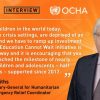
Education Cannot Wait Interviews Martin Griffiths, Under-Secretary-General for Humanitarian Affairs and Emergency Relief Coordinator
United Nations Secretary General António Guterres appointed Martin Griffiths of the United Kingdom as Under-Secretary-General for Humanitarian Affairs and Emergency Relief Coordinator in May 2021.

Mental Health as a Human Right Left Behind for Children in Fragile and Humanitarian Settings
Hiding in basements during bombings, fleeing their homes, going hungry, and facing the devastating and life-transformative traumas of losing their loved ones as their childhoods go up in flames of war. These are the lived experiences of crisis-impacted children and adolescents.
Humanitarian Crisis Unfolds With Pakistan in the Eye of Fiercest Climate Change Storm
 The heavy and incessant monsoon downpours across Pakistan in the last two months have triggered floods wreaking havoc across the country, submerging entire villages and vast tracts of land and entrapping people. Anything coming in the way of the relentless water is being destroyed, including roads, bridges, and standing crops.
The World Owes the Rohingyas their Right to Human Dignity
It has been five years since the forced exodus of the Rohingyas from Myanmar, and their plea for justice and accountability continues.
Keeping Hope Afloat in a Sea of Uncertainty
“I think I’m making a difference. I’m really helping,” Hanadi tells me, as she reflects on her work in the Za’atari refugee camp in Jordan.
UN Labour Report Highlights Employment Challenges for Youth
When COVID-19 prompted economic shutdowns across the globe, many analysts predicted that youth would be especially at risk. This is because young people tend to have fewer economic assets and limited experience in the labor market.
A Stress Test for Nuclear Deterrence
This month, the Tenth Review Conference of the Non-Proliferation Treaty (NPT) is taking place in New York (and scheduled to conclude August 26). The meeting of states parties, postponed four times because of the Covid-19 pandemic, had originally been scheduled for April 2020.
Funding Urgently Needed for Children’s Education in Conflict Areas—ECW Director
Yasmine Sherif, Director of Education Cannot Wait (ECW) issued a wake-up call for the global community to support efforts on facilitating education in crisis areas. She was speaking at the United Nations at the launch of the global fund's annual report titled We Have Promises to Keep.
Keeping the Promise of Education for Crisis-Impacted Children and Adolescents
Syrian refugee children are among the most disadvantaged in Iraq. Even before the COVID-19 pandemic, only 53 percent of school-aged Syrian refugee children in the country were enrolled.
Starvation Pounds Inflation-Hit Urban Zimbabweans
With inflation at 256.9 percent, 49-year-old Dambudzo Chauruka can no longer afford to buy bread despite working as a civil servant in Zimbabwe.
Afghanistan: What Went Wrong?
After the horrendous tragedies of 9/11 in the year 2001, the US intervened in Afghanistan. Promising statements such as "we are going to smoke them [Al-Qaeda and their Taliban protectors] out" and "we are after ending terrorism" received warm receptions.
Tapping into the Power of Young People for Climate Action
Today, our world is 1.1°C warmer than it was in the pre-industrial era, and failure to act urgently could possibly result in increases of 1.5°C-2°C between 2026 and 2042. Climate change poses a serious risk to the fundamental rights of people of every age.
Global Public Investment: Time to Build the Movement Now
Global Public Investment. A short and simple phrase. But one that means so much. At its most basic, GPI means public money being used to invest in goods and services that are of global benefit. There is no shortage of goods and services that need GPI, whether they be used to prevent or respond to environmental catastrophe, international war and conflict, or the next pandemic.
Refugees Face Often Neglected Mental Health Challenges – Report
While refugees globally face insecurity and uncertainty, a new World Health Organization (WHO) report highlights that they also face poorer health outcomes.« Previous Page — Next Page »