Languages
Sunday, October 4, 2026



News and Views from the Global South
Population

The Nairobi Summit Is about the Future of Humanity and Human Prosperity
As we count down the remaining days to the opening of the Nairobi Summit or the International Conference for Population and Development(ICPD), I am confounded by how much humanity has managed to simultaneously empower more women than at any other time in history, while at the same time failing to see that ‘women’s issues’ are actually ‘everyone’s issues’.
No Region is Immune from Rising Inequalities, Trade Tensions & Declining Growth Rates
We are facing tense and turbulent times around the globe. Rising inequality is a danger everywhere. Trade and technology tensions are building. Growth forecasts are being revised down. Unease and uncertainty are going up. This is a global phenomenon. No region is immune.
Locked Out – Nigeria’s Trafficked Children Have Never been to School
 “Human trafficking is when someone is taken from Nigeria to another country to be a prostitute. Or, to do other illegal jobs that are not good for humanity,” said Kingsley Chidiebere, a commercial motorcycle rider in Nigeria’s commercial capital, Lagos.

Africa Watch: Morocco Tourism Gains Momentum
The crème de la crème of Hollywood was in Marrakech, Morocco, for the wedding of British movie star Idris Elba in April this year. Elba tied the knot with his Canadian model girlfriend, former Miss Vancouver Sabrina Dhowre, at the Ksar Char-Bagh hotel, an exquisite Alhambra-style hotel.
How Can We All Hear That the World is on Fire?
The annual rhythm of the United Nations year peaks with the General Assembly in September. One month on, it’s a good time to reflect on this year’s gathering which was remarkable for its focus on fighting climate change, the transforming effect of one 16 year old girl telling it like it is, and the way people heard her words in a way they haven’t heard before.
Mother Earth’s Café Dares Climate Crises in India
The sun has barely risen when Phlida Kharshala shakes her 8-year-old grandson awake. He hoists an empty cone-shaped bamboo basket on his back, sets the woven strap flat across his forehead and off they go into the wilderness.
Climate Change to Further Escalate Violence in Western Africa
Nearly 50 million people in west Africa rely on agriculture and livestock for their livelihood but the land available for pastoral use has been rapidly shrinking.
Bangladesh’s Climate Change Victims Safeguard the Sundarbans’ Endangered Dolphins
Israfil Boyati lives along the shoreline of the Bay of Bengal. In the past he used to catch fish in the canals and rivers of Bangladesh’s Sundarbans mangrove forest — one of the world’s largest and habitat to many endangered species, including the Bengal tigers and freshwater dolphins.
Governments & Internet Companies Fail to meet Challenges of Online Hate
The prevalence of online hate poses challenges to everyone, first and foremost the marginalised individuals who are its principal targets. Unfortunately, States and companies are failing to prevent ‘hate speech’ from becoming the next ‘fake news’, an ambiguous and politicised term subject to governmental abuse and company discretion.
Solar Energy Transforms Villages in Argentina’s Puna Highlands
"On moonless nights it was very difficult to walk around this town," says Celia Vilte, a teacher from San Francisco, a highlands village of just 54 people in the extreme northwest of Argentina whose centre is not a town square but 40 solar panels, which provide one hundred percent of its electricity.
Private Finance and Agenda 2030: Way Off-Track
Four years ago, UN member states proclaimed their ambitions for development in a document named “Transforming Our World”, also known as Agenda 2030. Today, according to several assessments including of the UN’s inter-agency task force on financing for development (FfD) transformation has fallen off-track. It has received too little money, political commitment and action to change the workings of the global economy. Agenda 2030 spells out the Sustainable Development Goals (SDGs) needed to ‘transform our world’.
Agro-tech Offers Answers for African Farmers at Iowa Meet
Experts vaunted new strains of seeds, drone aircraft and other technological breakthroughs as solutions-in-the-making for farmers in Africa, where hunger, drought and food price hikes are continent-wide problems.
Huge moment for Ethiopia as Abiy Ahmed wins Nobel Peace prize
Ethiopia found itself in the global spotlight for all the right reasons after Abiy Ahmed, its young, dynamic prime minister was awarded the Nobel Peace Prize.
For Some in Kashmir Marriage Equates to Sexual Slavery
Haseena Akhtar was only 13 when an agent told her parents that they could earn a good amount of money by letting her marry a Kashmiri man. The man was, however, three times older than Akhtar, the agent said.
Abortion Remains an Unresolved Issue: ICPD25 Meeting next Month
Currently, the topic of abortion as human rights leaves the world bustling. When the state of Alabama1 in the United States enacted a very strict ban on abortion, it shocked the world. This prompted so-called conservative movements, led by female business owners, to make a full-scale advertisement in the New York Times claiming abortion is a human right2 ; hence the global debate between pro-life and pro-choice.
The Most Important Meeting You’ve Never Heard Of — & the Grand Challenge on Inequality
Last month 195 world leaders once again met in New York for big speeches and grand events. But on inequality, when all is said and done, more has been said than done.
Global Climate Change Investment Heavily Tilted Towards Mitigation and Low on Adaptation
Good news: the graph depicting climate investments has been steadily increasing. Climbing from the 2012 figure of $360 billion in climate investments across the world to close to $600 billion currently.
Hollywood and Business Luminaries Spotlight World’s ‘Stateless’ Woes
Movie star Cate Blanchett and businessman Richard Branson spoke up this week for the millions of people around the world who cannot get passports and other papers because they lack an official nationality.
Afghan War Deadly for Children Despite Peace Process: UN
The United Nations has warned that the past four years were among the deadliest for children in Afghanistan since the United States-led invasion of 2001, with nearly 13,000 youngsters killed and injured in that period.
Can We Feed the World and Ensure No One Goes Hungry?
Enough food is produced today to feed everyone on the planet, but hunger is on the rise in some parts of the world, and some 821 million people are considered to be “chronically undernourished”. What steps are being taken to ensure that everyone, worldwide, receives sufficient food?
Human Trafficking – It Came Disguised as the Opportunity of a Lifetime
Six years ago Mary Njambi* received news of a once-in-a-lifetime job opportunity far away from her poverty-stricken village situated in the heart of Kiambu County, Central Kenya. She was 20 years old, a single mother and out of work.« Previous Page — Next Page »


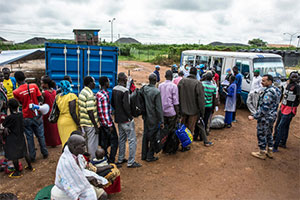 One Thousand Internally Displaced Persons (IDPs) Relocated from Tomping Camp in South Sudan. Credit: UN Photo/Isaac Billy
It took hundreds of thousands of years for the world’s human population to cross one billion in 1804. Approximately 200 years later, the population has multiplied sevenfold. In 2023, the global population crossed 8 billion, and is expected to reach 9 billion before 2050. With the planet more crowded than ever, it is essential to keep track of population trends, urbanization, migration, and reproduction across the world.
Life expectancy has seen significant strides in the past century, largely due to economic development and increased standards of living. On the contrary, trends in global fertility are shifting, with certain regions in Africa and Asia reporting higher rates, while parts of Europe and North America report stagnant or lower rates. This is in part due to differences in sexual and reproductive healthcare, as well as societal and economic conditions around the world. For example, child marriage is prevalent in certain societies, where childbearing is also considered a familial duty. Meanwhile, stagnating economies frequently experience lower marriage and childbearing rates.
The increase in migration and urban development around the world is also linked to global population trends. By 2050, it is expected that approximately 66 percent of all people will live in cities. Furthermore, global crises such as warfare and natural disasters also prompt transnational migration. Transnational migration is linked to a variety of socioeconomic issues in both host and receiving countries: migrants often leave developing countries with less access to educational and economic opportunities and arrive in developed countries where they are frequently the targets of ethnic, racial, and cultural discrimination, and economic exploitation. Recent crises in Europe and the United States demonstrate the importance of advocating for migrants worldwide. As migrants from the Global South are increasingly stripped of their legal and civic rights in unlawful deportations, or targeted in acts of identity-based violence, it is essential to keep track of population trends and protect the human rights of migrant populations. Climate-related disasters are now a major driver of displacement, with nearly half of all new internal displacements in 2025 being disaster-related.
IPS is devoted to covering issues surrounding population trends, migration, and reproduction through its compelling articles, which use both statistics and human stories to provide readers with robust and informative viewpoints.

The Week with IPS

NEXT STOP - SDGs
Tracking global progress towards a sustainable world
Tracking global progress towards a sustainable world
