Languages
Friday, October 23, 2026



News and Views from the Global South
Population

New Alliance to Shore Up Food Security Launched in Africa
As over 20 million sub-Saharan Africans face a shortage of food because of drought and development issues, representatives of the U.N. Food and Agriculture Organisation (FAO) and the Pan African Parliament (PAP) met in Johannesburg to forge a new parliamentary alliance focusing on food and nutritional security.
Climate and Terrorism
The media are increasingly reporting events in a basic manner, and have by and large abandoned the process of deep analysis. Now is the moment to focus our attention on terrorism. This topic be will remain a pressing issue for quite some time. We now know that terrorism has many causes, which can be rooted in religion to feelings of social exclusion and from a desire for glory to the actions of a damaged psyche.
Newly Empowered Black Farmers Ruined by South Africa’s Drought
Almost half a decade of drought across most of South Africa has led to small towns in crisis and food imports for the first time in over 20 years, as well as severely hampering the government’s planned land redistribution programme.
Chronic Hunger Lingers in the Midst of Plenty
In a fraught global economic environment, exacerbated by climate change and shrinking resources, ensuring food and nutrition security is a daunting challenge for many nations. India, Asia's third largest economy and the world's second most populous nation after China with 1.3 billion people, is no exception.
Urban Land – a Key Building Block to Full Rights
Now that the wind no longer blows her roof off and her house belongs to her, Cristina López feels safe in the shantytown where she lives on the outskirts of the Argentine capital. But she and her neighbours still need to win respect for many more rights they have been denied.
No Medals for Sanitation at Rio Olympics
The biggest frustration at the Olympic Games, to be inaugurated in the Brazilian city of Rio de Janeiro on August 5, is the failure to meet environmental sanitation targets and promises in the city’s beaches, rivers, lakes and lagoons.
Climate Migrants Lead Mass Migration to India’s Cities
Deepa Kumari, a 36-year-old farmer from Pithoragarh district in the Himalayan state of Uttarakhand, lives in a one-room tenement in south Delhi's Mongolpuri slum with her three children. Fleeing devastating floods which killed her husband last year, the widow landed up in the national capital city last week after selling off her farm and two cows at cut-rate prices.
How Did We Arrive at This Chaos?
A Chinese curse is “May you live in interesting times”. That meant that too many events would disrupt the essential elements of harmony, on which the Chinese pantheon is based. We certainly live in very interesting times where every day dramatic events pile on us, from terrorism to coup d’etat, from climate disaster to the decline of institutions and ever increasing social turmoil. It would be important, even if very difficult, to look in a nutshell why we are in this situation now - "lack of harmony" . So here goes a dramatically compressed explanation.
400 Million People Live with Hepatitis But They Do Not Know
With some 400 million people around the world infected with hepatitis B or C, mostly without being aware, the United Nations top health agency encourages countries to boost testing and access to services and medicines for people in need to combat the 'ignored perils' of this disease.
Uganda Ill-Equipped for Growing Cancer Burden
Lying on a dirty bed in a crowded, squalid hostel in Kampala, emaciated Jovia, 29, managed a weak smile as a doctor delivered her a small green bottle containing a liquid.
Biodiversity, GMOs, Gene Drives and the Militarised Mind
A recent report from the National Academy of Science of The United States, titled Gene Drives on the Horizon : Advancing Science, Navigating Uncertainty, and Aligning Research with Public Values”, warns:
Rewriting Africa’s Agricultural Narrative
Albert Kanga Azaguie no longer considers himself a smallholder farmer. By learning and monitoring the supply and demand value chains of one of the country’s staple crops, plantain (similar to bananas), Kanga ventured into off-season production to sell his produce at relatively higher prices.
Women Empowerment Holds the Key for Global Development
Latin America's inclusion of women in its development model, with greater participation within the work force and improved wage conditions, was a decisive factor in the region's successful diminishment of extreme poverty.
Entrenched Inequalities
Do a girl born in a poor household in rural Balochistan and a boy born in a rich household in Karachi have the same or even a similar set of opportunities in life? Are their chances of acquiring an education similar? Do they have access to comparable healthcare services and facilities? Do they have equal opportunities for access to physical infrastructure and the freedom of movement and association?
Indigenous Villages in Honduras Overcome Hunger at Schools
Barely 11 years old and in the sixth grade of primary school, this student dreams of becoming a farmer in order to produce food so that the children in his community never have to go hungry. Josué Orlando Torres of the indigenous Lenca people lives in a remote corner of the west of Honduras.
New Study on Earthquake
A new study using ground and satellite GPS monitors have concluded that the north-eastern corner of the Indian subcontinent encompassing Bangladesh, eastern India and parts of Myanmar is at risk of a major earthquake, and the effect when it occurs would be on a massive scale (8.2 to 9 on the Richter scale). The study conducted at the Lamont-Doherty Earth Observatory at Columbia University should be taken seriously, particularly by Bangladesh which has several issues going against it in the event of a major quake.
Large-Scale Rainwater Harvesting Eases Scarcity in Kenya
Rainwater harvesting in Kenya and other places is hardly new. But in this water-stressed country, where two-thirds of the land is arid or semiarid, the quest for a lasting solution to water scarcity has driven useful innovations in this age-old practice.Global Coalition Seeks Ban on Mercury Use
A coalition of over 25 international non-governmental organizations (NGOs) has launched a global campaign to end a longstanding health and environmental hazard: the use of mercury in dentistry.
The Future of Food in Cities: Urban Agriculture
Habitat III, the UN’s conference on cities this coming October will explore urban agriculture as a solution to food security, but here in New York City, it has shown potential for much more.
Rethinking the Population Problem
With the knowledge that Bangladesh's population - which was about 75 million in 1971 - now stands bloated to more than 160 million, all crammed into a land area of only 50,260 sq miles and that the population density is already five times that in any other 'mega' country, contemplate the following scenarios and see if you want to picture the country with any further addition to its population. A population that renders running trains to become invisible under loads of humanity spilling out of their interiors and clinging to all over their exteriors, while carrying people to their homes in the countryside on the eve of Eids; traffic jams resulting into prolongation of say a 30-minute trip in the cities to an absurd three-hour trip; unbridled population increase that has already brought down the per capita land to 24 decimals or less and cultivable land to some 11 decimals; law courts reeling under the unwieldy burdens of hundreds of thousands of civil and criminal suits; innumerable daily occurrences of land-related disputes, countless crimes and murders; dying and moribund rivers; desertification and salinity intrusion from the sea; dire inadequacy of water supply causing distress to an enormous segment of the urban and rural population; a catastrophe from the rising sea-level looming large and threatening to submerge one-third of the land area of the country, which could thus engender the need to move and rehabilitate over 50 million internal migrants in the remaining two-thirds of the country's land territory, which could in turn raise the already high population density to an absurd level; fast-shrinking agricultural and cultivable land due to unplanned and uncontrolled urbanisation, industrialisation, infrastructural and development projects implementation; increasing cost of living, healthcare and education, and rampant and ubiquitous corruption and unscrupulousness; admission of even infants to schools depending on lottery and parents' capability to pay donations and; myriads of such other woes afflicting our daily life.
Latin American Development Depends On Investing In Teenage Girls
Latin America’s teenage girls are a crucial force for change and for promoting sustainable development, if the region invests in their rights and the correction of unequal opportunities, according to Luiza Carvalho, the regional head of UN Women.« Previous Page — Next Page »





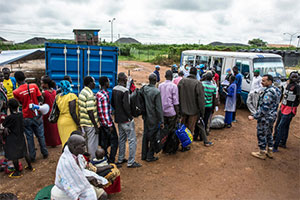 One Thousand Internally Displaced Persons (IDPs) Relocated from Tomping Camp in South Sudan. Credit: UN Photo/Isaac Billy
It took hundreds of thousands of years for the world’s human population to cross one billion in 1804. Approximately 200 years later, the population has multiplied sevenfold. In 2023, the global population crossed 8 billion, and is expected to reach 9 billion before 2050. With the planet more crowded than ever, it is essential to keep track of population trends, urbanization, migration, and reproduction across the world.
Life expectancy has seen significant strides in the past century, largely due to economic development and increased standards of living. On the contrary, trends in global fertility are shifting, with certain regions in Africa and Asia reporting higher rates, while parts of Europe and North America report stagnant or lower rates. This is in part due to differences in sexual and reproductive healthcare, as well as societal and economic conditions around the world. For example, child marriage is prevalent in certain societies, where childbearing is also considered a familial duty. Meanwhile, stagnating economies frequently experience lower marriage and childbearing rates.
The increase in migration and urban development around the world is also linked to global population trends. By 2050, it is expected that approximately 66 percent of all people will live in cities. Furthermore, global crises such as warfare and natural disasters also prompt transnational migration. Transnational migration is linked to a variety of socioeconomic issues in both host and receiving countries: migrants often leave developing countries with less access to educational and economic opportunities and arrive in developed countries where they are frequently the targets of ethnic, racial, and cultural discrimination, and economic exploitation. Recent crises in Europe and the United States demonstrate the importance of advocating for migrants worldwide. As migrants from the Global South are increasingly stripped of their legal and civic rights in unlawful deportations, or targeted in acts of identity-based violence, it is essential to keep track of population trends and protect the human rights of migrant populations. Climate-related disasters are now a major driver of displacement, with nearly half of all new internal displacements in 2025 being disaster-related.
IPS is devoted to covering issues surrounding population trends, migration, and reproduction through its compelling articles, which use both statistics and human stories to provide readers with robust and informative viewpoints.

The Week with IPS

NEXT STOP - SDGs
Tracking global progress towards a sustainable world
Tracking global progress towards a sustainable world
