Languages
Thursday, October 1, 2026



News and Views from the Global South
Population

School Meals Bolster Family Farming in Brazil
“That law should have existed since the end of slavery, which threw slaves into the street without offering them adequate conditions for working and producing, turning them into semi-slaves,” said Brazilian farmer Idevan Correa.
Parliamentary Forum to Set New Goals Against Hunger
Undertaking the challenge of pushing for new legislation to guarantee food security in their countries, legislators from Latin America and the Caribbean, together with guest lawmakers from Africa and Asia, will hold the Sixth Forum of the Parliamentary Front Against Hunger Nov. 15-17.
Open Data – Still Closed to Latin American Communities
Open data policies in Latin America have not yet enabled communities to exercise their right to access to information, consultation and participation with regard to mining or infrastructure projects that affect their surroundings and way of life.
Brazil’s Megaprojects, a Short-lived Dream
Working as a musician in a military band is the dream of 21-year-old Jackson Coutinho, since hopes that a petrochemical complex would drive the industrialisation of this Brazilian city near Rio de Janeiro have gone up in smoke.
Opinion: Women on Reproductive Strike
Women are having fewer than two children on average in 83 countries, representing nearly half of the world’s population. And in some countries, such as Germany, Italy, Japan, Poland, Singapore, South Korea and Spain, average fertility levels are now closer to one child per woman than the replacement level of about two children (Figure 1).
Opinion: The West Vote for a Better Yesterday
The recent elections in Switzerland and Poland are good indicators of what will happen elsewhere in Europe, with this irresistible growing wave of refugees. But let us first make some crucial considerations.
Medicinal Plants Popular and Unprotected in Mexico
“This plant heals 150 ailments, like diabetes, high blood pressure and gastritis. It's prepared as an infusion or blended with water, and you take it every day," says Clemente Calixto, a traditional indigenous healer in Mexico, holding up a green leafy branch.
Itaborai, a City of White Elephants and Empty Offices
Itaboraí still recalls its origins as a sprawling city that sprang up along a highway, not far from Rio de Janeiro. But a few years ago big modern buildings began to sprout all over this city in southeast Brazil, whose offices and shops are almost all empty today.
Terrace Farming – an Ancient Indigenous Model for Food Security
Terrace farming as practiced from time immemorial by native peoples in the Andes mountains contributes to food security as a strategy of adaptation in an environment where the geography and other conditions make the production of nutritional foods a complex undertaking.
Africa’s Senior Citizens Cornered By Poverty
Kenya has made tremendous steps towards ensuring that the elderly population does not slide into extreme poverty, hunger and, consequently, premature death.
Opinion: Demography and Destiny
The demographic revolutions the world is experiencing are profound and far-reaching, affecting virtually every aspect of human society. Whether in politics, business, international relations, environmental affairs or even personal matters, understanding the fundamental demographic changes underway and anticipating their juggernaut consequences can contribute considerably to the setting of meaningful goals, designing effective strategies and achieving genuine progress.
Opinion: From European Union to Just a Common Market
The success in the recent Swiss elections of the UDC-SVP, a xenophobic, anti European Union, right wing party, opens a number of reflections.
Native Women Green the Outskirts of the City, Feed Their Families
The hands of women who have migrated from rural areas carefully tend to their ecological vegetable gardens in the yards of their humble homes on the outskirts of Sucre, the official capital of Bolivia, in an effort to improve their families’ diets and incomes.
Youngster Uses Technology to Fight Teen Pregnancy in Honduran Village
Four years ago, Cinthia Padilla, who is now 16, learned how to use a computer in order to teach children, adolescents and adults in this isolated fishing village in northern Honduras how to use technology to better their lives.
Social Programmes Here to Stay in Argentina
Above and beyond the uncertainty about the direction that Argentina’s economy will take after the Oct. 25 presidential elections, the government’s main social programmes, which have helped bring down poverty levels in the last decade, are definitely here to stay, no matter who is elected.
Minorities Speak Out in Latin American Population Conference
“The countries of Latin America have not fully committed themselves to the international conventions and have not given indigenous peoples access. Nor have their contents been widely disseminated,” to help people demand compliance and enforcement, said Guatemalan activist Ángela Suc.
Healthy Oceans Key to Fighting Hunger
Seafood offers a large amount of animal protein in diets around the world, and the livelihoods of 12 percent of the global population depend directly or indirectly on fisheries and aquaculture.Rise in Large Scale Refugees Triggers New International Population Order
As the unprecedented flow of hundreds and thousands of migrants and refugees continues from war-ravaged countries to Europe, a new study warns that large-scale migration from poorer to rich nations will be a permanent feature of the global economy for decades.
Women’s Alliance Plans to Counter Violent Extremism
When the Security Council recently hosted a meeting of world leaders to discuss the growing threats from violent extremism, Secretary-General Ban Ki-moon warned that any success in battling intolerance will be predicated on a “unified response.”
Honduran Fishing Village Says Adios to Candles and Dirty Energy
A small fishing village on the Caribbean coast of Honduras has become an example to be followed in renewable energies, after replacing candles and dirty costly energy based on fossil fuels with hydropower from a mini-dam, while reforesting the river basin.
Men Start to Make Women’s Struggles Their Own in Argentina
The meeting was about gender equality, but for once there were more men than women. It marked a watershed in the struggle in Argentina to make the commitment to equality more than just “a women’s thing.”« Previous Page — Next Page »


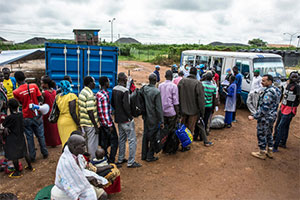 One Thousand Internally Displaced Persons (IDPs) Relocated from Tomping Camp in South Sudan. Credit: UN Photo/Isaac Billy
It took hundreds of thousands of years for the world’s human population to cross one billion in 1804. Approximately 200 years later, the population has multiplied sevenfold. In 2023, the global population crossed 8 billion, and is expected to reach 9 billion before 2050. With the planet more crowded than ever, it is essential to keep track of population trends, urbanization, migration, and reproduction across the world.
Life expectancy has seen significant strides in the past century, largely due to economic development and increased standards of living. On the contrary, trends in global fertility are shifting, with certain regions in Africa and Asia reporting higher rates, while parts of Europe and North America report stagnant or lower rates. This is in part due to differences in sexual and reproductive healthcare, as well as societal and economic conditions around the world. For example, child marriage is prevalent in certain societies, where childbearing is also considered a familial duty. Meanwhile, stagnating economies frequently experience lower marriage and childbearing rates.
The increase in migration and urban development around the world is also linked to global population trends. By 2050, it is expected that approximately 66 percent of all people will live in cities. Furthermore, global crises such as warfare and natural disasters also prompt transnational migration. Transnational migration is linked to a variety of socioeconomic issues in both host and receiving countries: migrants often leave developing countries with less access to educational and economic opportunities and arrive in developed countries where they are frequently the targets of ethnic, racial, and cultural discrimination, and economic exploitation. Recent crises in Europe and the United States demonstrate the importance of advocating for migrants worldwide. As migrants from the Global South are increasingly stripped of their legal and civic rights in unlawful deportations, or targeted in acts of identity-based violence, it is essential to keep track of population trends and protect the human rights of migrant populations. Climate-related disasters are now a major driver of displacement, with nearly half of all new internal displacements in 2025 being disaster-related.
IPS is devoted to covering issues surrounding population trends, migration, and reproduction through its compelling articles, which use both statistics and human stories to provide readers with robust and informative viewpoints.

The Week with IPS

NEXT STOP - SDGs
Tracking global progress towards a sustainable world
Tracking global progress towards a sustainable world
