Languages
Wednesday, September 30, 2026



News and Views from the Global South
Population

Cities Emerge as Urgent Climate Solution at COP21
As the climate conference advances into its final stages amid the colossal challenge of having 195 countries agree on a single and unified global policy on climate change, urban areas appear a a different issue but complementary solution for all.
Opinion: Retirement Unlikely Option for Most People
Pensionable retirement ages and government pension programs have been established for men and women in countries around the world. Nevertheless, retirement remains an unlikely option for most people.
Soy, an Exotic Fruit in Brazil’s Amazon Jungle
In the northern Brazilian state of Pará, the construction of a port terminal for shipping soy out of the Amazon region has displaced thousands of small farmers from their land, which is now dedicated to monoculture.
Water Shortages Have a Heavy Impact on Women in Cuba
Denia Arrascaeta suffers water shortages on a near daily basis in the neighbourhood in the Cuban capital where she lives. “Sometimes I don’t even have water to drink,” she told IPS.
Mother-to-Child AIDS Transmission Dealt a Blow in Zimbabwe
With the battle to combat HIV/AIDS intensifying in Zimbabwe, the Prevention of Mother to Child Transmission initiative (PMTCT) has increasingly become a success weapon in the war on transmission of the once dreaded disease to the country’s unborn babies, despite some mothers testing positive for the disease.
Native Seeds Help Weather Climate Change in El Salvador
Knife in hand, Domitila Reyes deftly cuts open the leaves covering the cob of corn, which she carefully removes from the plant – a process she carries out over and over all morning long, standing in the middle of a sea of corn, a staple in the diet of El Salvador.
“Paris Is Not the End of a Climate Change Process but a Beginning”
Chilean President Michelle Bachelet says the climate summit in Paris “is not the end of a process but a beginning,” and that it will produce “an agreement that, although insufficient with respect to the original goal, shows that people believe it is better to move ahead than to stand still.”
Zimbabwe’s Long Road in Ending Poverty and Hunger
Noel Bhizori has a permanent post at a traffic light in Bulawayo’s central business district where he sells mobile phone recharge cards at a busy intersection.
Hunger Heralds Climate Change’s Arrival in Botswana
A perfect storm of lower rainfall and a growing population beckons for Botswana. But others find climate change is already in the fields and paddocks. “As climate change ushers in more stress on the water sector, it is increasingly a concern that losses in rangeland productivity will result in food insecurity, especially in rural areas,” a country analysis report unveiled recently on Botswana states.
Analysis: Are Young People the Answer to Africa’s Food Security?
Are you young, energetic, creative, ambitious and need a job? Africa's agriculture sector needs you!
Cubans Seeking the American Dream, Stranded in Costa Rica
Thousands of Cubans heading for the United States have been stranded at the Costa Rican-Nicaraguan border since mid-November, waiting for the authorities in Managua to authorise their passage north.
Latin American Legislators Find New Paths to Fight Hunger
With eight specific commitments aimed at pushing through laws and policies on food security and sovereignty, family farming and school feeding programmes, legislators from 17 countries closed the Sixth Forum of the Parliamentary Front Against Hunger in Latin America and the Caribbean.Open Defecation to End by 2025, Vows UN Chief, Marking World Toilet Day
The state of the world’s toilets reveals the good, the bad and the ugly – but not necessarily in that order.
Latin America to Push for Food Security Laws as a Bloc
Lawmakers in the Parliamentary Front Against Hunger in Latin America and the Caribbean decided at a regional meeting to work as a bloc for the passage of laws on food security – an area in which countries in the region have show uneven progress.
Africa Clinches Mega Development Prospects
The Week of the Programme for Infrastructure Development in Africa (PIDA) in Abidjan, Ivory Coast, focusing on the continent’s infrastructural development ended today with resolutions that could catapult huge advances for Africa.
Analysis: More Countries Want More Babies
Concerned with the consequences of demographic decline and population ageing, especially with respect to economic growth, national defence and pensions and health care for the elderly, a growing number of governments are seeking to raise birth rates. Whereas nearly 40 years ago 13 countries had policies to raise fertility, today the number has increased four-fold to 56, representing more than one-third of the world’s population.
Gay Cruising Spots a Challenge for HIV/AIDS Prevention in Cuba
When night falls, young men can be seen sitting on a dismantled bus stop on a remote hill far from the centre of the Cuban capital. Later they climb uphill to have sex with other men in the thick forest.Maternal Deaths Decline by 44 Percent, Says New Study
When world leaders adopted a set of eight Millennium Development Goals (MDGs) at a summit meeting in September 2000, one of the heavily-publicised goals was the commitment to reduce extreme poverty and hunger by the end of 2015.
Latin American Legislators, a Battering Ram in the Fight Against Hunger
Lawmakers in Latin America are joining forces to strengthen institutional frameworks that sustain the fight against hunger in a region that, despite being dubbed “the next global breadbasket”, still has more than 34 million undernourished people.
Opinion: The Grant of Patents and the Exorbitant Cost of “Lifesaving” Drugs
The important relationship between the examination of patents carried out by national patent offices and the right of citizens to access to medicines hasn't always been well-understood. Too often these are viewed as unrelated functions or responsibilities of the state. And the reason is clear: patentability requirements are not defined by patent offices, but frequently by the courts, tribunals, legislation or treaty negotiators.
Opinion: From Despair to Hope – Fulfilling a Promise to Mothers and Children in Mandera County
Mandera in northeastern Kenya, has often been described as “the worst place on earth to give birth.” Mandera’s maternal mortality ratio stands at 3,795 deaths per 100,000 live births, almost double that of wartime Sierra Leone at 2,000 deaths per 100,000 live births.« Previous Page — Next Page »


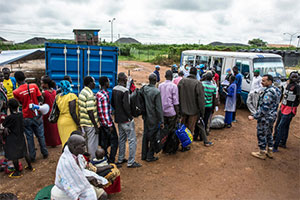 One Thousand Internally Displaced Persons (IDPs) Relocated from Tomping Camp in South Sudan. Credit: UN Photo/Isaac Billy
It took hundreds of thousands of years for the world’s human population to cross one billion in 1804. Approximately 200 years later, the population has multiplied sevenfold. In 2023, the global population crossed 8 billion, and is expected to reach 9 billion before 2050. With the planet more crowded than ever, it is essential to keep track of population trends, urbanization, migration, and reproduction across the world.
Life expectancy has seen significant strides in the past century, largely due to economic development and increased standards of living. On the contrary, trends in global fertility are shifting, with certain regions in Africa and Asia reporting higher rates, while parts of Europe and North America report stagnant or lower rates. This is in part due to differences in sexual and reproductive healthcare, as well as societal and economic conditions around the world. For example, child marriage is prevalent in certain societies, where childbearing is also considered a familial duty. Meanwhile, stagnating economies frequently experience lower marriage and childbearing rates.
The increase in migration and urban development around the world is also linked to global population trends. By 2050, it is expected that approximately 66 percent of all people will live in cities. Furthermore, global crises such as warfare and natural disasters also prompt transnational migration. Transnational migration is linked to a variety of socioeconomic issues in both host and receiving countries: migrants often leave developing countries with less access to educational and economic opportunities and arrive in developed countries where they are frequently the targets of ethnic, racial, and cultural discrimination, and economic exploitation. Recent crises in Europe and the United States demonstrate the importance of advocating for migrants worldwide. As migrants from the Global South are increasingly stripped of their legal and civic rights in unlawful deportations, or targeted in acts of identity-based violence, it is essential to keep track of population trends and protect the human rights of migrant populations. Climate-related disasters are now a major driver of displacement, with nearly half of all new internal displacements in 2025 being disaster-related.
IPS is devoted to covering issues surrounding population trends, migration, and reproduction through its compelling articles, which use both statistics and human stories to provide readers with robust and informative viewpoints.

The Week with IPS

NEXT STOP - SDGs
Tracking global progress towards a sustainable world
Tracking global progress towards a sustainable world
