Languages
Wednesday, September 30, 2026



News and Views from the Global South
Population

Small-scale Fishing Is About Much More than Just Subsistence in Chile
“Fishing isn’t just for making a living, it’s also enjoyable,” said Pedro Pascual, a 70-year-old fisherman who has been taking his small boat out to sea off Chile’s Pacific coast in the early hours of the morning almost every day for the past 50 years, to support his family.
Brazil Wages War against Zika Virus on Several Fronts
Brazil is deploying 220,000 troops to wage war against the Zika virus, in response to the alarm caused by the birth of thousands of children with abnormally small heads. But eradicating the Aedes aegypti mosquito requires battles on many fronts, including science and the pharmaceutical industry.
Mexico Creates First and Second-class Migrants
The Mexican government’s decision to grant humanitarian visas to Cuban migrants stranded in Costa Rica contrasts sharply with the poor treatment received by the tens of thousands of Central American migrants who face myriad risks as they make their way through this country on their long journey to the United States, social organisations and activists complain.
Precarious Nature of Public Employment Facilitated Mass Lay-offs in Argentina
Argentina’s new conservative government has already laid off 20,000 public employees since early December. Analysts have described the phenomenon as a “purge” of “militants” who supported the last administration, facilitated by the precarious employment conditions in the public sector, despite the steps taken to provide greater job stability over the last decade.
Tanzania: Girls Struggle to Avoid Forced Marriage, Yearn to Learn
Maria was barely 16 when her father removed her from school to marry her off to a man 20 years older than she was just so that the family could receive eleven cows as her dowry.New Year, New Fight Against Inequality
With New Year’s resolutions already fading fast for most people, attention turns to what 2016 will really hold. And so it is for those wanting to tackle the world’s biggest problems.
Q&A: Ensuring Food Security for All
Coming from a developing country where, in our generation, we have experienced the devastating effects of food insecurity and the complexity of its root causes, I take to heart the objective of ensuring that during my mandate, CFS will make a ‘real’ difference to people’s lives. Achieving results is something that we owe each and every undernourished person who today, in 2016 goes to bed hungry. There is still an unacceptable 793 million people in this condition worldwide! Ensuring food security for all is also something that we owe our children.
Maternal and Child Health Key to Kenya’s Economic Growth
On Friday, 06 November 2015, we had the honor of meeting the First Lady of Kenya Ms Margaret Kenyatta, a tireless advocate for “every woman and every child”, during the launch of the Beyond Zero campaign in Mandera County, North-Eastern Kenya, a place which has often been described as ‘the worst place on earth to give birth’.
57 Million Deaths in Perspective
The number of deaths worldwide in 2015 was approximately 57 million. Those deaths represent 0.78 percent of the world’s population of 7.3 billion. In comparison, 140 million births occurred in 2015, resulting in a global population increase of 83 million people.
Plan to Overcome Costa Rica’s Cuban Migrant Crisis Takes Off
After a nearly two-month wait, a group of 180 Cuban migrants, of the roughly 8,000 stranded in Costa Rica in their attempt to reach the United States, continued on their way as a result of a complex logistical process that emerged from diplomatic negotiations involving several countries in the region.
Zimbabwe: Poverty Stunting Minds and Growth
Mildren Ndlovu* knows the mental toll of Zimbabwe's long-drawn economic hardships in a country where a long rehashed statistic by labour unions puts unemployment at 90 per cent.
Drought Boosts Science in Dominican Republic
The recent lengthy drought in the Dominican Republic, which began to ease in late 2015, caused serious losses in agriculture and prompted national water rationing measures and educational campaigns.
Wrong Time of the Month: a Rights Gap for Developing Countries’ Girls
The onset of menstruation is a landmark event in the life of a young woman. Yet many complications and challenges accompany such an event. One in 10 adolescent girls miss school and eventually drop out due to menstruation-related issues.
Floods Pose Challenge for South American Integration
The flooding that has affected four South American countries has underscored the need for an integrated approach to addressing the causes and effects of climate change.
Insecurity in Dominican Countryside Threatens Local Food Supply
“Sometimes we have too much water, which washes everything away,” Cecilia Joseph, originally from Haiti, said in heavily accented Spanish while pulling up a ñame root (a kind of yam) on her farm in the municipality of Santo Domingo Norte in the Dominican Republic.Saudi Women Make Huge Advances After Victory in Polls
The triumph of 19 women in what is being seen as a landmark and historical election in a largely traditional and conservative country is a massive gain for women. A United Arab Emirates (UAE) daily newspaper called this a right step in the Islamic spirit.
Indigenous Villagers Fight “Evil Spirit” of Hydropower Dam in Brazil
At dusk on the Tapajós River, one of the main tributaries of the Amazon River in northern Brazil, the Mundurukú indigenous people gather to bathe and wash clothes in these waters rich in fish, the staple of their diet. But the “evil spirit”, as they refer in their language to the Sao Luiz Tapajós dam, threatens to leave most of their territory – and their way of life – under water.
Coffee Rust Aggravates Poverty in Rural El Salvador
Sitting in front of a pile of coffee beans that she has just picked, Ilsy Membreño separates the green cherries from the ripe red ones with a worried look on her face, lamenting the bad harvest on the farm where she works in western El Salvador and the low daily wages she is earning.
Haina, a Dominican City Famous Only for Its Pollution
Rubbish covers the beaches and clutters the rivers, the garbage dump is not properly managed, and more than 100 factories spew toxic fumes into the air in the city of Bajos de Haina, a major industrial hub and port city in the Dominican Republic.Tackling Climate Change in Africa: Europe’s Solution to the Migrant Crisis?
As thousands of Africans arrive in Europe every month, often risking their lives aboard shaky boats to get to a better life, lack of access to energy could be one of the reasons for their exodus.
Immigration – Still a Pending Issue in Cuban-U.S. Relations
The crisis that has broken out at several border crossings in Latin America as a result of thousands of Cubans attempting to reach the United States has revived a problem that remains unresolved between the two countries in spite of agreements, negotiations and the diplomatic thaw that started a year ago.« Previous Page — Next Page »


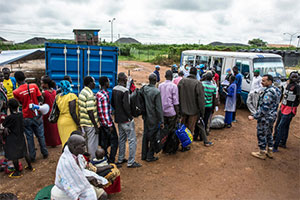 One Thousand Internally Displaced Persons (IDPs) Relocated from Tomping Camp in South Sudan. Credit: UN Photo/Isaac Billy
It took hundreds of thousands of years for the world’s human population to cross one billion in 1804. Approximately 200 years later, the population has multiplied sevenfold. In 2023, the global population crossed 8 billion, and is expected to reach 9 billion before 2050. With the planet more crowded than ever, it is essential to keep track of population trends, urbanization, migration, and reproduction across the world.
Life expectancy has seen significant strides in the past century, largely due to economic development and increased standards of living. On the contrary, trends in global fertility are shifting, with certain regions in Africa and Asia reporting higher rates, while parts of Europe and North America report stagnant or lower rates. This is in part due to differences in sexual and reproductive healthcare, as well as societal and economic conditions around the world. For example, child marriage is prevalent in certain societies, where childbearing is also considered a familial duty. Meanwhile, stagnating economies frequently experience lower marriage and childbearing rates.
The increase in migration and urban development around the world is also linked to global population trends. By 2050, it is expected that approximately 66 percent of all people will live in cities. Furthermore, global crises such as warfare and natural disasters also prompt transnational migration. Transnational migration is linked to a variety of socioeconomic issues in both host and receiving countries: migrants often leave developing countries with less access to educational and economic opportunities and arrive in developed countries where they are frequently the targets of ethnic, racial, and cultural discrimination, and economic exploitation. Recent crises in Europe and the United States demonstrate the importance of advocating for migrants worldwide. As migrants from the Global South are increasingly stripped of their legal and civic rights in unlawful deportations, or targeted in acts of identity-based violence, it is essential to keep track of population trends and protect the human rights of migrant populations. Climate-related disasters are now a major driver of displacement, with nearly half of all new internal displacements in 2025 being disaster-related.
IPS is devoted to covering issues surrounding population trends, migration, and reproduction through its compelling articles, which use both statistics and human stories to provide readers with robust and informative viewpoints.

The Week with IPS

NEXT STOP - SDGs
Tracking global progress towards a sustainable world
Tracking global progress towards a sustainable world
