Languages
Monday, October 12, 2026



News and Views from the Global South
Population

The Definition of ‘Rape’ Cannot Change with a Marriage Certificate
"I was brutally raped thrice by my husband. He kept me under surveillance in his Dubai house while I suffered from severe malnutrition and depression. When I tried to flee from this hellhole, he confiscated my passport, deprived me of money and beat me up," recalls Anna Marie Lopes, 28, a rape survivor who after six years of torture, finally managed to board a flight to New Delhi from the United Arab Emirates in 2012.
Reviving Dignity: The Remarkable Perseverance of Myanmar’s Displaced
In Myanmar’s Western Rakhine State, over a hundred thousand people displaced by inter communal violence that broke out nearly three years ago remain interned in camps on torrid plains and coastal marshes, struggling to survive.A Nightmare Comes to a Close in Liberia as MDs Declare It ‘Ebola-Free’
With no new infections in 42 days, Liberia has been declared free and clear of Ebola by the World Health Organization.
IACHR Tackles Violence Against Native Peoples in Costa Rica
After years of violence against two indigenous groups in Costa Rica, the Inter-American Commission on Human Rights (IACHR) demanded that the government adopt measures by May 15 to protect the life and physical integrity of the members of the two communities.
Farmers Fight Real Estate Developers for Kenya’s Most Prized Asset: Land
Vegetables grown in the lush soil of this quiet agricultural community in central Kenya’s fertile wetlands not only feed the farmers who tend the crops, but also make their way into the marketplaces of Nairobi, the country’s capital, some 150 km south.
Opinion: Don’t Leave Indigenous Peoples Behind in SDGs
U.N. member states are meeting throughout the year to finalize the Sustainable Development Goals (SDGs), which will set the global development agenda for the next 15 years. The goals are supposed to be universal and aspire to “leave no one behind.”
Farmers Fight Real Estate Developers for Kenya’s Most Prized Asset: Land
 Vegetables grown in the lush soil of this quiet agricultural community in central Kenya’s fertile wetlands not only feed the farmers who tend the crops, but also make their way into the marketplaces of Nairobi, the country’s capital, some 150 km south.

Latin America’s Social Policies Have Given Women a Boost
Although they do not specifically target women, social policies like family allowances and pensions have improved the lives of women in Latin America, the region that has made the biggest strides so far this century in terms of gender equality, although there is still a long way to go.
The Biggest Lessons Nepal Will Take Away From This Tragedy
There has never been any doubt that Nepal is sitting on one of the most seismically active areas in South Asia. The fact that, when the big one struck, damages and deaths would be catastrophic has been known for years.
Opinion: South-South Cooperation Vital for Sustainable Development
Sustainable development is central to a range of key discussions at the United Nations and elsewhere at the moment.
Falling Oil Prices Trigger Initial Economic Gains for Pacific Islanders
The recent dramatic fall in world oil prices, with Brent crude plummeting from a high of 115 dollars per barrel in June last year to around 47 dollars in January 2015, is beginning to benefit Pacific Islanders who are seeing lower prices for fuel and energy.
Sri Lanka’s Development Goals Fall Short on Gender Equality
When Rosy Senanayake, Sri Lanka’s minister of state for child affairs, addressed the U.N. Commission on Population and Development (CPD) in New York last month, she articulated both the successes and shortcomings of gender equality in a country which prided itself electing the world’s first female head of government: Mrs. Sirimavo Bandaranaike in July 1960.
Urban Slums a Death Trap for Poor Children
It’s called the urban survival gap – fuelled by the growing inequality between rich and poor in both developing and developed countries – and it literally determines whether millions of infants will live or die before their fifth birthday.
Families in Quake-Hit Nepal Desperate to Get on With Their Lives
Just over a week after a dreadful 7.8 magnitude earthquake rocked Nepal, displaced families are gradually – but cautiously – resuming their normal lives, though most are still badly shaken by the disaster and the proceeding aftershocks that devastated the country.
In India, a Broken System Leaves a ‘Broken’ People Powerless
As India paid glowing tributes to Bhimrao Ramji Ambedkar, the architect of its constitution and a champion of the downtrodden, on his 124nd birth anniversary last month, public attention also swivelled to the glaring social and economic discrimination that plagues the lives of lower-caste or ‘casteless’ communities – who comprise over 16 percent of the country's 1.2 billion people.
As Ebola Approaches Zero, Immunisation Gets a Boost in West Africa
As Sierra Leone, Guinea and Liberia work to end Ebola, critical healthcare services damaged by the epidemic are beginning to be revitalised.
In India, a Broken Systems Leaves a Broken People Powerless
As India paid glowing tributes to Bhimrao Ramji Ambedkar, the architect of its constitution and a champion of the downtrodden, on his 124nd birth anniversary last month, public attention also swivelled to the glaring social and economic discrimination that plagues the lives of lower-caste or ‘casteless’ communities – who comprise over 16 percent of the country’s 1.2 billion people.

Q&A: “People Need to Be at the Centre of Development”
In a populous archipelago nation like Indonesia, where 250 million live spread across some 17,500 islands, speaking over 300 languages, the question of development is a tricky one.
Draconian Ban on Abortion in El Salvador Targeted by Global Campaign
International and local human rights groups are carrying out an intense global campaign to get El Salvador to modify its draconian law that criminalises abortion and provides for prison terms for women.
Watch What Happens When Tribal Women Manage India’s Forests
Kama Pradhan, a 35-year-old tribal woman, her eyes intent on the glowing screen of a hand-held GPS device, moves quickly between the trees. Ahead of her, a group of men hastens to clear away the brambles from stone pillars that stand at scattered intervals throughout this dense forest in the Nayagarh district of India’s eastern Odisha state.
In Nicaragua Marriage Is Only for ‘Him’ and ‘Her’
A new Family Code that went into effect in Nicaragua this month represents an overall improvement in terms of the rights of Nicaraguans. However, it has one major gap: it fails to recognise same-sex marriage, and as a result it closes the doors to adoption by gay couples.« Previous Page — Next Page »





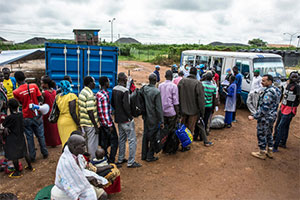 One Thousand Internally Displaced Persons (IDPs) Relocated from Tomping Camp in South Sudan. Credit: UN Photo/Isaac Billy
It took hundreds of thousands of years for the world’s human population to cross one billion in 1804. Approximately 200 years later, the population has multiplied sevenfold. In 2023, the global population crossed 8 billion, and is expected to reach 9 billion before 2050. With the planet more crowded than ever, it is essential to keep track of population trends, urbanization, migration, and reproduction across the world.
Life expectancy has seen significant strides in the past century, largely due to economic development and increased standards of living. On the contrary, trends in global fertility are shifting, with certain regions in Africa and Asia reporting higher rates, while parts of Europe and North America report stagnant or lower rates. This is in part due to differences in sexual and reproductive healthcare, as well as societal and economic conditions around the world. For example, child marriage is prevalent in certain societies, where childbearing is also considered a familial duty. Meanwhile, stagnating economies frequently experience lower marriage and childbearing rates.
The increase in migration and urban development around the world is also linked to global population trends. By 2050, it is expected that approximately 66 percent of all people will live in cities. Furthermore, global crises such as warfare and natural disasters also prompt transnational migration. Transnational migration is linked to a variety of socioeconomic issues in both host and receiving countries: migrants often leave developing countries with less access to educational and economic opportunities and arrive in developed countries where they are frequently the targets of ethnic, racial, and cultural discrimination, and economic exploitation. Recent crises in Europe and the United States demonstrate the importance of advocating for migrants worldwide. As migrants from the Global South are increasingly stripped of their legal and civic rights in unlawful deportations, or targeted in acts of identity-based violence, it is essential to keep track of population trends and protect the human rights of migrant populations. Climate-related disasters are now a major driver of displacement, with nearly half of all new internal displacements in 2025 being disaster-related.
IPS is devoted to covering issues surrounding population trends, migration, and reproduction through its compelling articles, which use both statistics and human stories to provide readers with robust and informative viewpoints.

The Week with IPS

NEXT STOP - SDGs
Tracking global progress towards a sustainable world
Tracking global progress towards a sustainable world
