Languages
Sunday, October 11, 2026



News and Views from the Global South
Population

Opinion: Tobacco Taxes Too Effective to Overlook in Financing for Development
Governments are in the midst of tough talks in New York over the text of the Addis Ababa Accord, which is scheduled to be adopted at the end of the Third Conference on Financing for Development (FfD) , to be held in Ethiopia in July.
Pineapple Industry Leaves Costa Rican Communities High and Dry
Twelve years after finding the first traces of pesticides used by the pineapple industry, in the rural water supply, around 7,000 people from four communities in Costa Rica’s Caribbean region are still unable to consume their tap water.
Q&A: Papua New Guinea Reckons With Unmet Development Goals
As Papua New Guinea celebrates 40 years of independence, 2015 marks a defining year for the largest Pacific Island nation, set to record 15 percent GDP growth this year.
School Gardens Combat Hunger in Argentina
In Argentina, where millions of families have unmet dietary needs despite the country’s vast expanse of fertile land, the Huerta Niño project promotes organic gardens in rural primary schools, to teach children healthy eating habits and show them that they can grow their own food to fight hunger.
Slum-Dwelling Still a Continental Trend in Africa
Nompumelelo Tshabalala, 41, emerges from her dwarf ‘shack’ made up of rusty metal sheets and falls short of bumping into this reporter as she bends down to avoid knocking her head against the top part of her makeshift door frame.
Bougainville: Former War-Torn Territory Still Wary of Mining
From Arawa, once the capital city of Bougainville, an autonomous region in eastern Papua New Guinea in the southwest Pacific Ocean, a long, winding road leads high up into the Crown Prince Ranges in the centre of the island through impenetrable rainforest.
Pakistan’s Streets Kids Drop the Begging Bowl, Opt for Pencils Instead
Khalil Ahmed's life story sounds like it could have come straight out of the plot of a Bollywood flick, but it didn’t. And that makes it all the more inspiring.
The U.N. at 70: Time to Prioritise Human Rights for All, for Current and Future Generations
Seventy years ago, with the founding of the United Nations, all nations reaffirmed their faith in fundamental human rights, in the dignity and worth of the human person, and in the equal rights of men and women and of nations large and small.
Lessons from an Indian Tribe on How to Manage the Food-Forest Nexus
Scattered across 240 sq km on the remote Niyamgiri hill range in the eastern Indian state of Odisha, an ancient tribal group known as the Dongria Kondh have earned themselves a reputation as trailblazers.
Lessons from an Indian Tribe on How to Manage the Food-Forest Nexus
 Scattered across 240 sq km on the remote Niyamgiri hill range in the eastern Indian state of Odisha, an ancient tribal group known as the Dongria Kondh have earned themselves a reputation as trailblazers.

Latin America Must Address Its Caregiving Crisis
As in the rest of the world, the care of children, the elderly and the disabled in Latin America has traditionally fallen to women, who add it to their numerous domestic and workplace tasks. A debate is now emerging in the region on the public policies that governments should adopt to give them a hand, while also helping their countries grow.
Murders of Gays Raise the Question of Hate Crimes in Cuba
During the events surrounding the eighth annual celebration of the Day Against Homophobia in Cuba, it emerged that a young transsexual had recently been killed in the city of Pinar del Río near the western tip of this Caribbean island nation.
Boatloads of Migrants Could Soon Be ‘Floating Graveyard’ on Southeast Asian Waters
On Thursday, May 14, a group of journalists rented a boat from Ko Lipe, a small island in Thailand’s southwest Satun Province, and headed out into the Andaman Sea – a water body in the northeastern Indian Ocean bounded by Myanmar, Thailand, Malaysia, Indonesia and the Strait of Malacca.
Opinion: Let’s Talk Menstruation. Period.
Every month, more than two billion women around the world menstruate, and yet the topic is still shrouded by a veil of silence. While some girls celebrate their period as the first step into womanhood, many girls in developing or emerging countries are shocked and ashamed of their monthly cycles.
The Asia-Pacific Region Is ‘Growing’, but Millions Are Living in Poverty
Home to an estimated 3.74 billion people, the Asia-Pacific region holds over half the global population, determining to a great extent the level of economic stability, or chaos, in the world.
Poor Land Use Worsens Climate Change in St. Vincent
For 32 years, Joel Poyer, a forest technician, has been tending to the forest of St. Vincent and the Grenadines.
Pregnancy and Childbirth Still Kill Too Many Women in Latin America
In spite of strides in social progress, Latin America’s maternal mortality rates remain unacceptable, and many of the deaths are avoidable, occurring partly because of neglect of the prescriptions provided by experts: preventive action and health promotion.
The U.N. at 70: Is It Still Fit for the Purpose?
Events are being organised around the world to celebrate the 70th anniversary of the founding of the United Nations, but a recent seminar held in the Austrian capital was not held to applaud the body’s past contributions.
The U.N. at 70: Energy Powers Lives, Literally
When, in 2003, Professor Richard Smalley, winner of the Nobel Prize for Chemistry, listed the top 10 problems facing humanity for the next 50 years in order of priority, energy was at the top of his list, followed by water, then food.
Indonesia Still a Long Way from Closing the Wealth Gap
Every afternoon, Wahyu sets up his wooden food cart by the side of a busy road in Central Jakarta to sell sweet buns, known as ‘bakpao’, to people passing by. In a good month, the street vendor can make around 800,000 rupiah, which amounts to roughly 62 dollars.
NGOs Urge Post-2015 Declaration Include Water, Sanitation as Basic Human Rights
Virtually every major international conference concludes with a “programme of action” (PoA) – described in U.N. jargon as “an outcome document” – preceded by a political declaration where 193 member states religiously pledge to honour their commitments.« Previous Page — Next Page »





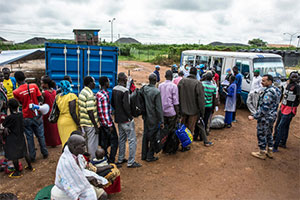 One Thousand Internally Displaced Persons (IDPs) Relocated from Tomping Camp in South Sudan. Credit: UN Photo/Isaac Billy
It took hundreds of thousands of years for the world’s human population to cross one billion in 1804. Approximately 200 years later, the population has multiplied sevenfold. In 2023, the global population crossed 8 billion, and is expected to reach 9 billion before 2050. With the planet more crowded than ever, it is essential to keep track of population trends, urbanization, migration, and reproduction across the world.
Life expectancy has seen significant strides in the past century, largely due to economic development and increased standards of living. On the contrary, trends in global fertility are shifting, with certain regions in Africa and Asia reporting higher rates, while parts of Europe and North America report stagnant or lower rates. This is in part due to differences in sexual and reproductive healthcare, as well as societal and economic conditions around the world. For example, child marriage is prevalent in certain societies, where childbearing is also considered a familial duty. Meanwhile, stagnating economies frequently experience lower marriage and childbearing rates.
The increase in migration and urban development around the world is also linked to global population trends. By 2050, it is expected that approximately 66 percent of all people will live in cities. Furthermore, global crises such as warfare and natural disasters also prompt transnational migration. Transnational migration is linked to a variety of socioeconomic issues in both host and receiving countries: migrants often leave developing countries with less access to educational and economic opportunities and arrive in developed countries where they are frequently the targets of ethnic, racial, and cultural discrimination, and economic exploitation. Recent crises in Europe and the United States demonstrate the importance of advocating for migrants worldwide. As migrants from the Global South are increasingly stripped of their legal and civic rights in unlawful deportations, or targeted in acts of identity-based violence, it is essential to keep track of population trends and protect the human rights of migrant populations. Climate-related disasters are now a major driver of displacement, with nearly half of all new internal displacements in 2025 being disaster-related.
IPS is devoted to covering issues surrounding population trends, migration, and reproduction through its compelling articles, which use both statistics and human stories to provide readers with robust and informative viewpoints.

The Week with IPS

NEXT STOP - SDGs
Tracking global progress towards a sustainable world
Tracking global progress towards a sustainable world
