Languages
Sunday, October 11, 2026



News and Views from the Global South
Population

Exodus in the Bay of Bengal
For a while it went unnoticed: a boatload of migrants here, a vessel full of refugees there. But since 2012, the complex and unregulated movement of human beings through South and Southeast Asia– and the fate of those who put their lives in the hands of smugglers and at the mercy of the high seas – is becoming bleaker with each passing day.
Ni Una Menos – The Cry Against ‘Femicides’ Finally Heard in Argentina
In the wake of the massive response to their call to protest violence against women in Argentina, the organisers of this week’s demonstrations are starting to plan the steps to be taken to get results for their demand “Ni Una Menos” (not one less), taking advantage of the strength in numbers shown to obtain political support for public policies aimed at protecting women.
The U.N. at 70: A Time for Reflection and Reform
Seventy years since its inception, the United Nations remains at the core of the multilateral system. The world body, together with the Bretton Woods institutions, was conceived in the mid-1940s by the architects of the postwar order with the central aim of saving succeeding generations from the scourge of war on the one hand, and the need to reconstruct and revive the global economy on the other.
U.N. Challenges Asia-Pacific to Be World’s First Region to End AIDS Epidemic
The United Nations has expressed confidence that the Asia-Pacific region, with almost five million people living with HIV, is politically committed towards the elimination of the deadly disease AIDS.
8.2 Million Iraqis In Need of Emergency Humanitarian Assistance
As fighting drags on between Iraqi armed forces and the Islamic State in Iraq and the Levant (ISIL), millions of refugees caught between the warring groups are in dire need of humanitarian assistance.
‘Legal Friends’ Fight Gender Violence in Rural India
Mamta Bai, 36, distinctly remembers the first time the police came to her village: it was December 2014 and her neighbour, Purva Bai, had just been beaten unconscious by her alcoholic husband, prompting Mamta to make a distress call to the nearest station.
Thirsty in Nicaragua, the Country Where ‘Agua’ Is Part of Its Name
Nicaragua, the Central American country with the most abundant water sources, and where water – “agua” in Spanish – is even part of its name, is suffering one of its worst water crises in half a century, fuelled by climate change, deforestation and erosion.
Pacific Civil Society Swings Out Against Free Trade Agreement
Fourteen Pacific Island Forum countries are currently locked in negotiations with their two largest economic neighbours, Australia and New Zealand, to forge a new regional free trade agreement called ‘PACER Plus’, which supporters believe will boost economic growth in the region.
Zimbabwean Women Weave Their Own Beautiful Future
Seventy-seven-year-old Grace Ngwenya has an eye for detail. You will never catch her squinting as she effortlessly weaves ilala palm fronds into beautiful baskets.
Zimbabwean Women Weave Their Own, Beautiful Future
 Seventy-seven-year-old Grace Ngwenya has an eye for detail. You will never catch her squinting as she effortlessly weaves ilala palm fronds into beautiful baskets.
The Neglected Street Vendors of India
For the past nine years, 27-year-old Jignesh has been hawking bed sheets on the bustling pavements of Janpath, a major throughway in India’s capital, New Delhi, as kamikaze traffic swirls around him.
Despite Setbacks, Global Sanitation Makes Progress, Says Fund
When the United Nations hosted a panel discussion last year urging its partners to “break their silence” on open defecation, Singapore’s deputy permanent representative Mark Neo was outspoken in his characterisation: “Open defecation is a euphemism. What we are talking about is shitting in the open.”
Garment Sweatshops in Argentina an Open Secret
The death of two Bolivian boys in a fire and the mistreatment and sexual abuse of a young Bolivian woman put the problem of slave-like labour conditions in clandestine sweatshops back in the headlines in Argentina.
Latin America’s Relative Success in Fighting Hunger
The Latin American and Caribbean region is the first in the world to reach the two global targets for reducing hunger. Nevertheless, more than 34 million people still go hungry.
Scores of Sri Lankan Tamils Still Living Under the ‘Long Shadow of War’
In many ways, Jayakumari Balendran epitomizes the plight of the Tamil people in Sri Lanka’s northern and eastern provinces, both during and after the island nation’s 26-year-long civil conflict.
Relief Organisation Urges Mandatory Funding for Humanitarian Appeals
The United Nations is not only overwhelmed by a spreading humanitarian crisis, largely in Africa and the Middle East, but also remains hamstrung by a severe shortfall in funds, mostly from Western donors.
Humanitarian Crisis in South Sudan Continues to Worsen
After peace talks failed earlier this month, the ongoing conflict in South Sudan between government forces and opposition forces that began at the end of 2013 is having a severe impact on the country’s food security and civilian safety.
Sri Lankan Women Stymied by Archaic Job Market
Wathsala Marasinghe, a 33-year-old hailing from the town of Mirigama, just 50 km from Sri Lanka’s capital, Colombo, once had high hopes that the progressive education and employment policies of this South Asian island nation would work in her favour. Today, she feels differently, believing that “an evil system” has let her down.
Opinion: Let’s End Chronic Hunger
At the 1996 World Food Summit (WFS), heads of government and the international community committed to reducing the number of hungry people in the world by half. Five years later, the Millennium Development Goals (MDGs) lowered this level of ambition by only seeking to halve the proportion of the hungry.
Laissez Faire Water Laws Threaten Family Farming in Chile
Family farmers in Chile are pushing for the reinstatement of water as a public good, to at least partially solve the shortages caused by the privatisation of water rights by the military dictatorship in 1981.
The U.N. at 70: A Glass Half Full
As the U.N. enters its 70th year, it is legitimate to ask whether it has been a success so far. Over the years, the media, in particular the Western media, has tended to highlight the U.N.'s failures.« Previous Page — Next Page »





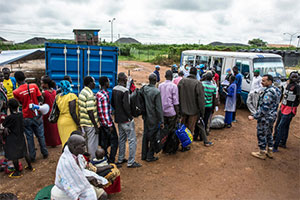 One Thousand Internally Displaced Persons (IDPs) Relocated from Tomping Camp in South Sudan. Credit: UN Photo/Isaac Billy
It took hundreds of thousands of years for the world’s human population to cross one billion in 1804. Approximately 200 years later, the population has multiplied sevenfold. In 2023, the global population crossed 8 billion, and is expected to reach 9 billion before 2050. With the planet more crowded than ever, it is essential to keep track of population trends, urbanization, migration, and reproduction across the world.
Life expectancy has seen significant strides in the past century, largely due to economic development and increased standards of living. On the contrary, trends in global fertility are shifting, with certain regions in Africa and Asia reporting higher rates, while parts of Europe and North America report stagnant or lower rates. This is in part due to differences in sexual and reproductive healthcare, as well as societal and economic conditions around the world. For example, child marriage is prevalent in certain societies, where childbearing is also considered a familial duty. Meanwhile, stagnating economies frequently experience lower marriage and childbearing rates.
The increase in migration and urban development around the world is also linked to global population trends. By 2050, it is expected that approximately 66 percent of all people will live in cities. Furthermore, global crises such as warfare and natural disasters also prompt transnational migration. Transnational migration is linked to a variety of socioeconomic issues in both host and receiving countries: migrants often leave developing countries with less access to educational and economic opportunities and arrive in developed countries where they are frequently the targets of ethnic, racial, and cultural discrimination, and economic exploitation. Recent crises in Europe and the United States demonstrate the importance of advocating for migrants worldwide. As migrants from the Global South are increasingly stripped of their legal and civic rights in unlawful deportations, or targeted in acts of identity-based violence, it is essential to keep track of population trends and protect the human rights of migrant populations. Climate-related disasters are now a major driver of displacement, with nearly half of all new internal displacements in 2025 being disaster-related.
IPS is devoted to covering issues surrounding population trends, migration, and reproduction through its compelling articles, which use both statistics and human stories to provide readers with robust and informative viewpoints.

The Week with IPS

NEXT STOP - SDGs
Tracking global progress towards a sustainable world
Tracking global progress towards a sustainable world
