Languages
Tuesday, October 13, 2026



News and Views from the Global South
Population

Campaign Against Glyphosate Steps Up in Latin America
After the World Health Organisation (WHO) declared glyphosate a probable carcinogen, the campaign has intensified in Latin America to ban the herbicide, which is employed on a massive scale on transgenic crops.
Opinion: Continuing the Centennial Work of Women and Citizen Diplomacy in Korea
A century ago, the suffragist Jane Addams boarded a ship with other American women peace activists to participate in a Congress of Women in The Hague.Anti-Foreigner Discrimination ‘Fostered in South African Schools’
A practice of denying admission to South African public schools of children without visas or whose parents are refugees from other African countries is creating a foundation for the current rash of xenophobia, critics of the practice say.
Opinion: Progress of the World’s Women 2015-2016: Transforming Economies, Realising Rights
Our world is out of balance. It is both wealthier and more unequal today than at any time since the Second World War.No Woman, No World
Almost exactly two years ago, on the morning of Apr. 24, over 3,600 workers – 80 percent of them young women between the ages of 18 and 20 – refused to enter the Rana Plaza garment factory building in Dhaka, Bangladesh, because there were large ominous cracks in the walls. They were beaten with sticks and forced to enter.
Want to Help Nepal Recover from the Quake? Cancel its Debt, Says Rights Group
The death toll has now passed 3,300, and there is no telling how much farther it will climb. Search and rescue operations in Nepal entered their third day Monday, as the government and international aid agencies scramble to cope with the aftermath of a 7.8-magnitude earthquake that struck this South Asian nation on Apr. 25.Swelling Ethiopian Migration Casts Doubt on its Economic Miracle
The 28 Ethiopian migrants of Christian faith murdered by the Islamic State (IS) on Apr. 19 in Libya had planned to cross the Mediterranean Sea in search of work in Europe.
Kenyan Pastoralists Protest Wanton Destruction of Indigenous Forest
Armed with twigs and placards, enraged residents from a semi-pastoral community 360 km north of Kenya’s capital, Nairobi, protested this week against wanton destruction of indigenous forest – their alternative source of livelihood.
Riches in World’s Oceans Estimated at Staggering 24 Trillion Dollars
The untapped riches in the world’s oceans are estimated at nearly 24 trillion dollars – the size of the world’s leading economies, according to a new report released Thursday by the World Wide Fund for Nature (WWF).
Talk of Death Squads to Combat New Wave of Gang Violence in El Salvador
The resurgence of violent crime in El Salvador is giving rise to a hostile social environment in El Salvador reminiscent of the country’s 12-year civil war, which could compromise the country’s still unsteady democracy.
Opinion: The World Has Reached Peak Plutocracy
Parents in despair because they can’t pay the fees at the privatised neighbourhood school…
U.N. Helpless as Crises Rage in 10 Critical Hot Spots
The United Nations is fighting a losing battle against a rash of political and humanitarian crises in 10 of the world’s critical “hot spots.”
From Slavery to Self Reliance: A Story of Dalit Women in South India
HuligeAmma, a Dalit woman in her mid-forties, bends over a sewing machine, carefully running the needle over the hem of a shirt. Sitting nearby is Roopa, her 22-year-old daughter, who reads an amusing message on her cell phone and laughs heartily.
Opinion: Realising Unfinished Business of MDGs : A Call for Greater Action and Investment for Malaria
Later this week, communities around the world will commemorate World Malaria Day for the last time in the context of the global development priorities set in 2000.
Instead of Scaling up Funding for Education, Major Donors Are Cutting Back
Despite commitments by the international community to achieve universal primary education by 2015, funds for education have been decreasing over the past ten years, according to a report released Friday by the global advocacy campaign ‘A World at School’.
Clean Cookstoves Could Change the Lives of Millions in Nepal
 When 26-year-old Laxmi married into the Archaya household in Chhaimale village, Pharping, south of Nepal’s capital Kathmandu, she didn’t think she would be spending half the day in the kitchen inhaling smoke from the stove.

U.N. Struggles to Cope with New Humanitarian Crisis in Yemen
The United Nations, which is providing humanitarian aid to over 50 million refugees worldwide, is struggling to cope with a new crisis in hand: death and destruction in Yemen.Sexual Violence in Conflict “The Contemporary Moral Issue” Says United Nations
Impunity for perpetrators of sexual violence in war must end, said Zainab Hawa Bangura, the Special representative of the United Nations Secretary-General on sexual violence in conflict, who presented to the U.N. Security Council the Secretary-General's 2015 report on the issue on April 15.
Investigation Tears Veil Off World Bank’s “Promise” to Eradicate Poverty
An expose published Thursday by the International Consortium of Investigative Journalists (ICIJ) and its media partners has revealed that in the course of a single decade, 3.4 million people were evicted from their homes, torn away from their lands or otherwise displaced by projects funded by the World Bank.
Clean Cookstoves Could Change the Lives of Millions in Nepal
When 26-year-old Laxmi married into the Archaya household in Chhaimale village, Pharping, south of Nepal’s capital Kathmandu, she didn’t think she would be spending half the day in the kitchen inhaling smoke from the stove.
Acid Attacks Still a Burning Issue in India
Vinita Panikker, 26, considers herself "the world's most unfortunate woman".« Previous Page — Next Page »





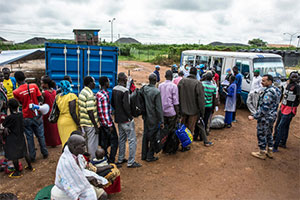 One Thousand Internally Displaced Persons (IDPs) Relocated from Tomping Camp in South Sudan. Credit: UN Photo/Isaac Billy
It took hundreds of thousands of years for the world’s human population to cross one billion in 1804. Approximately 200 years later, the population has multiplied sevenfold. In 2023, the global population crossed 8 billion, and is expected to reach 9 billion before 2050. With the planet more crowded than ever, it is essential to keep track of population trends, urbanization, migration, and reproduction across the world.
Life expectancy has seen significant strides in the past century, largely due to economic development and increased standards of living. On the contrary, trends in global fertility are shifting, with certain regions in Africa and Asia reporting higher rates, while parts of Europe and North America report stagnant or lower rates. This is in part due to differences in sexual and reproductive healthcare, as well as societal and economic conditions around the world. For example, child marriage is prevalent in certain societies, where childbearing is also considered a familial duty. Meanwhile, stagnating economies frequently experience lower marriage and childbearing rates.
The increase in migration and urban development around the world is also linked to global population trends. By 2050, it is expected that approximately 66 percent of all people will live in cities. Furthermore, global crises such as warfare and natural disasters also prompt transnational migration. Transnational migration is linked to a variety of socioeconomic issues in both host and receiving countries: migrants often leave developing countries with less access to educational and economic opportunities and arrive in developed countries where they are frequently the targets of ethnic, racial, and cultural discrimination, and economic exploitation. Recent crises in Europe and the United States demonstrate the importance of advocating for migrants worldwide. As migrants from the Global South are increasingly stripped of their legal and civic rights in unlawful deportations, or targeted in acts of identity-based violence, it is essential to keep track of population trends and protect the human rights of migrant populations. Climate-related disasters are now a major driver of displacement, with nearly half of all new internal displacements in 2025 being disaster-related.
IPS is devoted to covering issues surrounding population trends, migration, and reproduction through its compelling articles, which use both statistics and human stories to provide readers with robust and informative viewpoints.

The Week with IPS

NEXT STOP - SDGs
Tracking global progress towards a sustainable world
Tracking global progress towards a sustainable world
