Languages
Tuesday, October 13, 2026



News and Views from the Global South
Population

Cyclone Pam Worsens Hardship in Port Vila’s Urban Settlements
Severe Tropical Cyclone Pam, which swept through the South Pacific Island state of Vanuatu in mid-March, has deepened hardships faced by people living in the informal settlements of the capital, Port Vila. Winds of up to 340 kph and torrential rain shattered precarious homes, cut off fragile public services and flooded communities with unsealed roads, poor drainage and sanitation.
Nepal: A Trailblazer in Biodiversity Conservation
At dusk, when the early evening sun casts its rays over the lush landscape, the Chitwan National Park, a UNESCO World Heritage Site about 200 km south of Nepal’s capital, Kathmandu, is a place of the utmost tranquility.
781 Million People Can’t Read this Story
If you are reading this article, consider yourself one of the lucky ones; lucky enough to have received an education, or to be secure in the knowledge that your child will receive one. Lucky enough to be literate in a world where – more often than not – the ability to read and write can mean the difference between a decent life and abject poverty.U.N. Secretary-General Calls for International Unity on Yemen and Syria
"Political negotiations, not military intervention, are the solution" said United Nations Secretary-General, Ban Ki-moon, on the rapidly deteriorating conflict situation in Yemen and recent developments in Syria at the Yarmouk refugee camp.
State of Palestine in Overtime
The large majority of countries, and most of the people in the world, already recognise Palestine as an independent state.At Least 18 Already Killed in Yarmouk Attacks: Amnesty International
At least 18 civilians have already been killed in the attack on the Syrian refugee camp of Yarmouk, according to Amnesty International.
In Bangladesh, Gender Equality Comes on the Airwaves
Judging by how often they make headlines, one might be tempted to believe that women in Bangladesh don’t play a major role in this country’s affairs.
Women Still Struggling to Gain Equal Foothold in Nepal
Kali Sunar, 25, a resident of the Dumpada village in the remote Humla District in Far-West Nepal, lives a life that mirrors millions of her contemporaries.
Child Labour on U.S. Tobacco Farms: A Stubborn Problem in a Billion-Dollar Industry
For many young people, the summer is synonymous with free time, relaxation, or family vacations. For less fortunate kids the summer means labour, with scores of youths taking on part-time work to support their families.
Civil Society and Politics March for Negev Bedouin Recognition
There was a symbolic dimension to a recent four-day march from the periphery of Israel to the corridors of power in Jerusalem to seek recognition for Bedouin villages.
Effective War Crimes Inquiry Could Heal Sri Lanka’s Old Wounds
Jessi Joygeswaran seems like your typical 23-year-old young woman. She has an infectious smile and laughs a lot when she talks. Like many other young women anywhere in the world, her life is full of dreams.
No Rest for the Elderly in India
As more and more people in India enter the ‘senior citizen’ category, ugly cracks are beginning to appear in a social structure that claims to value the institution of family but in reality expresses disdain for the bonds of blood.Death Sentences up, Executions down in 2014
Governments worldwide sentenced at least 2,466 people to death in 2014; judgements which have been condemned by rights group Amnesty International.
U.N.’s Next Stop: Humanitarian Summit to Resolve Exploding Refugee Crisis
As the world's spreading humanitarian crisis threatens to spill beyond the borders of Syria and Iraq into Libya and Yemen, the United Nations is already setting its sights on the first World Humanitarian Summit scheduled to take place in Istanbul next year.
Millions of Dollars for Climate Financing but Barely One Cent for Women
The statistics tell the story: in some parts of the world, four times as many women as men die during floods; in some instances women are 14 times more likely to die during natural disasters than men.
Curbing Tobacco Use – One Step Forward, Two Steps Back
The numbers are in, and there’s not much to celebrate: every year, about six million people die as a result of tobacco use, including 600,000 who succumb to the effects of second-hand smoke.
Lesbians Receiving Unequal Treatment from Cuban Health Services
In addition to other forms of discrimination, lesbian and bisexual women in Cuba face unequal treatment from public health services. Their specific sexual and reproductive health needs are ignored, and they are invisible in prevention and treatment campaigns for women.
Pledges for Humanitarian Aid to Syria Fall Short of Target by Billions
When United Nations Secretary-General Ban Ki-moon stood before 78 potential donors at the Bayan Palace in Kuwait Tuesday, his appeal for funds had an ominous ring to it: the Syrian people, he remarked, "are victims of the worst humanitarian crisis of our time."U.N. Water Report Not “Doom And Gloom”, Says Author
The lead author of a United Nations water report has spoken out about media depictions of his findings, denying the report lays out a “doom and gloom” scenario.
There’s No Such Thing as Equality in India’s Labour Force
It calls itself the ‘world’s largest democracy’ but the 380 million working-aged women in India might disagree with that assessment.
Opinion: A Major Push Forward for Gender and Environment
Experts from around the world gathered in New York recently to launch work on the Global Gender Environment Outlook (GGEO), the first comprehensive, integrated and global assessment of gender issues in relation to the environment and sustainability.« Previous Page — Next Page »





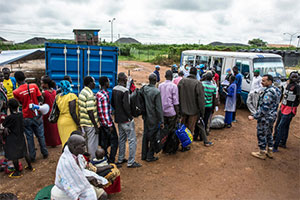 One Thousand Internally Displaced Persons (IDPs) Relocated from Tomping Camp in South Sudan. Credit: UN Photo/Isaac Billy
It took hundreds of thousands of years for the world’s human population to cross one billion in 1804. Approximately 200 years later, the population has multiplied sevenfold. In 2023, the global population crossed 8 billion, and is expected to reach 9 billion before 2050. With the planet more crowded than ever, it is essential to keep track of population trends, urbanization, migration, and reproduction across the world.
Life expectancy has seen significant strides in the past century, largely due to economic development and increased standards of living. On the contrary, trends in global fertility are shifting, with certain regions in Africa and Asia reporting higher rates, while parts of Europe and North America report stagnant or lower rates. This is in part due to differences in sexual and reproductive healthcare, as well as societal and economic conditions around the world. For example, child marriage is prevalent in certain societies, where childbearing is also considered a familial duty. Meanwhile, stagnating economies frequently experience lower marriage and childbearing rates.
The increase in migration and urban development around the world is also linked to global population trends. By 2050, it is expected that approximately 66 percent of all people will live in cities. Furthermore, global crises such as warfare and natural disasters also prompt transnational migration. Transnational migration is linked to a variety of socioeconomic issues in both host and receiving countries: migrants often leave developing countries with less access to educational and economic opportunities and arrive in developed countries where they are frequently the targets of ethnic, racial, and cultural discrimination, and economic exploitation. Recent crises in Europe and the United States demonstrate the importance of advocating for migrants worldwide. As migrants from the Global South are increasingly stripped of their legal and civic rights in unlawful deportations, or targeted in acts of identity-based violence, it is essential to keep track of population trends and protect the human rights of migrant populations. Climate-related disasters are now a major driver of displacement, with nearly half of all new internal displacements in 2025 being disaster-related.
IPS is devoted to covering issues surrounding population trends, migration, and reproduction through its compelling articles, which use both statistics and human stories to provide readers with robust and informative viewpoints.

The Week with IPS

NEXT STOP - SDGs
Tracking global progress towards a sustainable world
Tracking global progress towards a sustainable world
