Languages
Sunday, September 27, 2026



News and Views from the Global South
Poverty & SDGs

Large Corporations Cash in on COVID-19 Relief Funds
Poverty and income inequality are being deepened as COVID-19 relief funds are handed out to large corporations instead of social protection programmes in developing countries, groups involved in a new study of COVID-19 bailouts have said.
Women Leading Somalia’s Health System
Somalia is one of the most complex regions of the world, with threats and political instability, extreme weather conditions, movement of internally displaced people (IDPs), decades of conflict, poverty-related deprivation, poor health and communicable diseases that are killing people. There is a constant risk of gender violence making women, children and members of minority groups particularly vulnerable, and more so during displacement or while seeking work. Three decades of civil war and instability have weakened Somalia’s health system and contributed to it having some of the lowest health indicators in the world. The COVID-19 pandemic has added yet another strain on its tremendously fragile infrastructure presenting unexpected challenges and dilemmas.
Africa’s Worsening Climate: Here’s How the United States can Help Africa
Recently, I participated in a Congressional hearing on the “Effects of climate change in Africa”, before the House Foreign Affairs Subcommittee on Africa, Global Health, Global Human Rights, and Internal Organizations, chaired by Congresswoman, Karen Bass.
US Casts 45 Vetoes – and Counting—While Protecting a Client State
The UN Security Council (UNSC), the most powerful political body at the United Nations, has largely remained silent or ineffective in resolving one of the longstanding military conflicts in the Middle East involving Israelis and Palestinians.
Russia’s Sputnik Diplomacy
While Western countries were busy with their own vaccination campaigns, Russia has filled the leadership vacuum in developing countries. Amid the West’s scramble for vaccines, a trickle of news flies under the radar. Argentina becomes the first country in South America to produce Russia’s Sputnik V vaccine. The first shipment of Sputnik V is promised to Peru by May.
Reimagining Education with Imagination
The month of May marks mental health awareness month or mental health awareness week in several countries around the world. Many people will be reading posts and blogs about the importance of getting more sunshine and exercise to avoid the blues, about ways to deal with the stress of the pandemic, about dealing with everyday challenges that disrupt our striving for happiness.
Bridging the Digital Divide Will Save Our Planet
Data, analysis and information are essential building blocks in our race to save humanity from the clear and present risks posed by the climate crisis.
How to Assess the Willingness of US to Suspend Patent Protection on Vaccines?
The news of the Biden Administration's willingness to lift intellectual property rights protections in the case of the Covid-19 pandemic has sent the world into turmoil, even though in recent days this willingness had become increasingly airy.
Africa Goes Digital
In rebuilding after COVID-19, policymakers must invest in innovative technology to leapfrog obstacles to inclusive development. Africa has enjoyed strong economic growth for most of the 21st century, mainly because of robust global demand for primary commodities.
20 Million More People Face Food Crises, As Acute Hunger Rates Rise to a 5-Year High
The COVID-19 pandemic, protracted conflicts and climate change have created an untenable situation for the most vulnerable, with 155 million people across 55 territories suffering from severe food insecurity, sending acute hunger figures to a 5-year high.
How West African Leaders Can Tackle Youth and Gender Inequities
Recently, both Republics of Benin and Chad held their 2021 national elections. These countries are among thirteen countries on the continent billed to elect new political leaders in 2021 alone. This is a good opportunity to improve conditions on the continent. Indeed, the COVID-19 pandemic has magnified other issues on the continent like youth unemployment that better leadership could help improve.
Youth Voice and Action Critical to Reforming the World’s Food Systems
Global youth advocates have been told that they play a crucial role in ensuring that the world produces and consumes food with greater attention to nutrition, food security, equality and sustainability. As the United Nations prepares to host the inaugural Global Food Systems Summit in September, the organisation is hosting a series of dialogues to correct flaws in the way food is grown, processed, packaged and marketed, hoping to tackle growing world hunger, water scarcity and climate change.
Unlearning During a Lockdown
Children all over the world are having tough times while coping with the consequences of the pandemic but the circumstances affecting them in the Philippines are even more daunting.
Refugee Children Explain How Education Helped Put Their Trauma Behind Them
Eighteen-year-old Chuol Nyakoach lives in the Nguenyyiel Refugee Camp in Gambella, Ethiopia. Chuol is grateful that despite the trauma she has already experienced in her young life, she is able to continue her education in the refugee camp. Learning has given her a reason to wake up every day.
UN Women Launches New Programme to Foster Economic Participation in Care Industry
The lockdowns and illnesses brought on by the COVID-19 pandemic have dramatically increased the need to care for children, the elderly and the sick. And in societies where gender inequality and biased norms persist, most of this burden has fallen on women, many of whom have had to leave their regular jobs with no idea of when they can return.
A Year Later, COVID-19 Continues to Show the Fragility of Food Security
More than a year after the start of the COVID-19 pandemic, food and nutrition security continues to show its fragility.
Internet Restrictions Harm the Press & Public Alike
When Myanmar’s military seized power from the elected government in February, one of its first actions was to further squeeze the already restricted free flow of information in the country. It obstructed news stations, temporarily shuttered phone and internet access, and blocked social media platforms.
UN Banks on Water as the ‘Game Changer’ in Food Production and Consumption
As the United Nations prepares for its solutions-based Global Food Systems Summit in September, officials say resolving issues around water scarcity, pollution and wastage is crucial transforming food production and consumption.
World Press Freedom in an age of remoteness
Edmund Burke called the press the fourth estate, the fourth pillar of democracy, with an oversight role on the remaining three pillars – the legislature, executive and the judiciary. In an ideal world, this fourth estate would have unimpeded access to the other three pillars so that the citizenry could be kept informed at all times. This freedom was conceived to be so sacrosanct that many countries have included it as a fundamental right, e.g., the US Constitution enshrined it as the very first amendment.
Press Freedom Vital in the Fight Against the Pandemic
Access to accurate information is vitally important during the pandemic, so that people can understand how to protect themselves and their families, and to hold their governments to account for their response to the health emergency.
Spyware Threatens Press Freedom’s Privacy Imperative
Spyware’s repeated use to target journalists and those close to them poses an existential threat to the privacy required for press freedom to flourish. Without the ability to privately communicate with sources, conduct research, and compile information, journalists are hampered in their ability to keep the public informed and hold the powerful to account.« Previous Page — Next Page »


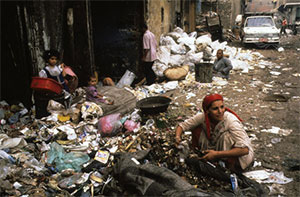 Romani people in Cairo, Egypt, forage through trash. Credit: UN Photo/Armineh Johannes
In 2015, the United Nations adopted the Sustainable Development Goals (SDGs) in an effort to promote “peace and prosperity for people and the planet.” To achieve that goal, it is essential to provide equal opportunities and access to basic services to all people. The 2025 UN SDG Report found that 35% of the 169 SDG targets are on track or making moderate progress, while 18% have reversed compared to the 2025 baseline. One in ten people still live in extreme poverty, one in eleven experience food insecurity, and over 1.1 billion people live in slums without access to clean water and sanitation. It is imperative to acknowledge the societal, technological, economic, and political issues that sustain poverty in countries around the world. Eradicating poverty will require significant frameworks in policy and governance on a national and international scale to ensure that all people will have equal access to basic services and economic opportunities by 2030. Furthermore, a dramatic reduction of United States foreign aid in 2025, including the termination of 83% of USAID programmes, threatens to erode years of fragile development gains.
Throughout the world, violent conflict and natural disasters also contribute to extreme poverty. The complete destruction of infrastructure and blockage of aid has significantly impoverished Palestine since October 7th. The destructive impact of Hurricane Maria in Puerto Rico left $91 billion in damage. An inadequate US government response also revealed significant and enduring questions within the issue of mitigating poverty: how do we rebuild infrastructure after its destruction? How do we restimulate economic development and bring in financial aid after disasters? Similar questions have been raised in the realm of regional cooperation, as devastating floods have wrecked hundreds of thousands of homes across multiple Southeast Asian nations in the past few years. Furthermore, the COVID-19 pandemic has greatly exacerbated the global poverty crisis, particularly in developing countries, setting back the United Nations goal of eradicating poverty by 2030.
IPS is committed to providing comprehensive features that focus on the persisting environmental, sociopolitical, and systemic issues that sustain poverty, and the steps taken worldwide towards poverty eradication.

The Week with IPS

NEXT STOP - SDGs
Tracking global progress towards a sustainable world
Tracking global progress towards a sustainable world

