Languages
Friday, October 23, 2026



News and Views from the Global South
Financial Crisis

How a Gay Rights Maverick Helped Topple Iceland’s Govt
By the time the political climate in Iceland was ripe for the Cutlery Revolution, Hörður Torfason was already well practiced at stirring things up.
Malawi Checks China’s African Advance
The move in Malawi to close down Chinese businesses outside of the four major cities has been condemned as xenophobic by rights organisations. A new law enforced Jul. 31 barred foreigners from carrying out trade in Malawi’s outlying and rural areas.
Teachers’ Strike Does Not Mean Political Liberation for Swaziland
Swazis should not see the ongoing nationwide one-month teachers’ strike as a movement capable of overthrowing the political regime here, despite the fact that civil servants and nurses have joined the action, according to political analyst Dr. Sikelela Dlamini.Caribbean Sees Progress on HIV/AIDS, Fears Funding Cuts
Ian McKnight, executive director of the Caribbean Vulnerable Communities Coalition (CVCC), used one word - “tokenistic” - to sum up his perspective on the 19th International AIDS Conference that ended here over the weekend.
Private Sector Debt Gnawing at Developing Countries
Twelve years after a global campaign successfully advocated the cancellation of some of the world’s poorest countries’ public debt, developing economies are again facing unsustainable debt burdens. Only this time, it is the private sector’s debt in developing economies that is inflating dangerously.
Govts Boost Nukes While Cutting Aid, Social Services
As U.N.-led talks on disarmament resume in Geneva Monday, calls are growing for nuclear-armed nations to cut spending on their stockpiles and instead divert resources to development.
Record Aid Shortfall Abandons Millions to Their Fate
Global funding for humanitarian aid interventions saw the biggest shortfalls in 10 years in 2011, according to a new report, raising questions about the international community’s ability to meet a 20-percent greater need for 2012 driven by drought and conflict.Bankers or ‘Banksters’?
European media, political leaders, and the citizenry are bashing bankers again, overtly calling them at best accomplices of numerous illegal activities, at worst downright criminals.
U.S. Aims for AIDS-Free Generation Amid Funding Cuts
As more than 20,000 health workers, scholars and activists from around the world gather here this week for a major biannual AIDS conference, observers are warning that U.S. government proposals to cut HIV/AIDS-related funding could undermine the significant potential to deal a decisive blow to the disease in the near future.
Austerity Package Sparks Protests in Spain
"This is war. Parliament has got to go! They're trying to make civil servants take the blame for a situation that was caused by the banking sector and which the government has allowed to happen."U.S.: Right-Wing Hawks, Arms Industry Rally Against Pentagon Cuts
While Iran, Russia, and China are all pretty scary, the ominous word "sequestration" is what is keeping right-wing hawks and their friends in the defence industry up at night.
Look to Developing World for Solutions, Says New World Bank Chief
Speaking on Wednesday at his first major public address, new World Bank President Jim Yong Kim said the institution needs to be more flexible and responsive, as well as more open to innovations coming from the developing world.Will Austerity Prompt Nuclear Disarmament?
The changing international political order and a dramatic budgetary situation at home are forcing France to consider giving up the extremely expensive nuclear arsenal the country has maintained since the late 1950s.‘Israeli Bouazizi’ Raises Questions
During a march Saturday marking one year since social protests engulfed Israel, a man silently set himself on fire, leaving behind him a painful “I accuse!” letter that exposes widespread disillusionment in the face of the immense expectation for change, and the abyss between the people and the State.
U.S.: Being Young and Homeless Could Get Even Worse
Amber, 24, who’s been living on the streets half her life, was sitting on a sunny sidewalk in downtown Berkeley last week, cuddling her three-month-old puppy and talking to a friend. But if voters approve a measure the city council placed on the November ballot, sitting on the sidewalk – after a warning – could cost her 75 dollars.Amid Stormy Waters, Caribbean Tacks South
The Eurozone crisis and growing influence of countries like China and Brazil are leading the Caribbean to reassess its dependence on traditional trade and aid partners.Europe Dithering on Tobin Tax
Despite the grave financial and sovereign debt crisis sweeping the region, the European Union has once again failed to reach unanimous approval of a proposition made by its executive body, the European Commission (EC), to tax financial transactions in order to reduce speculation and increase state revenues.
South Sudan Celebrates a Troubled First Birthday
The streets have been swept clean and lined with flags to mark the first anniversary of South Sudan’s independence. But cosmetic changes in the capital, Juba, mask deep concerns about the future of the world’s newest nation.
South Sudan’s Women Await Independence From Poverty
One year after the formation of South Sudan, the country’s women say that independence has not resulted in the positive political, economic and social changes that they had hoped for.U.N. Calls for Tax on Ultrarich to Boost Development
What if billionaires the world over are asked to shell out at least one percent of their wealth as an international tax for development?New Banknotes Elicit Hopes and Fears in DRC
"The macroeconomic climate is looking good, with a growth rate varying between five and seven percent," said Jean-Claude Masangu, governor of the Democratic Republic of Congo's Central Bank as he justified the release of new denominations of the Congolese franc.« Previous Page — Next Page »





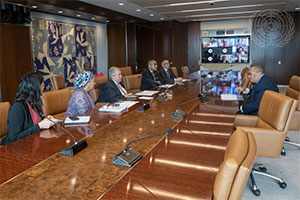 Secretary-General Meets with Members of Debt Expert Group. Credit: UN Photo/Eskinder Debeb
Financial crises are often defined by banking panics, recession, loss of market value, and deflation. Various financial crises at the turn of the 20th century, such as the Asian Crisis of 1997-1998 and the 2007-2008 Global Financial Crisis, have had immense impacts on the world economy. The COVID-19 pandemic also caused a financial crisis when mass lockdowns triggered staggering unemployment rates, a stagnation of economic growth, and led to the 2020 stock market crash. With the Russian invasion of Ukraine, the world has also witnessed a global energy crisis with shortages and increased prices in oil, gas, and electricity markets. According to UNCTAD’s World of Debt 2025, global public debt surpassed $100 trillion in 2024, with developing country debt growing twice as fast as developed economies since 2010. Burdens of debt servicing come with economic slowdowns and demands of austerity from lenders, with some economists arguing that this will lead to a new “lost decade” for the Global South. IPS brings you worldwide coverage of these financial developments and how we should manage these crises.

The Week with IPS

NEXT STOP - SDGs
Tracking global progress towards a sustainable world
Tracking global progress towards a sustainable world
