Languages
Monday, September 28, 2026



News and Views from the Global South
Green Economy

Ships Bring Your Coffee, Snack and TV Set, But Also Pests and Diseases
“Every evening, millions of people all over the world will settle into their armchairs to watch some TV after a hard day at work. Many will have a snack or something to drink…
Concern over Profit-Oriented Approach to Biodiversity in Latin America
In July 2015, the Mexican government granted a U.S. corporation permission for the use of genetic material obtained in Mexican territory for commercial and non-commercial purposes, in one of the cases that has fuelled concern in Latin America about the profit-oriented approach to biodiversity.
Literature Professor Probes Novels of the Anthropocene Age
A literature professor at Cornell University in upstate New York, Nick Admussen, has recently published an online literary essay about writing novels in the Anthropocene Age.
Native Plants Boost Local Diets in El Salvador
Juana Morales is cooking one of the most popular dishes in El Salvador: pupusas, corn tortillas with different fillings. But hers are unique: they are not made with the traditional corn tortillas, but use Maya nuts, a highly nutritional seed that has fallen out of use but whose consumption is being encouraged in rural communities.
Lessons from Germany for Latin America’s Energy Transition
Germany has been undergoing an energy transition for over 20 years, and it can offer valuable lessons to Latin America with regard to promoting renewable energy and moving towards a low-carbon economy.
Forests and Crops Make Friendly Neighbors in Costa Rica
While Latin America keeps expanding its agricultural frontier by converting large areas of forest, one country, Costa Rica, has taken a different path and is now a role model for a peaceful coexistence between food production and sustainable forestry.
San Juan City: The Smart City of the Future
The Philippines has so much to offer to the world, not only ecological treasures by way of tourism, but brilliant minds, visionaries, and craftsmen. Other nations find the uniqueness and diversity of our ecology unimaginable—such as having the third-longest coastline in the world as well as endemic species of plants and animals. Another unimaginable phenomenon, our economy remains strong despite the fact we are crossed by an average of 21 typhoons a year and is located in the Pacific Ring of Fire—prone to eruption of active volcanoes, and earthquakes.
Economic Recovery Needed To Enhance Food Security
After a half century of decline, agricultural commodity prices rose with oil prices in the 1970s, and again for a decade until 2014. Food prices rose sharply from the middle of the last decade, but have been declining since 2012, and especially since last year, triggering concerns of declining investments by farmers.
We Ignore Greenhouse Gas Emissions from the Livestock Industry at Our Own Peril
According to the UN Food and Agricultural Organization, the production of meat and other animal-based products is responsible for around 18 to 20 percent of all anthropogenic greenhouse gas emissions.
Germany’s Energy Transition: The Good, the Bad and the Ugly
Immerath, 90 km away from the German city of Cologne, has become a ghost town. The local church bells no longer ring and no children are seen in the streets riding their bicycles. Its former residents have even carried off their dead from its cemetery.
Rewriting Africa’s Agricultural Narrative
Albert Kanga Azaguie no longer considers himself a smallholder farmer. By learning and monitoring the supply and demand value chains of one of the country’s staple crops, plantain (similar to bananas), Kanga ventured into off-season production to sell his produce at relatively higher prices.
Record High Seafood Consumption Not Sustainable, Warns UN
The UN's Food and Agricultural Organisation (FAO) warned Thursday that global fish stocks cannot keep up with record consumption, with the average person now consuming 20 kilograms of fish a year.
Biogas Brings Heat and Light to Pakistan’s Rural Poor
Nabela Zainab no longer chokes and coughs when she cooks a meal, thanks to the new biogas-fueled two-burner stove in her kitchen.
Toward a More Reflective Planet
The last time the atmosphere held as much carbon dioxide as it does today was about three million years ago – a time when sea levels were 10-30 meters higher than they are now. Climate models have long struggled to duplicate those large fluctuations in sea levels – until now. Indeed, for the first time, a high-quality model of Antarctic ice and climate has been able to simulate these large swings. That is smart science, but it brings devastating news.
Making Sustainability Part of the Corporate DNA
Companies, governments and non-profit actors agree that economic growth and sustainable development have to go hand in hand to shape our increasingly globalised world in a fair way.
Can Better Technology Lure Asia’s Youth Back to Farming?
Farming and agriculture may not seem cool to young people, but if they can learn the thrill of nurturing plants to produce food, and are provided with their favorite apps and communications software on agriculture, food insecurity will not be an issue, food and agriculture experts said during the Asian Development Bank (ADB)’s Food Security Forum from June 22 to 24 at the ADB headquarters here.
Aquaculture Meets Agriculture on Bangladesh’s Low-Lying Coast
A continuous influx of sea water is threatening agriculture and food security in vast coastal areas of Bangladesh, but farmers are finding ways to adapt, like cultivating fish and crops at the same time.
The Environment: Latin America’s Battleground for Human Rights
2015 was the deadliest year on record for the killings of environmental activists around the world, according to a new Global Witness report.
What is Missing on the Global Health Front?
The last World Health Assembly (WHA) in Geneva (23-28 May) discussed the manifold global health crises that require urgent attention, and adopted resolutions to act on many issues. We are currently facing many global health related challenges, and as such multiple actions must be taken urgently to prevent these crises from boiling over.
Building Africa’s Energy Grid Can Be Green, Smart and Affordable
It’s just after two p.m. on a sunny Saturday and 51-year-old Moses Kasoka is seated outside the grass-thatched hut which serves both as his kitchen and bedroom.
Climate-Proofing Agriculture Must Take Centre Stage in African Policy
After over a year of extreme weather changes across the world, causing destruction to homes and lives, 2015-16 El Niño has now come to an end.« Previous Page — Next Page »


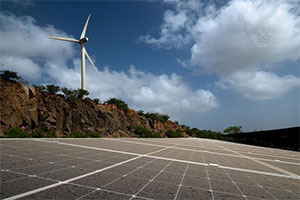 Renewable Energy in Cabo Verde. Credit: UN Photo/Mark Garten
A green economy is an economic model that aims to reduce environmental risks and build a sustainable future. Many of the UN SDGs seek to facilitate a green economy, such as ensuring access to affordable and reliable clean energy, building sustainable cities and communities, and implementing urgent action to combat climate change. Various key negotiations have strived to achieve a green economy, such as the Green New Deal and the Inflation Act of 2022. COP30, held in Belém, Brazil in 2025, agreed to mobilize $1.3 trillion annually for climate action and launched the Belém Mission to 1.5°C. However, the conference was not able to develop a fossil fuel reduction roadmap. Recent years have witnessed a sharp transformation in the geopolitical landscape of international sustainability cooperation. In March 2025, the United States stepped back from formal multilateral support for the SDGs, while China is on the rise as an international leader in renewable energy production. The actions of these global powers may shape shifting alliances on environmental governance. IPS is dedicated to sharing timely news on international developments in building a sustainable future.

The Week with IPS

NEXT STOP - SDGs
Tracking global progress towards a sustainable world
Tracking global progress towards a sustainable world
