Languages
Saturday, September 26, 2026



News and Views from the Global South
Green Economy

Native Seeds Sustain Brazil’s Semi-Arid Northeast
In his 76 years of life, Raimundo Pinheiro de Melo has endured a number of droughts in Brazil’s semi-arid Northeast region. And he remembers every one of them since 1958. “The worst one was in 1982 and 1983, the only time that the river dried up,” said Pinheiro do Melo, who has lived near the river since 1962. “The one in 1993 was also very bad,” he told IPS, because neither Bolsa Familia nor Networking in Brazil’s Semi-Arid Region (ASA) existed yet, which contribute to a less traumatic coexistence with droughts like the current one, which has dragged on for five years.
No More Mass Deaths from Drought in Northeast Brazil
The drought that has plagued Brazil’s semiarid Northeast region since 2012 is already more severe than the 1979-1983 drought, the longest in the 20th century. But prolonged dry spells no longer cause the tragedies of the past.
Agroecology Booming in Argentina
Organic agriculture is rapidly expanding in Argentina, the leading agroecological producer in Latin America and second in the world after Australia, as part of a backlash against a model that has disappointed producers and is starting to worry consumers.
Feminism Helps Villagers Coexist with Drought in Northeast Brazil
“The vegetable garden changed my life,” said Rita Alexandre da Silva, in the village of Primeiro do Maio where 65 families have obtained land to grow crops since 1999, in this municipality in the state of Rio Grande do Norte, in Northeast Brazil.
Carbon Tax Could Boost Green Energy in Bangladesh
Bangladesh is weighing a World Bank proposal to introduce a carbon tax, the first of its kind in the South Asian nation, amid fears of a backlash from consumers.
Developmentalism and Conservation Clash Out at Sea
“We don’t have access to marine areas, because most are protected areas or are in private hands. We indigenous people have been losing access to our territories, as this decision became a privilege of the state,” complained Donald Rojas, a member of the Brunka indigenous community in Costa Rica.
SDGs: Making the Universal Agenda Truly Universal
One of the key features of the 2030 Agenda which the United Nations and member states identified in the lead up to the SDG agreement was the principle of universality.
Convincing Investors to Unlock Africa’s Green Energy Potential
Lowering investment risks in African countries is key to achieving a climate-resilient development pathway on the continent, say experts here at the U.N.-sponsored Climate Conference.
Adaptation Funding a Must for Africa
The Paris Agreement hammered out at the summit on climate change in the French capital last year committed all parties to low-carbon and climate-resilient economies. The big question at the follow-up meeting here in Marrakech is how that deal will be implemented, especially for the developing nations of Africa.
President of UNGA Disillusioned by Unsustainable Development
Development should be about more than building roads or buying air conditioners, the President of the UN General Assembly, Peter Thomson told IPS in a recent interview.
Indigenous Land Rights Bring Economic, not just Environmental Benefits
Secure indigenous land rights not only bring environmental benefits, they can also foster economic development, according to a new report released by the World Resources Institute.
$90tn Infrastructure Investment Could Combat Climate Change: Report
The world will need to more than double its current infrastructure stock over the next 15 years - a massive undertaking which could either contribute to or combat catastrophic climate change - according to a new report.
Making Policy out of Scientific Bricks, not Straw
Given the enormity of the challenges confronting humanity, the world’s investment in science, technology and innovation is woefully inadequate.
Making African Palm Oil Production Sustainable
“In San Lorenzo they cut down the jungle to plant African oil palms. The only reason they didn’t expand more was that indigenous people managed to curb the spread,” Ecuadorean activist Santiago Levy said during the World Conservation Congress.
When It Comes to Conservation, Size Matters
When the communities living in the Tatamá y Serranía de los Paraguas Natural National Park in the west of Colombia organised in 1996 to defend their land and preserve the ecosystem, they were fighting deforestation, soil degradation and poaching.
Dire Warnings But Also Hope as IUCN Environmental Congress Opens
A congress billed as the world’s largest ever to focus on the environment has opened to warnings that our planet is at a “tipping point” but also with expressions of hope that governments, civil society and big business are learning to work together.
Obama Stresses Climate Change Urgency Ahead of IUCN Congress
U.S. President Barack Obama has stressed the urgency of tackling climate change in a speech to Pacific leaders in his home state of Hawaii.
Indigenous People Demand Shared Benefits from Forest Conservation
"Why don’t the authorities put themselves in our shoes?” asked Cándido Mezúa, an indigenous man from Panama, with respect to native peoples’ participation in conservation policies and the sharing of benefits from the protection of forests.
Thailand’s Sufficiency Economy Philosophy and the Sustainable Development Goals
The UN’s 17 Sustainable Development Goals (SDGs) don’t just define development in terms of economic growth, they also call for sustainable use of the world’s limited natural resources.
Asia, Looking Beyond the Green Revolution
 More than 2.2 billion people in Asia rely on agriculture for their livelihoods, but the Asian Development Bank warns that stagnant and declining yields of major crops such as rice and wheat can be ultimately linked to declining investments in agriculture. Public investments in agriculture in India, for instance, have been roughly the same since 2004.

Ships Bring Your Coffee, Snack and TV Set, But Also Pests and Diseases
“Every evening, millions of people all over the world will settle into their armchairs to watch some TV after a hard day at work. Many will have a snack or something to drink…« Previous Page — Next Page »


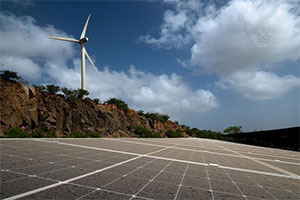 Renewable Energy in Cabo Verde. Credit: UN Photo/Mark Garten
A green economy is an economic model that aims to reduce environmental risks and build a sustainable future. Many of the UN SDGs seek to facilitate a green economy, such as ensuring access to affordable and reliable clean energy, building sustainable cities and communities, and implementing urgent action to combat climate change. Various key negotiations have strived to achieve a green economy, such as the Green New Deal and the Inflation Act of 2022. COP30, held in Belém, Brazil in 2025, agreed to mobilize $1.3 trillion annually for climate action and launched the Belém Mission to 1.5°C. However, the conference was not able to develop a fossil fuel reduction roadmap. Recent years have witnessed a sharp transformation in the geopolitical landscape of international sustainability cooperation. In March 2025, the United States stepped back from formal multilateral support for the SDGs, while China is on the rise as an international leader in renewable energy production. The actions of these global powers may shape shifting alliances on environmental governance. IPS is dedicated to sharing timely news on international developments in building a sustainable future.

The Week with IPS

NEXT STOP - SDGs
Tracking global progress towards a sustainable world
Tracking global progress towards a sustainable world
