Languages
Sunday, November 15, 2026



News and Views from the Global South
Labour
EUROPE: Financial Crisis Leads to Rapes
Several groups across Eastern Europe have called for a crackdown on mafia-run job agencies amid reports that their members are raping and torturing migrant workers who have lost their jobs in the economic crisis.
AFGHANISTAN: Carpet Industry Crippled Without Govt Help
Carpet weaving has long been a part of Afghanistan's history and culture.BRAZIL: Marching for Real Land Reform
After 10 years of waiting for secure title to the land they occupy and farm, 35 families in Resende, in the southeastern Brazilian state of Rio de Janeiro, have joined a huge march organised by the Landless Workers Movement (MST) in Brasilia to demand effective agrarian reform.LABOUR-GUATEMALA: Domestics Finally Gain (Limited) Rights
"What really hurt was that they refused me my right to rest before and after I had my baby. Even when my contractions started, they wouldn't let me go to the hospital," said Mildred Díaz, a Guatemalan domestic employee, talking about the worst aspects of her job.
TRADE: Carpets – Made in Afghanistan for Pakistan’s Profit
The Afghan carpet weaving industry is Afghanistan's second largest, behind only agriculture in terms of size and number of people employed.
RIGHTS-SOUTH AFRICA: Women Want Land to Call Their Own
In 1956, twenty thousand women marched to parliament to protest discriminatory pass laws. The march, commemorated as Women’s Day in South Africa on Aug. 9 each year, has become iconic of women’s quest for equality.INDIA: Kashmir Carpet Industry Hit By Recession
Kashmir’s carpet industry has been hit very hard by the global economic slowdown, 47-year-old Bashir Ahmad Bhat explained while working on his loom in a run-down hut in downtown Srinagar.
HEALTH-SOUTH AFRICA: Wheeling and Healing
Every weekday morning, a stylish procession leaves the offices of MaAfrika Tikkun NGO in Delft, Cape Town; bumps and jolts through the gravel entry gates; then hits the tar and scatters into every corner of the township...
AGRICULTURE: Cultivating Rural Prosperity in Cameroon
Emilie Nyate has a two million CFA smile on her face these days. She's one of the beneficiaries of the Roots and Tubers Market- Oriented Programme, known better by its French acronym of PNDRT, which is transforming the lives of small-scale farmers in Cameroon.
PARAGUAY: Indigenous Squatter Communities Organise Self-Help
Indigenous families living in a squatter settlement on the outskirts of the Paraguayan capital are organising themselves, and now have a community soup kitchen and are producing and selling handicrafts. They don't want to return to panhandling on the streets of Asunción, so far from their home villages.EUROPE: Focus Shifts to Trafficking of Males
Governments and third sector organisations must raise awareness of a growing problem with male human trafficking in some of Eastern Europe's poorest countries if its victims are to get the help they need, people trafficking monitors say.
RIGHTS-BULGARIA: Two Women Take on Defence Ministry
Two young women are suing Bulgaria's Ministry of Defence over gender discrimination in the mainly ceremonial, National Guard - a case that could go a long way in changing patriarchal social norms.
URUGUAY: Eight-Hour Day for Rural Workers
Seventy years old now, Mr. Arrúa lives a comfortable enough life in Durazno, a town in central Uruguay. But he still remembers when his father took him to work as a farmhand when he was only nine.
ECONOMY-ANGOLA: Entrepreneurial Spirit Born Out of Necessity
"Amiga, amiga," the women shout out, "Apples, pears, pineapples..." their cries fading into the beeps and growls of the traffic noise.POVERTY-SWAZILAND: Planning Oversight Halts Food Security Programme
A Food-for-Work programme, which cleverly aims to combat both environmental degradation and food shortages, has come to a halt due to lack of long-term planning.
AUSTRALIA: Male Job Losses Rise as Families Count Costs
Despite concerns that female workers would bear the brunt of Australian job losses due to the global economic downturn, employees in the male-dominated manufacturing industry have so far been the hardest hit.
LATIN AMERICA: While Women Pull Double Shift, State Looks the Other Way
Little does it matter if they’re black or white, rich or poor, young or old. Neither does it matter if they work or hold a degree. In Latin America, women bear the brunt of household chores, child-raising and care of the elderly, while the state looks the other way.CUBA: What Schools Can and Cannot Do for Equality
They are sisters, just two years apart, and had the same upbringing and education, but they have completely different aspirations. While Ana, the younger, dreams of going to university and following a professional career, Marlén is only interested in boyfriends, getting married and living happily and quietly at home.FINANCE: Remittances to Poor Countries Plunge up to 10 Percent
The amount of money immigrants from poor countries send to their families back home is expected to decline between seven and 10 percent in 2009 compared to 2008 levels, according to a new report released here Monday by the World Bank.EUROPE: Bringing Up a ‘Lost Generation’
A "lost generation" of children vulnerable to crime and exploitation is growing up in Eastern Europe as their parents migrate abroad for work and leave them behind, migration watchdogs warn.SAUDI ARABIA: New Bill Fails to Protect Domestic Workers, HRW Says
Despite a bill passed by Saudi Arabia's Shura Council on Wednesday, a prominent New York-based human rights group is asking for more protection for the estimated 1.5 million domestic workers in the country.« Previous Page — Next Page »


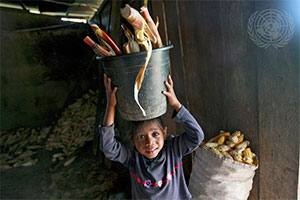 Timorese Girl with Fresh-Picked Corn. Credit: UN Photo/Martine Perret
A global common denominator is the need for a decent job. The economic realities of each country determine just how difficult it is to find one. Despite the labour movement's achievements, serious challenges persist: gender discrimination, child labour, worker migration, the digital divide and AI automation, evaporating pensions, unsafe workplaces, corporate pressure against union organising, negative impacts of trade agreements, and the precariousness of informal employment. The 2025 UN SDG Report identifies jobs and social protections as one of the six priority areas requiring urgent action, with progress either stalled or reversing in many developing nations.
In recent years, the fight to protect labour equality has taken on new dimensions with the rise of Environmental, Social and Governance standards. With the Social aspect aiming to promote equality and human rights, ESG principles have strengthened labour advocacy within corporate and governmental regulatory landscapes. In particular, ESG has become much more institutionalized in emerging economies such as Brazil and China. IPS follows the world’s workers as they confront these challenges - their setbacks and their successes.

The Week with IPS

NEXT STOP - SDGs
Tracking global progress towards a sustainable world
Tracking global progress towards a sustainable world
