Languages
Saturday, October 3, 2026



News and Views from the Global South
Labour

A Taste of India in Australia’s Hinterland
Julmat Khan migrated from the seaside resort town of Digha in West Bengal, India, about 14 years ago to the coastal tourist town of Broome in Western Australia. He is amongst a small proportion of international migrants to have settled in a regional town instead of Australia’s popular metropolises of Sydney and Melbourne.
Merkel’s Defeat Confirms Dismal Trend for Europe
Generally, media have failed to analyse why the result of German elections is the worst possible. Merkel is not a winner, but a leader now in a very fragile position, who will have to make many compromises and pay now for her mistakes. Let us make at least the most important four points of analysis.
More Public Spending, Not Tax Cuts, for Sustainable, Inclusive Growth
The Trump administration’s promise to increase infrastructure spending should break the straightjacket the Republicans imposed on the Obama administration after capturing the US Congress in 2010. However, in proportionate terms, it falls far short of Roosevelt’s New Deal effort to revive the US economy in the 1930s.
Even in School, More Than Half of All Children Aren’t Learning, Says UNESCO
Six out of ten children in the world are not achieving basic proficiency in reading and mathematics, a new report by the United Nations Educational, Scientific and Cultural Organization (UNESCO) shows.
Gov’t Actions, Not Religion, ‘Tipping Point’ for African Youths Joining Violent Extremism
Government action, rather than religious ideology, is a stronger predictor for radicalization in Africa, according to a two-year landmark study by the United Nations Development Programme (UNDP).
Parliamentarians a “Fourth Pillar” of Sustainable Development
Investing in youth and the population dividend, women's health, sustainable development objectives, and the key role of parliamentarians to promote transparency, accountability and good governance to achieve the 2030 Agenda on Sustainable Development topped the agenda of a two-day conference of Asian and African lawmakers in New Delhi last week.
Out of Africa: Understanding Economic Refugees
Not a single month has passed without dreadful disasters triggering desperate migrants to seek refuge in Europe. According to the International Organization for Migration (IOM), at least 2,247 people have died or are missing after trying to enter Europe via Spain, Italy or Greece in the first half of this year. Last year, 5,096 deaths were recorded.
Ending Modern Slavery
Two centuries ago, right here in this city soon to emerge as the world’s center of commerce, a coalition of clergy, government officials, business leaders and rescued victims rose to fight the scourge of human slavery.
ITUC: The Global Economic Model has Failed
Sharan Burrow has just returned from a long weekend in Latin America. In Panama she met with laborers. Out in the real world. That is where she is most at home. Where working conditions are poor. Conditions that she has spent her life trying to change.
South-South trade cooperation key to sustainable and inclusive model of globalization
Thanks to globalization and trade liberalization of commodities, services and goods, global trade has reached an unprecedented level. According to the United Nations Conference on Trade and Development, world trade in goods was valued at approximately USD 16 trillion. North-North trade generates the highest trade volume at approximately 6 trillion; trade flows within and between countries of the Global South amounts to 4.6 trillion. Trade between the Global South and the Global North -approximately between 2.5 and 3 trillion - add up to less than the trade flows within the Earth’s two main poles.
How Aid in Cash, Not Goods, Averted a Famine in Somalia
In February, when the government of Somalia sounded an alarm to the UN about risks of a famine in the country, the UN’s Office of Coordination of Humanitarian Affairs (OCHA), besides quickly shuffling a response team, was acting from a steep sense of history. The Office, instead of sending out massive aid packages, distributed cash vouchers to families who could spend it to buy goods according to their needs.
Cambodia no Longer Compliant with the Global Deal
Swedish Prime Minister Stefan Löfven made a special effort to reach this global agreement between countries, unions and businesses. The bearing idea is that by initiating dialogue in society, salaries can be raised, business profits improved and political stability strengthened.
Robots: A Solution to Declining and Aging Populations?
Are humanoid robots or androids a solution to declining and aging populations? Given the prospects of demographic decline and population aging coupled with growing opposition to immigration, countries are increasingly turning to and investing in advanced robotics and androids to address shrinking workforces and rising numbers of elderly.
Small Entrepreneurs Emerge as Backbone of Bangladesh’s Rural Economy
She was born in the early 1950’s to an ultra-poor family in Kundihar, a remote village of Banaripara of Barisal division in Bangladesh. She was a beautiful baby and her father named her ‘Shahndah Rani’ which means ‘Queen of Evenings’. But in reality her life was far from that of a queen.
Union Conflict Rages on in South Africa
It was two thirty at night. Inside his home, the telephone rang. Sibongile Nota’s brother’s life drew nearer its end. A few minutes passed, the telephone rang again. His brother was now dead.
Women Slowly Break Barriers in Bangladesh
When one thinks of Bangladesh, its political leadership naturally comes to mind as the leaders of the country’s major parties are women, including the Prime Minister, the Opposition Leader and the Speaker of the National Parliament.
Women Build Rural Infrastructure in Bangladesh
Breaking all the social barriers and taboos, poor women in Bangladesh are now engaged in rural development works across the country as labourers.
Promise or Peril? Africa’s 830 Million Young People by 2050
Last month, Spanish charity workers rescued 167 migrants arriving from Africa aboard a small boat.
Leadership Failure Perpetuates Stagnation
What kind of leadership does the world need now? US President Franklin Delano Roosevelt’s leadership was undoubtedly extraordinary. His New Deal flew in the face of the contemporary economic orthodoxy, begun even before Keynes’ General Theory was published in 1936.
World Still Lagging on Indigenous Rights 10 Years After Historic Declaration, UN Experts Warn
The world’s indigenous peoples still face huge challenges a decade after the adoption of an historic declaration on their rights, a group of United Nations experts and specialist bodies has warned. Speaking ahead of the International Day of the World’s Indigenous Peoples on 9 August, the group says States must put words into action to end discrimination, exclusion and lack of protection illustrated by the worsening murder rate of human rights defenders.
Zaatari Camp Marks Fifth Year With 80,000 Refugees
Jordan’s Zaatari camp, which opened in 2012 as a makeshift camp to house Syrian refugees fleeing the war, marked its fifth year on June 28.« Previous Page — Next Page »


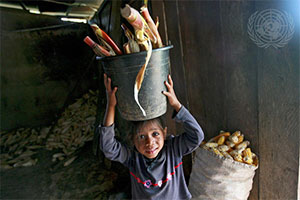 Timorese Girl with Fresh-Picked Corn. Credit: UN Photo/Martine Perret
A global common denominator is the need for a decent job. The economic realities of each country determine just how difficult it is to find one. Despite the labour movement's achievements, serious challenges persist: gender discrimination, child labour, worker migration, the digital divide and AI automation, evaporating pensions, unsafe workplaces, corporate pressure against union organising, negative impacts of trade agreements, and the precariousness of informal employment. The 2025 UN SDG Report identifies jobs and social protections as one of the six priority areas requiring urgent action, with progress either stalled or reversing in many developing nations.
In recent years, the fight to protect labour equality has taken on new dimensions with the rise of Environmental, Social and Governance standards. With the Social aspect aiming to promote equality and human rights, ESG principles have strengthened labour advocacy within corporate and governmental regulatory landscapes. In particular, ESG has become much more institutionalized in emerging economies such as Brazil and China. IPS follows the world’s workers as they confront these challenges - their setbacks and their successes.

The Week with IPS

NEXT STOP - SDGs
Tracking global progress towards a sustainable world
Tracking global progress towards a sustainable world
