Languages
Sunday, October 4, 2026



News and Views from the Global South
Labour

Has Disability Risen among the Elderly?
The Rights of Persons with Disabilities Act 2016 (or RPD Act) is laudable in its intent and procedural detail, but mostly silent on disabilities among the elderly. Indeed, for this reason alone, it is arguable that its overarching goal—“The appropriate Government shall ensure that the persons with disabilities enjoy the right to equality, life with dignity and respect for his or her integrity equally with others” —is mere rhetoric, if not a pipe dream.
“The Time is Now” to Invest in Youth, Girls
The demographic dividend: though not a new concept, it is one of the major buzzwords at the UN this year. But what does it really mean? There are 1.8 billion young people between the ages of 10 and 24 around the world, the most in the history of humankind.
Migrant Contributions to Development: Creating a “New Positive Narrative”
Despite the “undeniable” benefits of migration, barriers including public misconceptions continue to hinder positive development outcomes, participants said during a series of thematic consultations here on safe, orderly, and regular migration.
The Unnoticed Demise of Democracy
Politicians are so busy fighting for their jobs, they hardly seem to notice that they risk going out of business. Democracy is on the wane, yet the problem is nowhere in Parliaments. Common to all is a progressive loss of vision, of long term planning and solutions, with politics used just for power.
Parliamentarians Study Nexus of Youth, Refugees and Development
Held for the first time in the Arab world, an annual meeting of Asian and Arab Parliamentarians examined how regional conflicts hinder the development of effective policies to achieve sustainable development, particularly as they generate large numbers of refugees, internally displaced persons and migrants.
Brazil’s Shipyards – Victims of a Failed Reindustrialisation Process
“I have lived through three good periods and two bad ones,” prior to the present crisis in the Brazilian shipping industry, said Edson Rocha, a direct witness since the 1970s of the ups and downs of a sector where nationalist feelings run high.
Don’t Move Resources from Development to Security, Warns UN Chief
Twenty years ago, when I was starting my functions as Prime Minister of Portugal, the world was surfing a wave of optimism. The Cold War had ended, technological prosperity was in full swing, the internet was spreading and there was the idea that globalisation would not only increase global wealth, but that it would trickle down and would benefit everybody in our planet.
How to Achieve Universal Goals, Strategically
Discussion around the 2030 Agenda for Sustainable Development, a list of 17 goals listed by the UN, was all the buzz in the conference rooms of UN headquarters this week.
Civil Society on SDG Engagement: “We Are Not Guests”
Showing up in record numbers, civil society groups are urging greater inclusion and accountability in sustainable development processes at a UN high level meeting.
The Arab Youth Bulge and the Parliamentarians
More than ever before, the Arab region now registers an unprecedented youth population growth while facing huge challenges such as extremely high unemployment rates --more than half of all regional jobless population--, and inadequate education and health provision, in particular among young women.
Climate Change-Poverty-Migration: The New, Inhuman ‘Bermuda Triangle’
World organisations, experts and scientists have been repeating it to satiety: climate change poses a major risk to the poorest rural populations in developing countries, dangerously threatening their lives and livelihoods and thus forcing them to migrate.
An African Atlas for Youth and Sustainable Development
As its population changes, Africa has the potential to transform its society into one that is productive and prosperous, according to a new report.
‘Address African Rural Youth Unemployment Now or They Will Migrate’
 In 2014 alone, about 11 million young Africans entered the labour market. But many see few opportunities in the agriculture sector and are constrained by a lack of skills, low wages, and limited access to land and financial services. Combined, this makes them more prone to migrate from rural areas.

Top 300 Cooperatives Generate 2.5 Trillion Dollars in Annual Turnover
The top 300 cooperatives alone generate 2.5 trillion dollars in annual turnover, more than the Gross Domestic Product (GDP) of France, according to the UN Department of Economic and Social Affairs (UNDESA).
Ending Child Marriage Could Add Trillions to World Economy
The benefits of ending child marriage are many—boosting a young girl’s morale and increasing her chances of education and work, and by that virtue, curbing high population rates in developing economies and boosting growth.
Putting the Spotlight on Women Migrant Workers
Migrant workers, and their economic contribution to the development of both the country of origin and the host country, have caught the eye of governments and policymakers worldwide.
Rural Poverty? Cooperatives!
Humanity has had and has big projects. Mastery of nature is one, still going on. Middle range phenomena have been mastered, but not the micro level of viri–HIV is a current case–nor the macro level of climate–to the contrary, humanity is making it worse.
Global Devaluation of Work Drives Up Unemployment in Brazil
In addition to driving up the number of unemployed people to 14.2 million, the severe recession of the last two years led Brazil to join the global trend of flexibilisation of labour laws in order to further reduce labour costs.
The World Society Needs to Express Greater Solidarity for Refugees Worldwide
The world is heading into troubled waters as we are witnessing an unprecedented movement of people – refugees, migrants and internally displaced persons (IDPs) alike – fleeing from misery, poverty and conflicts. The refugee crisis that has swept across Europe and the Middle East is becoming the 21st century’s most protracted crisis with no immediate solution in sight. The world has not witnessed a more complex movement of people since the end of the Second World War; thousands of human beings undertake perilous and treacherous journeys in hope for a better and a safer future. Many of them perish during these hazardous journeys.
UN Work Stoppage in Geneva Halts Human Rights Meeting
As UN staffers in Geneva threaten a strike, protesting a proposed salary cut of over 7.5 percent, a token two-hour “work stoppage” last week forced the Human Rights Council to suspend its meeting.
Africa: Drought and Jobless, Hopeless Youth, Fertile Grounds for Extremism
Ignoring the plight of jobless young people in sub-Saharan Africa is a recipe for political instability and global insecurity, warned a high-level symposium of Africa’s interior, environment and foreign affairs ministers in Ouagadougou, Burkina Faso.« Previous Page — Next Page »


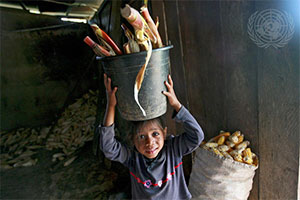 Timorese Girl with Fresh-Picked Corn. Credit: UN Photo/Martine Perret
A global common denominator is the need for a decent job. The economic realities of each country determine just how difficult it is to find one. Despite the labour movement's achievements, serious challenges persist: gender discrimination, child labour, worker migration, the digital divide and AI automation, evaporating pensions, unsafe workplaces, corporate pressure against union organising, negative impacts of trade agreements, and the precariousness of informal employment. The 2025 UN SDG Report identifies jobs and social protections as one of the six priority areas requiring urgent action, with progress either stalled or reversing in many developing nations.
In recent years, the fight to protect labour equality has taken on new dimensions with the rise of Environmental, Social and Governance standards. With the Social aspect aiming to promote equality and human rights, ESG principles have strengthened labour advocacy within corporate and governmental regulatory landscapes. In particular, ESG has become much more institutionalized in emerging economies such as Brazil and China. IPS follows the world’s workers as they confront these challenges - their setbacks and their successes.

The Week with IPS

NEXT STOP - SDGs
Tracking global progress towards a sustainable world
Tracking global progress towards a sustainable world
