Languages
Thursday, August 27, 2026



News and Views from the Global South
Natural Resources

El Salvador Passes Pathbreaking Law Banning Metal Mining
El Salvador, Central America’s smallest country, has become the first country in the world to pass a law banning metal mining in all its forms, setting a precedent for other nations in the world to follow, according to activists and local residents.
World Bank Ignores Land Grabbing
Sales of huge land areas of Ethiopia, by the Ethiopian government, to foreign investors, have led to starvation and forced displacement. In his documentary Dead Donkeys Fear no Hyenas, Swedish film director Joakim Demmer exposes the consequences of land grabbing, and holds the World Bank complicit.
Caribbean Faces Forecast for Prolonged Drought
The Caribbean Drought & Precipitation Monitoring Network (CDPMN) is warning countries in the region that the same abnormal climate conditions they have experienced over the last few years, which resulted in some of the worst drought in two decades, could continue this year.
1 in 4 Children Worldwide Facing Extremely Scarce Water by 2040
Warning that as many as 600 million children – one in four worldwide – will be living in areas with extremely scarce water by 2040, the United Nations children's agency has called on governments to take immediate measures to curb the impact on the lives of children.
Civil Society Representatives: “Water is the Foundation of our Life”
“Water is life”—a slogan that arose from the anti-Dakota Access Pipeline movement is one that resonates not only in the U.S., but around the world as millions still lack access to clean, safe water.
Climate Breaks All Records: Hottest Year, Lowest Ice, Highest Sea Level
Climate has, once more, broken all records, with the year 2016 making history-highest-ever global temperature, exceptionally low sea ice, unabated sea level rise and ocean heat. And what is even worse-- extreme and unusual trends continue in 2017.
Don’t Understand Clouds? But You Should!
Obviously, there are so many issues and phenomena that have been brought up by growing impact of climate change that one would likely not think about. Some of them, however, are essential and would be good to learn about. For instance, the fact that clouds play a "pivotal role" in weather forecasts and warnings.
No Water, No Life – Don’t Waste It!
During the final exams of Spanish official high school of journalists, a student was asked by the panel of professors-examiners: If scientists discover that there is water in Planet Mars, how would you announce this news, what would be your title? The student did not hesitate a second: “There is life in Mars!” The student was graduated with the highest score.
Asia’s Water Politics Near the Boiling Point
In Asia, it likely will not be straightforward water wars.
Three Times as Many Mobile Phones as Toilets in Africa
Though key to good health and economic wellbeing, water and sanitation remain less of a development priority in Africa, where high costs and poor policy implementation constrain getting clean water and flush toilets to millions.
Guyana’s New Oil Fields Both Blessing and Curse
The recent discovery of large volumes of oil offshore of Guyana could prove to be a major headache for the country, as the Caribbean Community (CARICOM) and other Alliance of Small Island States (AOSIS) members press for keeping global temperature rise to 1.5 degrees C above pre-industrial levels as provided for in the historic Paris Climate Agreement.
Another Town in El Salvador Votes No to Mining
The citizens of Cinquera municipality in Cabañas delivered a resounding vote against mining, on Sunday February 26th, when 98 percent of residents voted in favour of becoming El Salvador's fifth "territory free of mining."
Maritime Boundary Dispute Masks Need for Economic Diversity in Timor-Leste
Juvinal Dias has first-hand experience of mistreatment at the hands of a foreign power. Born in 1981 in Tutuala, a village in the far east of Timor-Leste, Dias’ family fled into the jungle following the 1975 invasion by Indonesia.
Antarctic Ice Lowest Ever – Asia at High Risk – Africa Drying Up
For those who still deny the tangible impact of climate change, please note that the extended spell of high global temperatures is continuing; the Arctic is witnessing exceptional warmth with record low ice volumes--the lowest on record; global heat is putting Asia on higher risk than ever, and Africa is drying up.
Netherlands to Host Global Centre of Excellence on Climate Adaptation
The Netherlands announced that it will work with Japan and UN Environment Programme (UNEP) to establish a Global Centre of Excellence to help countries, institutions and businesses to adapt to a warming climate, which is increasing the frequency of natural disasters and causing economic disruptions.
UN Declares War on Ocean Plastic
The available data is enough for the United Nations to literally declare war on oceans plastic: more than 8 million tonnes of leaks into their waters each year – equal to dumping a garbage truck of plastic every minute, wreaking havoc on marine wildlife, fisheries and tourism, and costing at least 8 billion dollars in damage to marine ecosystems.
Humankind’s Ability to Feed Itself, Now in Jeopardy
Mankind’s future ability to feed itself is in jeopardy due to intensifying pressures on natural resources, mounting inequality, and the fallout from a changing climate, warns a new United Nations’ report.
Shrinking and Darkening, the Plight of Kashmir’s Dying Lakes
Mudasir Ahmad says that two decades ago, his father made a prophecy that the lake would vanish after the fish in its waters started dying. Three years ago, he found dead fish floating on the surface, making him worried about its fate.
Making the Deep Blue Sea Green Again
Children growing up in the Seychelles think of the ocean as their backyard, says Ronald Jean Jumeau, Seychelles' ambassador for climate change.
Alternative Mining Indaba Makes Its Voice Heard
“Comrades, we have arrived. This cherry is eight years awaited. We have made it to this place,” Bishop Jo Seoka told the crowd, pausing to allow for the whistles and cheers.
“Serious Retreats” In Indigenous Rights Protection, Says UN Rapporteur
As the 10-year anniversary for the Declaration on Indigenous Rights approaches, UN indigenous rights activists came together to assess the many challenges that still remain on the ground.« Previous Page — Next Page »


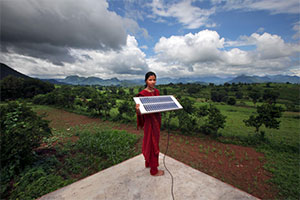 Bringing clean energy to rural India. Credit: Abbie Trayler-Smith / Panos Pictures / Department for International Development
Large reserves of oil, gas and minerals in developing countries generate opulent revenues. They could be used to stimulate economic growth and reduce poverty, but often result in environmental destruction and conflict, benefiting large companies and corrupt governments. Furthermore, competition over natural resources often manifests through geopolitical conflict. For example, before the US-Iraq war, Iraq’s domestic oil industry was nationalized. With US aggression came weakened Iraqi institutions and foreign intervention, thus eventually leading to the privatization of Iraqi oil, leaving the industry now largely dominated by Western companies. As another example, China’s rising investments within the lithium sector in South America are increasing the US-China rivalry across the Western Hemisphere. Notably, Bolivia has the largest reserves of lithium in the world, and the nation’s state-owned lithium extraction firm recently signed a contract with China’s CBC Consortium, while rejecting the entry of Western firms into the nation. In Bolivia’s case, rising Chinese investment in the nation’s lithium sector also raises concerns about environmental sustainability and the sociopolitical rights of Indigenous communities. More broadly, Sub-Saharan Africa holds nearly 30% of global reserves of critical minerals required for low-carbon technologies. Despite this, the region attracts less than 10% of global exploration investment, depicting a critical barrier to both the clean energy transitions and Sub-Saharan Africa’s economic development. Furthermore, resource wealth continues to fuel conflict like Sudan’s civil war, which has led to 9.1 million internally displaced people and is intensely connected to competition over gold, water, and agricultural land. IPS covers news about major oil, gas, and mining projects, their effects on the environment and local communities, and the ideas and actions of the interest groups involved.

The Week with IPS

NEXT STOP - SDGs
Tracking global progress towards a sustainable world
Tracking global progress towards a sustainable world
