Languages
Friday, August 28, 2026



News and Views from the Global South
Natural Resources

Can Africa Slay Its Financial Hydra?
Thanks to growing investor interest, increasing respect for democratic reforms, and its vast food production potential, the Africa Rising narrative is only getting better.
Drought Could Cost Sri Lanka Billions
The warnings are stark, the instructions, for a change, clear. Sri Lanka is heading into one of its worst droughts in recent history, and according some estimates the worst in 30 years. The reservoirs are running on empty, at 30 percent or less capacity. Only 12 percent of the island’s power generation is currently from hydropower and 85 percent comes from thermal, with a staggering 41 percent from coal.
Looting and Unrest Spread in Mexico Over Gas Price Hike
“We are absolutely fed up with the government’s plundering and arbitrary decisions. We don´t deserve what they’re doing to us,“ said Marisela Campos during one of the many demonstrations against the government´s decision to raise fuel prices.
Anti-Fracking Movement Alarmed at Trump’s Focus on Fossil Fuels
Earl Hatley, a descendant of the Cherokee/Delaware tribe, has witnessed the consequences of using hydraulic fracturing or “fracking” on his native land to produce shale gas.
Battle Lines Drawn Over Indian Mega Mine
Among those leading the fight against the massive Indian-owned Carmichael coal project in Australia’s Queensland state is 21-year-old Murrawah Johnson of the Wangan and Jagalingou aboriginal people, the traditional owners of the land where the proposed mine is to be located.
Bringing South Africa’s Small-Scale Miners Out of the Shadows
In a country with unemployment rising above 25 percent, South Africans are increasingly looking for job creation in small-scale mining, an often-informal industry that provides a living for millions across the continent.
Beyond Standing Rock: Extraction Harms Indigenous Water Sources
Since the decision by the U.S. army to suspend the Dakota Access pipeline on 4 December, many are still unsure of the controversial pipeline's future or its implications for other mega infrastructure projects affecting indigenous communities across North America.
Soil: Keeping Nutrients in Food and Carbon in the Ground
Healthy soil not only makes food more nutritious it also helps keep carbon out of the atmosphere by storing it underground.
Unleashing Africa Full Potential
Africa, the cradle of mankind and home to the youngest population in the world, has a historic opportunity to realise its full potential, in sharing our potential prosperity, by enhancing economic growth, promoting and entrenching democratic ideals. That is why I am so passionate to be running for the coveted African Union Commission (AUC) Chairperson.
Coal Mine Threatens Ecological Paradise in Chile’s Patagonia Region
An open-pit coal mine in the southern island of Riesco, a paradise of biological diversity in Chile’s southern Patagonia wilderness region, is a reflection of the weakness of the country’s environmental laws, which are criticised by local residents, activists, scientists and lawmakers.
Battle of the Desert (II): A ‘Great Green Wall for Africa’
Desertification, land degradation, drought, climate change, food insecurity, poverty, loss of biodiversity, forced migration and conflicts, are some of the key challenges facing Africa—a giant continent home to 1,2 billion people living in 54 countries.
Phosphate Mining Firms Set Sights on Southern Africa’s Sea Floor
A persistent fear of diminishing phosphorus reserves has pushed mining companies to search far and wide for new sources. Companies identified phosphate deposits on the ocean floor and are fighting for mining rights around the world.
Funding Lags to Combat Land Degradation
Land degradation already affects millions of people, bringing biodiversity loss, reduced availability of clean water, food insecurity and greater vulnerability to the harsh impacts of climate change.
Kenya Greens Drylands to Combat Land Degradation
Faced with growing degradation that is swallowing large swathes of land in arid and semiarid areas, Kenya is heavily investing in rehabilitation efforts to stave off the threat of desertification.
Changing Climate Threatens World’s Smallholder Farmers
Farmers are already experiencing the effects of climate change but can also help to fight it, according to a new report released by the UN Food and Agriculture Organization (FAO).
Indigenous Land Rights Bring Economic, not just Environmental Benefits
Secure indigenous land rights not only bring environmental benefits, they can also foster economic development, according to a new report released by the World Resources Institute.
Resisting the Dakota Access Pipeline: “This Is Not The End”
Resistance towards the controversial Dakota Access pipeline continues after a federal court rejected requests to halt construction on Monday.
Amid South Africa’s Drought, Proposed Mine Raises Fears of Wetlands Impact
The dam supplying Johannesburg’s water sits less than 30 percent full. Water restrictions have been in place since November and taxes on high water use since August. Food prices across South Africa have risen about 10 percent from last year, in large part due to water shortages.
Environmental Crimes Could Warrant International Criminal Court Prosecutions
The International Criminal Court (ICC) will pay more attention to crimes of environmental destruction and land-grabs, according to a new policy paper published by the court.
Unregulated Promotion of Mining in Malawi Brings Hazards and Hardships
Nagomba E. is no longer young; her hip is giving her trouble and her back is stooped from years of bending over her corn and rice fields. Yet every morning, at the crack of dawn, the wiry 74-year-old sets out on a strenuous half-hour walk to fetch water from a nearby river so that her ailing husband can take a bath. Despite her limp, Nagomba moves fast and with the sure-footedness of a mountain goat.
New Government Inherits Conflict over Peru’s Biggest Mine
Of the 150 socioeconomic conflicts related to the extractive industries that Peru’s new government inherited, one of the highest-profile is the protest by the people living near the biggest mining project in the history of the country: Las Bambas.« Previous Page — Next Page »


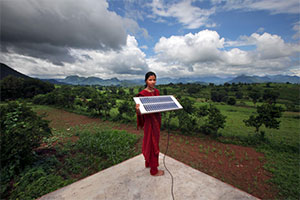 Bringing clean energy to rural India. Credit: Abbie Trayler-Smith / Panos Pictures / Department for International Development
Large reserves of oil, gas and minerals in developing countries generate opulent revenues. They could be used to stimulate economic growth and reduce poverty, but often result in environmental destruction and conflict, benefiting large companies and corrupt governments. Furthermore, competition over natural resources often manifests through geopolitical conflict. For example, before the US-Iraq war, Iraq’s domestic oil industry was nationalized. With US aggression came weakened Iraqi institutions and foreign intervention, thus eventually leading to the privatization of Iraqi oil, leaving the industry now largely dominated by Western companies. As another example, China’s rising investments within the lithium sector in South America are increasing the US-China rivalry across the Western Hemisphere. Notably, Bolivia has the largest reserves of lithium in the world, and the nation’s state-owned lithium extraction firm recently signed a contract with China’s CBC Consortium, while rejecting the entry of Western firms into the nation. In Bolivia’s case, rising Chinese investment in the nation’s lithium sector also raises concerns about environmental sustainability and the sociopolitical rights of Indigenous communities. More broadly, Sub-Saharan Africa holds nearly 30% of global reserves of critical minerals required for low-carbon technologies. Despite this, the region attracts less than 10% of global exploration investment, depicting a critical barrier to both the clean energy transitions and Sub-Saharan Africa’s economic development. Furthermore, resource wealth continues to fuel conflict like Sudan’s civil war, which has led to 9.1 million internally displaced people and is intensely connected to competition over gold, water, and agricultural land. IPS covers news about major oil, gas, and mining projects, their effects on the environment and local communities, and the ideas and actions of the interest groups involved.

The Week with IPS

NEXT STOP - SDGs
Tracking global progress towards a sustainable world
Tracking global progress towards a sustainable world
