Languages
Friday, October 16, 2026



News and Views from the Global South
Natural Resources
Explainer: How the GEF Funds Global Environmental Action
The Global Environment Facility, widely known as the GEF, plays a central role in financing environmental protection across the world. It supports developing countries in tackling climate change, biodiversity loss, land degradation, pollution, and threats to ecosystems.
Civil Society Launch a Campaign Against Extractive Industry Exploitation and Land Grabs
Over 800 households in Ikolomani Constituency in Kakamega County, Western Kenya, fear eviction to pave the way for a British firm, Shanta Gold Limited, to begin extracting gold valued at Sh683 billion ($5.29 billion) on an estimated 337 acres of residential and agricultural land.
Nations pledge $3.9bn to Global Environment Facility as Race to Meet 2030 Goals Tightens
With just four years left to meet a series of global environmental targets, governments are committing to shore up one of the world’s main environmental funds, the Global Environment Facility (GEF), with a $3.9 billion pledge.
“Humanity at the Edge of Its Own Humanity”
We live in a century of extraordinary achievement. Humanity has split the atom, mapped the genome, and sent astronauts to the Moon, with plans now underway to reach Mars. Our knowledge has expanded, our tools have become more powerful, and our capacity to shape the world around us exceeds anything previous generations could have imagined. We communicate instantaneously across continents, diagnose diseases earlier, monitor climate patterns in real time, and design artificial intelligences that can aid in everything from medicine to climate modelling.
Ugandan Farmers Sue EACOP in London in Last Minute Effort to Stop Crude Oil Pipeline
Environmental activists and farmer groups opposed to the construction of the East African Crude Oil Pipeline (EACOP), the world's longest heated oil pipeline, are mounting a last-ditch legal effort meant to stop its construction in a suit they plan to have filed in London, UK, believing that it stands a chance to stop the controversial project despite being at the 78 percent completion stage.
It Is Time For Africa to Fund Its Health Security
Relying on foreign aid is bad for Africa's health and it must stop if the continent is to enjoy health security.
Artisanal Miners in Western Kenya Move Away From Mercury
They call this land Bushiangala. Gold has been mined here for nearly a century. In 1931, colonial prospectors arrived after traces were found in the nearby Yala River, setting off a rush that changed this quiet corner of western Kenya.
As East Africa’s Migratory Fish Vanish, a Food Security Crisis Surfaces
By the time the auction begins at Nangurukuru fish market in Tanzania’s southern Lindi region, the crisis is already visible. Wooden canoes that once returned from the Rufiji River with heavy catches now bring only a fraction of what they used to. Traders scan for the long-whiskered catfish that once defined the market but find none.
World Heating Faster Than Expected, Scientists Sound Alarm in latest UN Report
The global climate system continued its alarming trajectory in 2025, with multiple indicators reaching record or near-record extremes, underscoring the accelerating pace of climate change and its cascading impacts on ecosystems and human societies, according to the latest State of the Global Climate 2025 report released by the World Metereological Organisation (WMO).
80 Percent of Rural Households Without Direct Water Access – World Water Report
A new United Nations report has warned that global water inequality remains one of the most pressing development challenges of the decade, with billions still lacking safe drinking water and sanitation – while women and girls continue to bear the heaviest burden of water insecurity.

Africa’s Minerals Boon, Cautious Optimism Amid Geopolitical Disruptions
Africa’s eye on minerals as the be-all-and-cure-all for the continent’s development agenda is being tested by geopolitical gamesmanship as global superpowers jostle to carve new spheres of influence.
Oil Shocks, Political Upheaval and the One Solution Governments Keep Ignoring
Once again, global oil prices are spiking, driven by the Israeli-US war against Iran. With Iran retaliating by attacking infrastructure and transport hubs and blocking the Strait of Hormuz, through which one-fifth of the world’s oil passes, oil supplies from the region are being choked, pushing up prices. The cost of a barrel of Brent crude – the international benchmark for oil prices – stood at US$73 before the conflict but has surged beyond US$100 since. It could go higher still as war continues.
Tanzania, Mozambique and Malawi Launch $7.12 Million GEF Project to Protect the Ruvuma Basin
At dawn, the Ruvuma River moves quietly through a vast wetland along the border between Tanzania and Mozambique. Its muddy waters appear calm, disturbed only by drifting logs and the occasional ripple.
One in Four Migratory Species Under Threat, But Conservation Efforts Can Reap Rewards
Global wildlife is facing a deepening crisis as the latest United Nations assessment warns that nearly half of the world’s migratory species are in decline due to human activity, habitat destruction, and climate change.
Financing Africa’s Biodiversity Conservation With Dwindling Donor Support
As the global community marks 2026 World Wildlife Day today (March 3), this year's focus is on Medicinal and Aromatic Plants: Conserving Health, Heritage and Livelihoods. However, beneath these celebrations, a difficult question emerges: who will bear the cost of conservation when traditional donor funding becomes uncertain and in the face of climate change?
As Biodiversity Loss Grows, Rome Talks Urge Nations to Step Up Action
Governments meeting in Rome last week acknowledged that global efforts to protect nature are still not moving fast enough, even as biodiversity loss continues to affect ecosystems, livelihoods, and economies worldwide.
From Pledges to Proof: UN Biodiversity Meeting Begins First Global Review of Nature Action
Governments convened in Rome on Monday (February 16) for a critical round of UN biodiversity negotiations, launching the world’s first global review of how countries are acting to protect nature.
Support Science in Halting Global Biodiversity Crisis—King Charles
British Monarch King Charles says science is the solution to protecting nature and halting global biodiversity loss, which is threatening humanity’s survival.
Big Nature-Based Finance Turnaround Needed to Restore, Protect Ecosystems
The world is pouring trillions of dollars each year into activities that destroy nature while investing only a fraction of that amount in protecting and restoring the ecosystems on which economies depend, according to a new United Nations report released on January 22.
World Living Beyond Its Means: Warns UN’s Global Water Bankruptcy Report
The world has entered what United Nations researchers now describe as an era of Global Water Bankruptcy, a condition where humanity has irreversibly overspent the planet’s water resources, leaving ecosystems, economies, and communities unable to recover to previous levels.
Experts Urge Rapid Adaptation as India Braces for ‘Stronger’ Cyclones, Quakes
Despite early warnings reportedly reaching communities before the cyclones (Ditwah and Senyar) struck coastal regions in Sri Lanka and Southeast Asia late in November 2025, over 1,500 people lost their lives and hundreds went missing even as millions were impacted by these disasters, which caused massive destruction. Scientists say that these disasters reflect a changing climate system, which is making cyclones more hazardous than what we considered “typical” in the past.« Previous Page — Next Page »





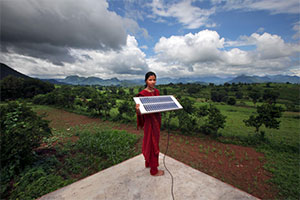 Bringing clean energy to rural India. Credit: Abbie Trayler-Smith / Panos Pictures / Department for International Development
Large reserves of oil, gas and minerals in developing countries generate opulent revenues. They could be used to stimulate economic growth and reduce poverty, but often result in environmental destruction and conflict, benefiting large companies and corrupt governments. Furthermore, competition over natural resources often manifests through geopolitical conflict. For example, before the US-Iraq war, Iraq’s domestic oil industry was nationalized. With US aggression came weakened Iraqi institutions and foreign intervention, thus eventually leading to the privatization of Iraqi oil, leaving the industry now largely dominated by Western companies. As another example, China’s rising investments within the lithium sector in South America are increasing the US-China rivalry across the Western Hemisphere. Notably, Bolivia has the largest reserves of lithium in the world, and the nation’s state-owned lithium extraction firm recently signed a contract with China’s CBC Consortium, while rejecting the entry of Western firms into the nation. In Bolivia’s case, rising Chinese investment in the nation’s lithium sector also raises concerns about environmental sustainability and the sociopolitical rights of Indigenous communities. More broadly, Sub-Saharan Africa holds nearly 30% of global reserves of critical minerals required for low-carbon technologies. Despite this, the region attracts less than 10% of global exploration investment, depicting a critical barrier to both the clean energy transitions and Sub-Saharan Africa’s economic development. Furthermore, resource wealth continues to fuel conflict like Sudan’s civil war, which has led to 9.1 million internally displaced people and is intensely connected to competition over gold, water, and agricultural land. IPS covers news about major oil, gas, and mining projects, their effects on the environment and local communities, and the ideas and actions of the interest groups involved.

The Week with IPS

NEXT STOP - SDGs
Tracking global progress towards a sustainable world
Tracking global progress towards a sustainable world
