Languages
Friday, October 23, 2026



News and Views from the Global South
Natural Resources
Women Warriors Take Environmental Protection into Their Own Hands
Aleta Baun, an Indonesian environmental activist known in her community as Mama Aleta, has a penchant for wearing a colourful scarf on her head, but not for cosmetic reasons.
Will Obama’s “New Africa” Deliver on Its Promises?
As the three-day U.S- Africa Leaders Summit here drew to a close Wednesday, experts across the private, public and non-profit sectors continued to debate the opportunities and obstacles posed by the U.S’ expanding business partnership with Africa.
Bringing “Smart” Building Technology to Jamaica’s Shantytowns
Buildings are among the largest consumers of earth’s natural resources. According to the Sustainable Buildings and Climate Initiative, they use about 40 percent of global energy and 25 percent of global water, while emitting about a third of greenhouse gas emissions.
Africa Activists Urge Obama to Act on Extractive Industries Law
As the three-day U.S.-Africa Leaders Summit got underway here Monday, anti-corruption activists urged President Barack Obama to prod a key U.S. agency to issue long-awaited regulations requiring oil, gas, and mining companies to publish all payments they make in countries where they operate.
Will Climate Change Lead to Conflict or Cooperation?
The headline of every article about the relationship between climate change and conflict should be “It’s complicated,” according to Clionadh Raleigh.
The ‘Global’ Land Rush
The first years of the twenty-first century will be remembered for a global land rush of nearly unprecedented scale.
U.S. Summit Seeks to Play Catch-Up in Africa
Despite worsening crises in Ukraine, Gaza, and elsewhere in the Middle East, the administration of President Barack Obama hopes next week to focus at least some more positive attention on Africa.World Bank Board Declines to Revise Controversial Draft Policies
A key committee of the World Bank’s governing board Wednesday spurned appeals to revise a draft policy statement that, according to nearly 100 civil-society groups, risks rolling back several decades of reforms designed to protect indigenous populations, the poor and sensitive ecosystems.Land Grabbing – A New Political Strategy for Arab Countries
Food price rises as far back as 2008 are believed to be the partial culprits behind the instability plaguing Arab countries and they have become increasingly aware of the importance of securing food needs through an international strategy of land grabs which are often detrimental to local populations.
Is Europe’s Breadbasket Up for Grabs?
Amidst an exodus of some 100,000 people from the conflict-torn eastern Ukraine, ongoing fighting in the urban strongholds of Donetsk and Luhansk between Ukrainian soldiers and separatist rebels, and talk of more sanctions against Russia, it is hard to focus on the more subtle changes taking place in this eastern European nation.
Oil Alliance Between China and Costa Rica Comes to Life Again
China’s plan to become Costa Rica’s main energy ally through the joint reconstruction of an oil refinery has been revived after the presidents of the two countries agreed to review the conditions of the project during a meeting in the Brazilian capital.
Food – Thou Shall Not Waste
“Only two years ago, the soup kitchen was serving 50 meals a day. Today the number has almost doubled and, what is even more worrying, we have started receiving families with children,” says Donatella Turri, director of the Caritas Diocese of Lucca.
Antigua Weighs High Cost of Fossil Fuels
Caught between its quest to grow the economy, create jobs and cut electricity costs, and the negative impacts associated with building an oil refinery, the Antigua and Barbuda government is looking to a mix of clean energy and fossil fuels to address its energy needs.
Drought and Misuse Behind Lebanon’s Water Scarcity
In front of Osman Bin Affan Mosque, in a central but narrow street of Beirut, several tank trucks are being filled with large amounts of water. The mosque has its own well, which allows it to pump water directly from the aquifers that cross the Lebanese underground. Once filled, the trucks will start going through the city to supply hundreds of homes and shops.
A Carrot Is a Carrot – or Is It?
Food security is often thought of as a question of diversifying supply and being able to move food through areas plagued by local scarcity, relying on the global economic system – including trade and transport – as the basis for operations.
OPINION: The Affinity Between Iraqi Sunni Extremists and the Rulers of Saudi Arabia
Which story line sounds the more credible – that linking the rebel movement ISIS (the Islamic State in Iraq and Syria) to policies pursued by Iran or that linking the Sunni extremist force to Iran’s adversary Saudi Arabia?
Fish Before Fields to Improve Egypt’s Food Production
Less than four percent of Egypt’s land mass is suitable for agriculture, and most of it confined to the densely populated Nile River Valley and Delta. With the nation’s population of 85 million expected to double by 2050, government officials are grappling with ways of ensuring food security and raising nutritional standards.
Oil Lubricates Equatorial Guinea’s Entry into Portuguese Language Community
Evidently, oil talked louder. By unanimous resolution, the Community of Portuguese Language Countries (CPLP) admitted Equatorial Guinea as a full member, in spite of the CPLP’s ban on dictatorial regimes and the death penalty.
Cameroon’s Rising Sea Drowns Tourism
Pierre Zambo is a hotel manager in Kribi, a sea resort town in Cameroon’s South Region. In the past his hotel would have “more than 100 tourists each week. But today if I manage to have 50 people registered into my hotel weekly, then it's good business.”
Forest Rights Offer Major Opportunity to Counter Climate Change
The international community is failing to take advantage of a potent opportunity to counter climate change by strengthening local land tenure rights and laws worldwide, new data suggests.
Disasters Poised to Sweep Away Development Gains
Extreme poverty and hunger can be eliminated, but only through far greater efforts to reduce carbon emissions that are overheating the planet and producing punishing droughts, catastrophic floods and ever wilder weather, said climate activists involved in talks to set the Sustainable Development Goals (SDGs).« Previous Page — Next Page »





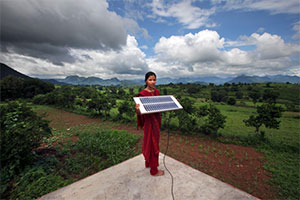 Bringing clean energy to rural India. Credit: Abbie Trayler-Smith / Panos Pictures / Department for International Development
Large reserves of oil, gas and minerals in developing countries generate opulent revenues. They could be used to stimulate economic growth and reduce poverty, but often result in environmental destruction and conflict, benefiting large companies and corrupt governments. Furthermore, competition over natural resources often manifests through geopolitical conflict. For example, before the US-Iraq war, Iraq’s domestic oil industry was nationalized. With US aggression came weakened Iraqi institutions and foreign intervention, thus eventually leading to the privatization of Iraqi oil, leaving the industry now largely dominated by Western companies. As another example, China’s rising investments within the lithium sector in South America are increasing the US-China rivalry across the Western Hemisphere. Notably, Bolivia has the largest reserves of lithium in the world, and the nation’s state-owned lithium extraction firm recently signed a contract with China’s CBC Consortium, while rejecting the entry of Western firms into the nation. In Bolivia’s case, rising Chinese investment in the nation’s lithium sector also raises concerns about environmental sustainability and the sociopolitical rights of Indigenous communities. More broadly, Sub-Saharan Africa holds nearly 30% of global reserves of critical minerals required for low-carbon technologies. Despite this, the region attracts less than 10% of global exploration investment, depicting a critical barrier to both the clean energy transitions and Sub-Saharan Africa’s economic development. Furthermore, resource wealth continues to fuel conflict like Sudan’s civil war, which has led to 9.1 million internally displaced people and is intensely connected to competition over gold, water, and agricultural land. IPS covers news about major oil, gas, and mining projects, their effects on the environment and local communities, and the ideas and actions of the interest groups involved.

The Week with IPS

NEXT STOP - SDGs
Tracking global progress towards a sustainable world
Tracking global progress towards a sustainable world
