
Monday, September 14, 2026



News and Views from the Global South
Globalisation

The Role of the State in Developing Countries under Attack from New FTAs
Two new trade agreements involving the two economic giants, the United States and the European Union, are leading a charge against the role of the state in the economy of developing countries.
Revenge Rises From Sinai
The violence in Cairo came amidst firm indications that Muslim Brotherhood members hit back after a brutal crackdown this week that left many hundreds dead. And the winds of retaliation have blowing in from the Sinai peninsula, the desert to the east.Linking Fair and SQUAR in Myanmar
What’s less than two months old, has hit the headlines globally, and has more than 79,000 ‘likes’ and over 16,000 people talking about it?Mongolia Wrestles with Dutch Disease Dilemma
Ochir Damchaa chuckles as he drives his second-hand Toyota sedan through the alleyways of Nalaikh, a ramshackle town 35 kilometres east of Ulaanbaatar: “There’re just two kinds of jobs here: drive a taxi, or dig coal.”
Freeing Prisoners, at a Price
Standing in front of the makeshift memorial corner of his deceased children that he arranged in the room , Tzion Swery says to himself, “How ironical that we mark the 12th anniversary of their death on Tuesday just as Israel starts releasing Palestinian prisoners.”
Ivory Course Runs From Africa to Malaysia to China
A distance of nearly 9,000 kilometres separates Malaysia from Africa, but that hasn’t stopped the Southeast Asian nation from becoming a key staging post in the illegal trade of ivory from Africa to China.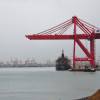
Seeking More Indian Business, With Chinese Help
As he stood on the westernmost edge of Colombo’s new harbour expansion, it was hard for Priyath Bandu Wickrema - the man tasked with reinventing the port as a regional giant - to cap his enthusiasm.Global Value Chains from a Development Perspective
The current discourse on Global Value Chains by key proponents and also the World Trade Organisation (WTO) secretariat is that developing countries should liberalise - in goods and services - and conclude a trade facilitation agreement.
Interpol ‘Misused’ by Human Rights Abusers
The world's largest international policing organisation Interpol is being used by governments to track down political opponents and human rights campaigners, an IPS investigation reveals.
Making Peace with Our Futures
Future studies, like peace-development-environment studies, is an interdisciplinary, international effort to get a grip on key issues, divided into ‘preferred futures’ – utopias – whose?; ‘predicted futures’ – forecasting – who does it, for whom?; and ‘future practice’ – scenarios bending the predicted toward the preferred – by and for whom?Economists’ Fantasies, Planetary Nightmares
While debating a high frequency trader recently, I encountered the familiar rationalisations that high frequency trading (HFT) contributes to liquidity and price discovery in markets. Assertions about liquidity are hard to justify after the “flash crash” of May 6, 2010, where the “faux liquidity” of HFT disappeared when needed and the traditional market-making obligations of the old specialists were absent.
Brazil Wide Open to Cyber Invasion
Brazil, reportedly one of the main targets of U.S. signals spying, is attempting to untangle a web of hi-tech espionage with low-tech equipment reminiscent of a novel by British author John le Carré.Big Brother Is Watching Us
We were afraid this would happen. We had been warned by books (George Orwell's "1984") and films (Steven Spielberg's "Minority Report") that with the progress being made in communication technology, we would all end up under surveillance.
A New Bretton Woods, to Prevent Future Crises?
Almost five years have passed since the global financial crisis, and the world economy is still reeling from its consequences. The main reason for this is the continued stagnation in developed countries, which is adversely affecting economic dynamism in other regions.
Brazil Holds Key to Door Between Pacific Alliance and Mercosur
The Mercosur and Pacific Alliance blocs can strengthen Latin American integration rather than weaken it, analysts say.
The New Fascism
The atrocious Second World War left behind lasting damage by lowering our standards for what is marginally acceptable.
If Not Quantitative Easing, Then What?
It took world leaders some time to realise that the financial crisis initiated by the collapse of the subprime mortgage segment of U.S. financial markets in 2007 would not exhaust its effects in an ordinary recession.
Climate Change to Determine Economic Growth
The Monetary Board of Sri Lanka’s Central Bank, tasked with keeping the island’s economy on an even keel, does not only keep tabs on exchange rates, gold prices and inflation – it also has an eye on a less obvious indicator of economic stability: water levels in the country’s main reservoirs.
Opponents Question Proposed Trans-Atlantic Trade Deal
Controversy is building following the announcement that negotiations will soon begin on a free trade agreement between the United States and European Union, with critics warning that any such agreement could negatively affect a host of regulatory concerns.
Job Creation Looming Challenge for Post-2015 World
In the aftermath of the global economic crisis and with three years to go until the 2015 deadline of the Millennium Development Goals, global leaders are struggling to formulate a post-2015 agenda that can address the widespread dilemmas of employment and inclusive growth.
Time for a Leap Forward for the European Union
Three different models for regional unification have been proposed by the movement for European integration since its inception. One vision is a league of states that preserve national sovereignty while committing themselves to follow specific policies agreed by consensus.« Previous Page — Next Page »


The international flow of capital and the emergence of diverse blocs and alliances are dramatically reshaping lives and the environment all around us, with the world's poorest paying the price of prosperity for the few. But the globalisation process offers unprecedented advantages too. Since WWII the possibilities for international cultural, social and economic interaction have increased at an explosive rate. The effects of these trends on trade, geopolitics, environment, media and many other fields are interconnected and extremely complex. IPS news agency seeks to analyse the free trade initiatives' impact on the individual, as well as the behaviour of corporations, international finance institutions and the multilateral system, giving visibility to the perspectives of a more diverse range of people, including civil society and the individual.

The Week with IPS

Tracking global progress towards a sustainable world
