
Friday, September 18, 2026



News and Views from the Global South
Globalisation

Nicaragua Takes Decisive Step Towards Chinese Construction of Canal
A five-century wait could come to an end when the Nicaraguan government grants a concession this year to a Chinese company to build a canal between the Pacific and Atlantic oceans, despite local protests and international scepticism.
Reforming U.S. Food Aid Would Eliminate 7,000-Mile Food Chain
Lawmakers attempted Wednesday to push along an ongoing effort to modernise U.S. international food aid policy amid mounting bipartisan support for the use of more locally grown food products over the long-standing practise of shipping U.S.-grown commodities.
Behind the Climate Finance Headlines
Developed countries report that they delivered more than 33 billion dollars in Fast Start Finance (known as FSF), beyond the pledges they made at COP 15 in Copenhagen in 2009. Recent analysis suggests that the funding delivered may have exceeded 38 billion dollars. But that is not the whole story.
Are Developing Countries Waving or Drowning?
More than five years since the outbreak of the global financial crisis, the world economy has shown few signs of stabilising and moving towards strong and sustained growth.Shift in Latin America’s Approach to Drugs – from Security to Health Issue
The drug problem should be tackled not as a security issue but as a public health question, with policies for "prevention, treatment and rehabilitation," delegations from the 34 countries participating in the 43rd General Assembly of the Organisation of American States agreed.
Quantitative Easing: Impact on Emerging and Developing Economies
The global economy is awash with successive waves of liquidity generated over the past few years by the four most advanced economies, viz., the United States, the European Union, (EU), Japan and the United Kingdom, known as the G4. This liquidity has taken the form of “quantitative easing” (QE).
Native People More Than Just Park Rangers
Some good-byes can actually mean the start of a long road working together. That was how it felt at the end of the World Indigenous Network (WIN) conference in this northern Australian city.
Sharing Indigenous Knowledge from All Ends of the Globe
This city in northern Australia brought them together to share their experiences this week. They are indigenous Shipiba people fighting indiscriminate logging in Peru’s Amazon jungle region and delegates from the Ando-Kpomey community in Togo, which created and protects a 100-hectare forest.
Guardians of the Land and Sea Meet in Darwin
“Are you a park ranger?” IPS asked. “No, I am one of the owners of the territory,” Ángel Durán responded in a firm voice. The Bolivian indigenous leader is in this northern Australian city along with 1,200 other native delegates from over 50 countries for the World Indigenous Network (WIN) conference.
Europe on the Edge of the Abyss
The economic crisis began in the United States under the administration of then-President George W. Bush, following the collapse of the Lehman Brothers Bank. It came as a result of unregulated globalisation and a neoliberal ideology that places usurious markets, offshore bank accounts, and money for the sake of money, above state power. It is an ideology that ignores citizens, even as they starve.
Australian Retailers Feel Heat of Bangladesh Tragedy
Australia’s largest textile workers’ union and activist groups are up in arms that the country’s leading retail chains, who source most of their fashion labels from Bangladesh, are refusing to sign a legally binding accord that will help to improve labour and safety standards in Bangladeshi garment factories.
Indian Gov’t on Collision Course With Civil Society
For years India’s pro-liberalisation, Congress party-led coalition government chafed at civil society groups getting in the way of grand plans to boost growth through the setting up of mega nuclear power parks, opening up the vast mineral-rich tribal lands to foreign investment and selling off public assets.
Remittances Buoy Up Myanmar’s Economy
Nangnyi Foung reaches into the dryer, pulls out another pair of pants and places it on the ironing board. "I still have several more loads to go," she says as the clock strikes nine p.m., marking the start of her 14th hour on the shift.
Has Caribbean Diplomacy Lost Its Mojo?
Whether by accident or coincidence, recent days have seen a variety of Caribbean leaders and journalists question whether the region is failing to pursue leadership roles within international organisations - and thus losing its voice in global issues like trade, climate change, and peace and security.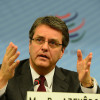
WTO Chooses New Latin American Chief to Mark a Change in Course
Brazilian diplomat Roberto Carvalho de Azevêdo was named the new director general of the WTO with broad support from the developing world, beating out his Mexican rival Herminio Blanco, who was backed by the industrialised nations.
U.S. Gov’t Accused of “Corporate Diplomacy” for Biotech Industry
A consumer protection group here is accusing U.S. diplomats of engaging in a concerted and at times forceful advocacy campaign on behalf of genetically modified seeds and even specific biotechnology companies, particularly aiming to influence governments in developing countries.
Culture Becomes Latest Front in Afghanistan’s War
Another kind of war, less explosive than bombs and more subtle than night raids, is taking place in the Central Asian country of Afghanistan: a war of cultural influence. Its means are financial sponsorships and other support for cultural and artistic events.
Developing Resilience to Financial Shocks
The global repercussions of the 2007-2008 financial crisis are a stark reminder of the economic interdependence in our globalising world. No country was spared from the shock waves that originated in the financial systems of developed economies.Institutional Tangles, Deindustrialisation Hurt Mercosur
July will mark the start of a new era for the Common Southern Market (Mercosur), when it will expand to five full members, if the South American bloc manages to overcome the commotion caused by the admission of Venezuela and the suspension of Paraguay.
U.N. Harnesses Social Media to Reach Outside World
As the world continues to turn digital, so does the United Nations - slowly but steadily.
Japan’s Aid Programme Takes a Selfish Turn
As Japan slips from its former top spot as the world’s biggest donor, experts here are worried about long-term changes in the country’s development assistance programme, which has played a crucial role in global poverty reduction efforts.« Previous Page — Next Page »


The international flow of capital and the emergence of diverse blocs and alliances are dramatically reshaping lives and the environment all around us, with the world's poorest paying the price of prosperity for the few. But the globalisation process offers unprecedented advantages too. Since WWII the possibilities for international cultural, social and economic interaction have increased at an explosive rate. The effects of these trends on trade, geopolitics, environment, media and many other fields are interconnected and extremely complex. IPS news agency seeks to analyse the free trade initiatives' impact on the individual, as well as the behaviour of corporations, international finance institutions and the multilateral system, giving visibility to the perspectives of a more diverse range of people, including civil society and the individual.

The Week with IPS

Tracking global progress towards a sustainable world
