Languages
Sunday, November 15, 2026



News and Views from the Global South
Asia-Pacific

The Roots of Exodus: Why Are People Compelled to Leave their Homes?
Facts are facts, and one of them is that while everybody talks about the growing forced movement of people --be they migrants or refugees—decision-makers haven’t seriously acted on the root causes of why millions of humans are compelled to leave their homes.
Adolescent Health Congress Skirts Issue of Abuse, Trafficking
Twenty-year-old Gogontlejang Phaladi of Mahalapye, Botswana is grateful she was never sent to a so-called “hyena” like scores of girls in neighboring Malawi were.
Stopping Child Marriage Forever
The mother moved in like a tigress to save her cub. In 2015, when her 13-year-old daughter Shumi Akhter was about to be married off, Panna Begum pleaded with her husband, Dulal Mia, to cancel the marriage he’d arranged for their daughter.
Kashmir’s Farmland Plowed Under in Wave of Urbanization
In central Kashmir’s Ganderbal district, 40-year-old Javaid Ahmad Hurra remembers vividly how his small hamlet used to be lush and green when he was a child. It is now subtly turning into a concrete jungle, with cement structures dominating the scenery.
Developing World Faces Challenge of Large Ageing Population
Experts on population ageing converged in Seoul this week to discuss how to make reaching one's "golden years" a happy and sustainable process across the world.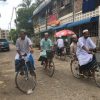
Myanmar’s Democracy Feels Strain of Religious Fault Lines
I try to hold on tight as my driver navigates his motorbike over a bumpy and muddy track. His helmet is decorated with a swastika and an eagle, part of an ill-inspired fashion trend called Nazi chic. It's symbolic for a country where hate and racism seen to have become normalized.
Why 1997 Asian Crisis Lessons Lost
Various different, and sometimes contradictory lessons have been drawn from the 1997-1998 East Asian crises. Rapid or V-shaped recoveries and renewed growth in most developing countries in the new century also served to postpone the urgency of far-reaching reforms. The crises’ complex ideological, political and policy implications have also made it difficult to draw lessons from the crises.
Rohingya Crisis Stokes Fears of Myanmar’s Muslims
In a quiet street, the sound of children's voices can be heard from an open window. They are reciting verses of the Koran in unison. The small Islamic school lays hidden in a walled neighborhood where only Muslims live. This is an island of tranquility in Mandalay, the second-largest city of predominantly Buddhist Myanmar.
Lack of International Action on Rohingya Crisis Called a “Disgrace”
As the crisis in Myanmar reaches unprecedented levels, frustration is at its peak as the international community remains slow to respond and act cohesively.
What Do You Really Eat When You Order a Steak, Fish or Chicken Filet?
The world is running out of antibiotics to combat the growing threat of antimicrobial resistance, the UN World Health Organization (WHO) warned while announcing the World Antibiotic Awareness Week on 13-19 November.
New Villages Bloom in the Shadow of a Mountain’s Wrath
Repeated volcanic eruptions of Mount Sinabung since 2010 have displaced thousands of people, leaving villages around the mountain deserted, with volcanic ash, lava and mud covering the soil, trees and empty houses.
How to Change the Future of Migration
The world is on the move. More people have been forced to flee their homes than at any time since the Second World War due to increased conflict and political instability, hunger, poverty, and an increase in extreme weather events linked to climate change.
Stepping Forward to Lead on Indigenous Rights
When nine women farmers from the Kendeng community in Central Java encased their feet in cement blocks last year, many indigenous advocates understood how that felt. Dressed in their traditional clothing, these women protested outside the State Palace in Jakarta to block a proposed cement plant that would pollute the rivers flowing through their villages. Their livelihoods as farmers were under threat, as was their cultural heritage.
Not True that Hunger Doesn’t Discriminate — It Does
In a world where only 8 individuals – all of them men—possess as much as half of all the planet’s wealth, and it will take women 170 years to be paid as men are*, inequality appears to be a key feature of the current economic model. Now a new study reveals that there is also a widening gap in hunger.
Land Settlement Empowers: Bangladesh Sets an Example
History was made for 400 landless families in the remote char lands of Noakhali district. On 4th October, they all received land titles from the government for which they had waited for over two decades. In Bangladesh, as in other countries, the title is a permanent legal ownership document.
Will EU & US Part Ways on Iran Nuclear Deal?
The Iran nuclear deal has demonstrated that diplomacy can triumph in nuclear non-proliferation: dialogue, rather than military action, can convince states to forgo pursuing nuclear weapons. The European Union has long played an instrumental role in the multilateral diplomacy that produced the historic deal, formally known as the Joint Comprehensive Plan of Action (JCPOA).
Rohingya Refugee Women Bring Stories of Unspeakable Violence
Yasmin, 26, holds her 10-day-old baby, who she gave birth to in a crowded refugee camp in Cox’s Bazar, a southeastern district bordering Myanmar.
How to Eradicate Rural Poverty, End Urban Malnutrition – A New Approach
Population growth, increasing urbanisation, modern technologies, and climate change are transforming the world at a fast pace. But what direction are these transformations headed in? Are they benefitting the poor and the food insecure? And will the food systems of the future be able to feed and employ the millions of young people poised to enter labour markets in the decades to come?
US Call for Suspending Arms Sales to Myanmar Faces Road Block in Security Council
When US Ambassador Nikki Haley called for a virtual arms embargo against the repressive and much-maligned military regime in Myanmar, she took a passing shot at two of her fellow veto-wielding, permanent members of the Security Council – namely China and Russia – who are primary arms suppliers to the increasingly politically-isolated nation.
Women and Girls: The Hardest Hit Rohingya Refugees
Of the nearly half a million Rohingya refugees who’ve fled across the border and have sought refuge in Bangladesh, women and girls are the most at risk, sleeping under open skies, roadsides, and forest areas with little or no protection.
A Taste of India in Australia’s Hinterland
Julmat Khan migrated from the seaside resort town of Digha in West Bengal, India, about 14 years ago to the coastal tourist town of Broome in Western Australia. He is amongst a small proportion of international migrants to have settled in a regional town instead of Australia’s popular metropolises of Sydney and Melbourne.« Previous Page — Next Page »


The Week with IPS

NEXT STOP - SDGs
Tracking global progress towards a sustainable world
Tracking global progress towards a sustainable world
