Languages
Wednesday, November 25, 2026



News and Views from the Global South
Civil Society

Curbing the Illegal Wildlife Trade Crucial to Preserving Biodiversity
For over five years, 33-year-old Maheshwar Basumatary, a member of the indigenous Bodo community, made a living by killing wild animals in the protected forests of the Manas National Park, a tiger reserve, elephant sanctuary and UNESCO World Heritage Site that lies on the India-Bhutan border.
Can China Pacify Its Restive Minorities Peacefully?
The Uighur scholar Ilham Tohti was recently sentenced to life imprisonment on charges of separatism.
Judaisation Means Housing Crisis for Palestinians in East Jerusalem
A deliberate Israeli policy to Judaise East Jerusalem has forced thousands of Palestinians out of their homes and created a chronic housing shortage in the occupied part of the city.
In Pakistan’s Tribal Areas, a Nobel Prize Is a ‘Ray of Hope’
For girls living in northern Pakistan’s sprawling tribal regions, the struggle for education began long before that fateful day when members of the Taliban shot a 15-year-old schoolgirl in the head, and will undoubtedly continue for many years to come.
Marine Litter: Plunging Deep, Spreading Wide
Imagine a black-footed albatross feeding its chick plastic pellets, a baby seal in the North Pole helplessly struggling with an open-ended plastic bag wrapped tight around its neck, or a fishing vessel stranded mid-sea, a length of discarded nylon net entangled in its propeller. Multiply these scenarios a thousand-fold, and you get a glimpse of the state of the world’s oceans.
World Bank Pushes Private Sector for Major Investments in Infrastructure
The World Bank has initiated a major call to action for private sector investors around infrastructure projects in developing countries.
Family Farmers Don’t Need Climate-Smart Agriculture
Small farmers can look to options like agroecological intensification and innovation, without necessarily turning to climate-smart agriculture, which is promoted by the United Nations but has awakened doubts among global experts meeting in this Italian city.
2015 a Make-or-Break Year for Nuclear Disarmament
U.N. Secretary-General Ban Ki-moon last month singled out what he described as "one of the greatest ironies of modern science": while humans are searching for life on other planets, the world's nuclear powers are retaining and modernising their weapons to destroy life on planet earth.
A Billion Tons of Food Wasted Yearly While Millions Still Go Hungry
In his parody of the Michael Jackson hit “Beat It”, the American satirist and singer Weird Al Yankovic has a parent urging his son to eat the food on his plate, warning that “other kids are starving in Japan”.
Youth Employment Critical to Sustainable Development in Pacific Islands
The size of the youth population in the Pacific Islands is double the global average with 54 percent aged below 24 years, creating enormous challenges for slow-growing small island economies unable to create jobs fast enough.
Displacement Spells Danger for Pregnant Women in Pakistan
Imagine traveling for almost an entire day in the blistering sun, carrying all your possessions with you. Imagine fleeing in the middle of the night as airstrikes reduce your village to rubble. Imagine arriving in a makeshift refugee camp where there is no running water, no bathrooms and hardly any food. Now imagine making that journey as a pregnant woman.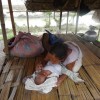
Floods Wash Away India’s MDG Progress
 The northeastern Indian state of Assam is no stranger to devastating floods. Located just south of the eastern Himalayas, the lush, 30,000-square-km region comprises the Brahmaputra and Barak river valleys, and is accustomed to annual bouts of rain that swell the mighty rivers and spill over into villages and towns, inundating agricultural lands and washing homes, possessions and livestock away.

Synthetic Biology Could Open a Whole New Can of Worms
Haiti, the poorest country in the Western Hemisphere, is the world’s leading producer of vetiver. In the southwest of the country, vetiver production is hard to ignore.
Financing for Biodiversity: A Simple Matter of Keeping Promises
With governments, activists and scientists tearing their hair out over the world’s impending crisis in biodiversity, the outgoing president of the Convention on Biological Diversity (CBD) delivered a simple message to participants at the 12th Conference of the Parties to the CBD (COP12) currently underway in the Republic of Korea’s northern Pyeongchang county: honour the promises you made last year.
OPINION: Put People Power Back at Centre of Citizen Action
A few weeks ago, I co-signed perhaps the most important open letter of my career. It was an open provocation to my fellow activists and colleagues, to the members of our organisation, and to all those who, like me, earn their living in the civil society sector.
U.S. Investigation into Illegal Timber Imports a “Sea Change”
A year after a U.S. company was accused of engaging in the systematic importing of flooring made from illegally harvested timber, pressure is mounting on federal agencies currently investigating the allegations.
OPINION: Planet Racing Towards Catastrophe and Politics Just Looking On
If ever there was a need to prove that we are faced with a total lack of global governance, the U.N. Climate Summit, extraordinarily called by U.N. Secretary-General Ban Ki-moon on Sep. 23, makes a very good case.
Harper Playing Defence in Canada’s Pipeline Politics
Canada’s tar sands oil boom may be in jeopardy and it appears the ruling Conservative government of Prime Minister Stephen Harper does not have any plan B in its ambition to remake this resource-rich country into “an energy superpower.”
Antigua Faces Climate Risks with Ambitious Renewables Target
Ruth Spencer is a pioneer in the field of solar energy. She promotes renewable technologies to communities throughout her homeland of Antigua and Barbuda, playing a small but important part in helping the country achieve its goal of a 20-percent reduction in the use of fossil fuels by 2020.
Humanity Failing the Earth’s Ecosystems
In pure numbers, the past few decades have been marked by destruction: over the last 40 years, Earth has lost 52 percent of its wild animals; nearly 17 percent of the world’s forests have been felled in the last half-century; freshwater ecosystems have witnessed a 75-percent decline in animal populations since 1970; and nearly 95 percent of coral reefs are today threatened by pollution, coastal development and overfishing.
Sustaining the Future Through Culture
International experts working in the creative sector are calling for governments to recognise the integral role that culture plays in development and to ensure that culture is a part of the post-2015 United Nations development goals, to be discussed next year.« Previous Page — Next Page »


 Representatives of Civil Society, Sierra Leone. Credit: UN Photo/Eskinder Debebe
Civil society faces mounting threats worldwide, even as it remains essential for democratic accountability, especially in countries struggling with economic instability and social inequality. However, at the same time, nations with weak democratic governance structures also systemically suppress the power of civil society. Human rights activists across the Global South frequently challenge issues such as political persecution and gender oppression, but in return face state-sanctioned punishment for their advocacy. Imprisonment and exile are common mechanisms of punishment that seek to erode the strength of civil society. The 2026 World Press Freedom Index has reached its lowest level in 25 years, with more than half of the world’s countries now falling into the "difficult" or “very serious” category for press freedom. IPS seeks to highlight the work of civil society across the Global South as well as the challenges that they face.
Updated by Yilan Batista and Shuli Wong August 2026

The Week with IPS

NEXT STOP - SDGs
Tracking global progress towards a sustainable world
